NASA’s Webb telescope may have solved the mystery of the universe’s ‘little red dots’
Move the Saguaro deeper into space, and its spiral arms disappear while its strange red nucleus remains visible.

 Edited By: Joshua Shavit

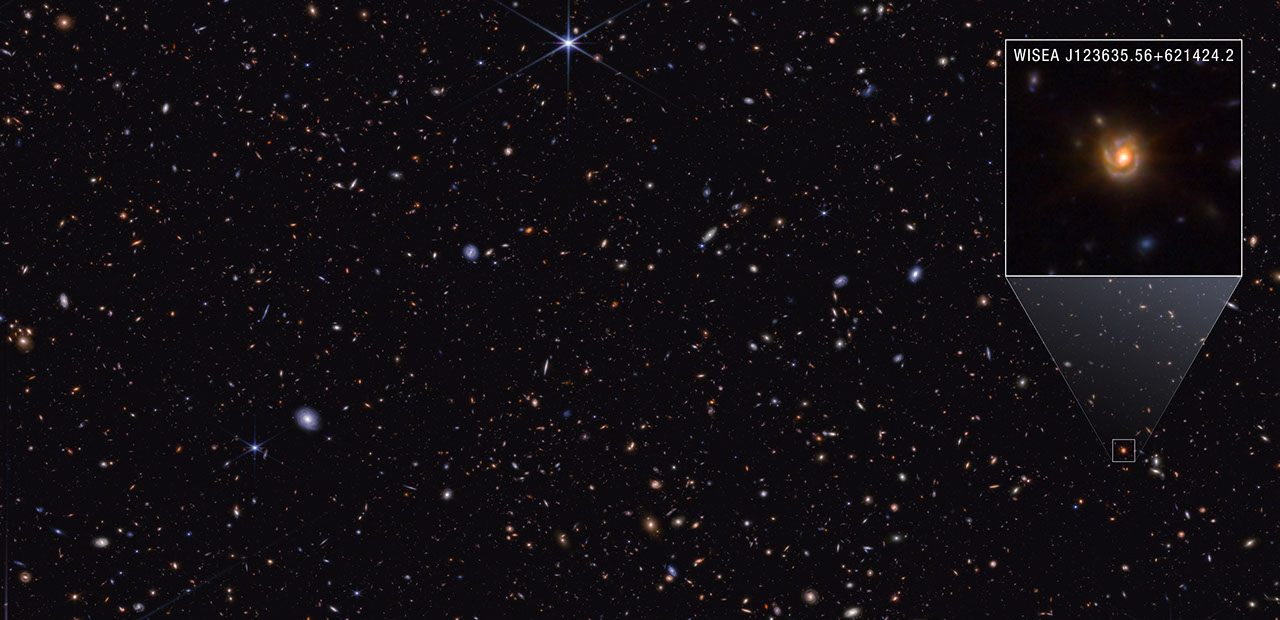
Scientists have proposed one pathway little red dots can follow as the universe matures based on their analysis of spiral galaxy WISEA J123635.56+621424.2, nicknamed the “Saguaro.” They suggest little red dots may be a temporary phase of highly active supermassive black holes. (CREDIT: NASA, ESA, CSA, STScI, Pierluigi Rinaldi (Steward Observatory); Image Processing: Alyssa Pagan (STScI))
- A spiral galaxy called the Saguaro may show what some mysterious little red dots become as the universe ages.
- When astronomers simulated moving the galaxy farther away, its spiral arms vanished from view and only its bright red center remained.
- The result suggests many little red dots may sit inside faint galaxies that current telescopes cannot fully detect.
A bright red point glows at the center of an enormous spiral galaxy more than 10 billion light-years away. Move that galaxy deeper into the universe, however, and the spiral disappears, leaving behind something astronomers have struggled to explain.
The galaxy, WISEA J123635.56+621424.2, is known as the Saguaro because its sweeping arms resemble the branching desert cactus. Its compact red center looks remarkably similar to the “little red dots” uncovered by NASA’s James Webb Space Telescope.
Little red dots, or LRDs, became an astronomical puzzle soon after Webb began finding them in 2022. They appear compact and unusually red in visible wavelengths, yet often look blue in ultraviolet light. Many also show signs of rapidly feeding supermassive black holes.
Their numbers create another mystery. LRDs appear abundant during the universe’s early history but become far less common at later times. Astronomers have struggled to determine whether they disappear, transform or simply become harder to recognize.
A spiral galaxy with an unusual heart
Pierluigi Rinaldi of the Space Telescope Science Institute led a team investigating whether the Saguaro could represent one possible later stage. The research combines observations from Webb, the Hubble Space Telescope and the Chandra X-ray Observatory.
The Saguaro sits at a redshift of about 2, corresponding to roughly 3.3 billion years after the big bang. Unlike most distant LRDs, its surrounding galaxy remains clearly visible.
“Everything created in the early universe must evolve into something around us. We have had little idea of what LRDs become, but these results finally show us how to find their progeny,” said co-author George Rieke of the University of Arizona.
At the galaxy’s center lies a compact source that grows brighter in ultraviolet and infrared light than in visible wavelengths. That pattern produces the characteristic V-shaped spectrum associated with little red dots.
“The Saguaro is important because it’s a prototypical little red dot and is one of the few we have found at lower redshift. It can be used to study the pathway of these dots throughout cosmic time,” said Fabio Pacucci of the Harvard-Smithsonian Center for Astrophysics.
Separating the nucleus from the spiral
The team used detailed image modeling to separate light from the compact nucleus and the surrounding disk. The V-shaped signal came primarily from the central region rather than the spiral galaxy.
Webb spectroscopy also showed that the signal was strongest within the innermost 0.8 to 1.5 kiloparsecs. Farther from the center, ordinary starlight increasingly dominated.
That distinction matters because standard searches often classify objects using their overall shape and color. At its current distance, the Saguaro appears too extended to satisfy the usual compactness requirement for an LRD.
A smaller observational aperture would capture more of the red nucleus and less of the spiral. The same object could therefore receive different classifications depending on the telescope’s sensitivity, image depth and sampling method.
“Because the Saguaro is at lower redshift, we can see the very beautiful and bright host galaxy in high resolution and detail with Webb and Hubble,” said Zihao Wu of the Harvard-Smithsonian Center for Astrophysics. “Webb’s observations can help us understand how the galaxy and its little red dot-like nucleus are connected.”
A buried black hole emerges
Chandra detected weak X-ray emission from the Saguaro, providing evidence that its center contains an active galactic nucleus. In such systems, a supermassive black hole pulls in surrounding material and releases enormous amounts of energy.
The nucleus remains heavily obscured by gas and dust. Its X-ray output also appears weak compared with its total energy production, a combination that may explain why most distant LRDs lack individual X-ray detections.
“What the X-ray light observations show is that this galaxy has an active galactic nucleus, and a very obscured one at that,” said Carys Gilbert of the University of Cape Town. “It’s not only obscured but also X-ray weak. That kind of combination could explain the lack of X-ray emission that we see from all other little red dots. It fits the puzzle of little red dots nicely.”
The Saguaro is also forming stars at an estimated rate of 500 solar masses each year. Its intense star-forming phase may fade within a few tens of millions of years as available gas runs low.
Researchers also detected absorption from helium gas moving toward Earth at about 885 kilometers per second relative to the galaxy. The signal points to dense gas near the nucleus, another feature that resembles conditions proposed for some LRDs.
Distance erases the surrounding galaxy
To test how the Saguaro might appear in the early universe, the team artificially shifted its observations from redshift 2 to redshift 7.
The experiment included cosmological surface brightness dimming, which causes extended objects to become dramatically fainter with distance. The galaxy’s broad spiral structure dropped below the simulated detection limit, while its compact center remained visible.
The transformed image closely resembled an ordinary high-redshift little red dot.
“Our theory is that most of these distant sources are affected by this cosmological effect, creating an observational bias,” Rinaldi said. “We simply are not able to sample the immediate environment of high-redshift little red dots because their surroundings are just too faint to be observed even with Webb.”
The researchers then stacked ultraviolet images of 99 LRDs found between redshifts 4 and 8. Combining the images allowed extremely faint structures shared across the sample to become more visible.
The stacked profile showed excess light extending roughly 2 to 3 kiloparsecs across. That result suggests at least some apparently point-like LRDs may sit inside faint stellar envelopes.
A separate model estimated that surface brightness dimming could hide about 69 percent of a host galaxy’s light by redshift 7. By redshift 9, the lost fraction rose to nearly 98 percent.
One pathway among several possibilities
The Saguaro does not prove that every little red dot becomes a spiral galaxy with an obscured black hole. LRDs display varied properties, and researchers increasingly suspect the category includes several kinds of objects or evolutionary stages.
The redshifting experiment was also simplified. It moved the Saguaro through cosmic distance without fully modeling how its stars, black hole and dust would physically change over time.
Even so, the case challenges the assumption that little red dots are isolated objects. Their compact appearance may partly reflect what telescopes fail to see.
“Little red dots are far more complex than just being a dot,” Rinaldi said. “They’re just the tip of the iceberg, of a supermassive black hole interacting with its nearby surroundings.”
Practical implications of the research
The Saguaro gives astronomers a nearby laboratory for studying an LRD-like nucleus and its host galaxy together. That is difficult at higher redshifts, where surrounding stars become too faint to measure directly.
The findings may also help researchers improve how they select and classify little red dots. Searches based only on compactness could overlook lower-redshift relatives whose host galaxies have become easier to detect.
Future observations will need to isolate the Saguaro’s nucleus more precisely and determine what produces its unusual spectrum. Astronomers also plan to search Webb’s archives for additional galaxies with similar red centers.
Finding more examples could reveal whether the Saguaro represents a common stage in black hole and galaxy growth or only one branch in a much broader family tree.
Research findings are available online in the journal The Astrophysical Journal.
The original story "NASA’s Webb telescope may have solved the mystery of the universe’s 'little red dots'" is published in The Brighter Side of News.
Related Stories
- Little red dot galaxies may solve a cosmic neutrino mystery
- Cosmic simulations reveal how galaxies formed and evolved over billions of years
- Supercomputer simulations reveal why some black holes shine and others stay dim
Like these kind of feel good stories? Get The Brighter Side of News' newsletter.
Joseph Shavit
Writer, Editor-At-Large and Publisher
Joseph Shavit, based in Los Angeles, is a seasoned science journalist, editor and co-founder of The Brighter Side of News, where he transforms complex discoveries into clear, engaging stories for general readers. With vast experience at major media companies like The Los Angeles Times, Times Mirror and Tribune Publishing, he writes with both authority and curiosity. His writing focuses on space science, planetary science, quantum mechanics, geology. Known for linking breakthroughs to real-world markets, he highlights how research transitions into products and industries that shape daily life.