Space dust points to an ancient water reservoir beyond Neptune
Dust collected high above Earth preserves a chemical record of unusual water that once reacted with rock beyond Neptune.

 Edited By: Joshua Shavit

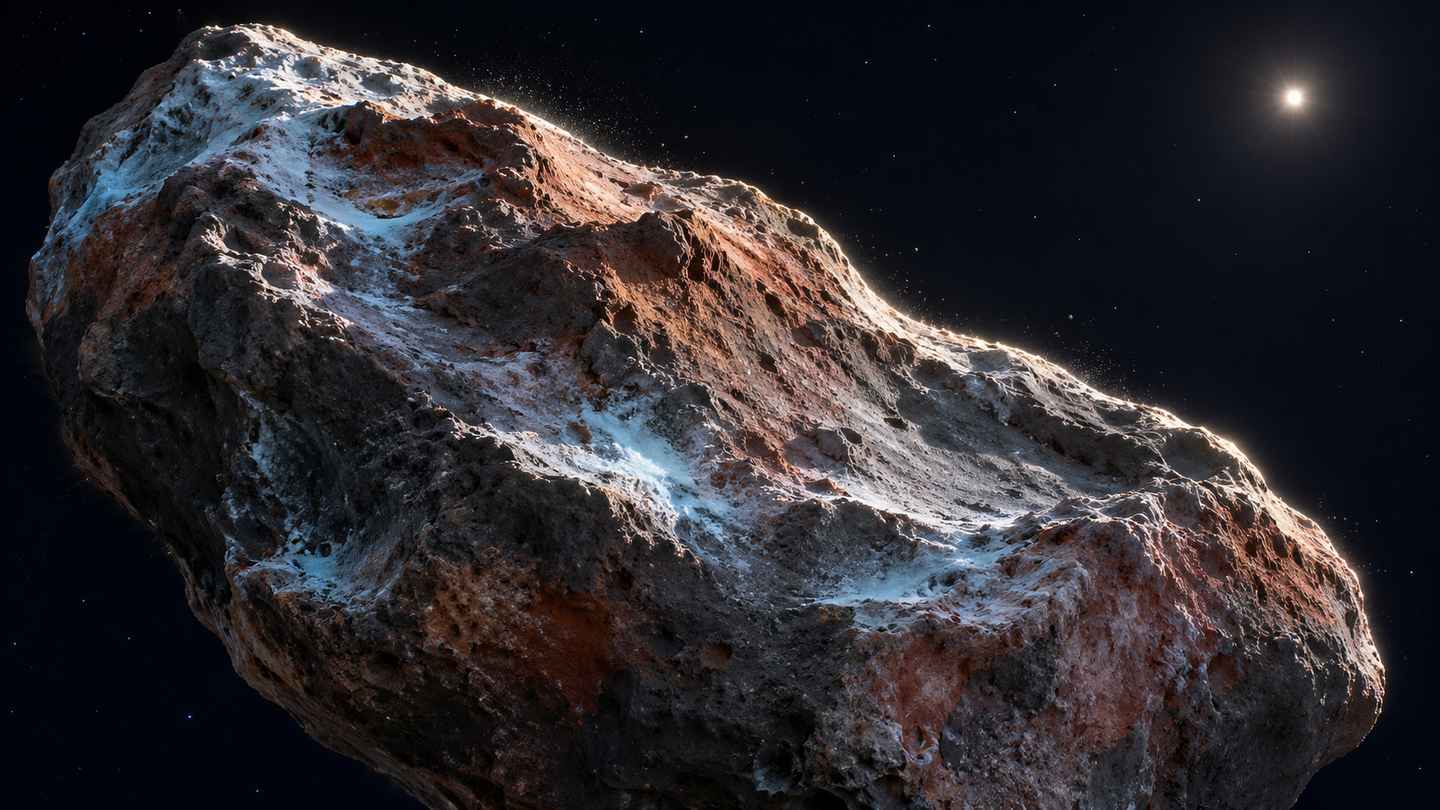
An artist’s impression shows sunlight catching patches of frost on a rocky Kuiper Belt object. Microscopic dust grains collected high above Earth preserve chemical clues that ancient water beyond Neptune was enriched in oxygen-17 and oxygen-18. (CREDIT: The Brighter Side of News)
- Twelve dust grains collected high above Earth carry chemical evidence of ancient water enriched in heavy oxygen beyond Neptune.
- Radiation tracks point to a Kuiper Belt origin, while clay minerals preserve clues about cold water-rock reactions inside the grains’ parent bodies.
- The findings suggest that some outer solar system water remained largely isolated from material closer to the Sun.
NASA aircraft collecting dust in Earth’s stratosphere caught fragments of a place no mission has sampled and brought home. Among those grains, researchers found 12 with a chemical record of water that once reacted with rock in the Kuiper Belt, the distant region of icy bodies beyond Neptune.
The findings, published in Science Advances, support a long-standing prediction that the outer solar system held water unusually rich in oxygen-17 and oxygen-18. Lindsay Keller of NASA Johnson Space Center and colleagues at the University of California, Los Angeles used the composition of the grains to estimate what that ancient water was like.
The evidence comes from minerals formed when water altered the original dust. The researchers measured oxygen in the grains and then calculated how much heavy oxygen the water would have needed to leave that signature. The result offers a way to investigate the chemistry that shaped the distant solar system, where even familiar worlds such as Pluto still hold surprises about how their ices behave.
Radiation tracks point to the Kuiper Belt
Comets and asteroids shed microscopic debris that drifts toward the Sun. As a grain travels, fast particles from the Sun can damage crystals inside it, leaving tracks visible under an electron microscope. A grain’s track count can therefore help researchers work out how long it spent exposed to radiation.
Earlier work by Keller and George Flynn calibrated how quickly those tracks form. They found that some grains collected at Earth had exposure ages exceeding a million years, too long to fit the expected journeys from the main asteroid belt or from Jupiter-family comets. Their track densities were consistent with an origin farther out, where bodies such as Arrokoth preserve material from the solar system’s early history.
The grains in the new study were small enough to survive atmospheric entry without melting. High-altitude aircraft collected them in the stratosphere, where NASA regularly gathers interplanetary dust. Those samples complement the different view of the outer solar system provided by New Horizons. A spacecraft can examine a known object up close, while grains collected near Earth can be studied with laboratory instruments that are impractical to fly.
Even a heavily scarred grain cannot be traced to a particular object. The radiation tracks are closer to a measure of travel time than a return address. They narrow down where the grains likely came from, while the minerals inside them tell a separate story about what happened there.
Clay preserves a record of ancient water
Electron microscopy revealed that the grains consisted mostly of water-bearing clay minerals, especially saponite. The team also found carbonates rich in magnesium and iron, but few of the minerals typical of some water-altered meteorites. The mixture points to chemical reactions inside the icy bodies that supplied the dust.
The researchers modeled how initially dry silicates could react with cold fluids containing water and carbon dioxide. The resulting mineral mix resembled what they saw in the grains. The chemistry differs in important ways from that of Bennu samples, which also record water-rock reactions but formed under different conditions.
The clay offers a clue to the fluid itself. When water reacts with a mineral, some oxygen atoms from the water can become part of the new mineral’s structure. That chemical record can survive after the water is gone. The same principle makes studies of ancient water on asteroids useful for reconstructing environments that disappeared long ago.
Carbonates helped the team distinguish the environment that produced these grains from some better-studied asteroid settings. The dust contained magnesium- and iron-rich carbonates, and the team found no calcium-rich carbonates such as calcite or dolomite. The authors suggest that carbon-rich fluids could favor the mix they observed. A limited supply of water or short-lived reactions could also help explain why the grains retained their distinctive chemical signature.
Heavy oxygen gives the ice away
Oxygen comes in three stable forms. Oxygen-16, the most common, has eight neutrons. Oxygen-17 and oxygen-18 have one and two extra neutrons, respectively. In this study, “heavy water” refers to water enriched in those heavier forms of oxygen. The familiar heavy water used in some nuclear reactors gets its extra mass from deuterium, a heavy form of hydrogen.
The team measured oxygen isotope ratios with an ion microprobe and compared the hydrated grains with dry dust that could represent their starting material. In the model’s main reaction, only one in eight oxygen atoms in the resulting minerals comes from water. Because the original rock supplies the rest, the water would have needed a much stronger heavy-oxygen signature than the finished grains show. The modeled oxygen-18-to-oxygen-16 ratio was roughly 15% higher than the standard for Earth’s ocean water, an upper-limit estimate under the study’s assumptions.
That estimate gives researchers a point of comparison for models of the early solar system. Chemical fingerprints can help distinguish bodies that grew from different raw materials, as research on the ice giants also illustrates. In the dust study, the isotope pattern suggests that at least some water in the far reaches of the solar system retained a chemical signature rarely seen in meteorites.
The pattern also bears on a longstanding idea about the Sun’s birth. In one proposed explanation, ultraviolet light broke apart some forms of carbon monoxide more readily than others. That would free oxygen enriched in the heavier isotopes, which could then become part of water ice. The grains preserve evidence consistent with such a reservoir, though their chemistry alone cannot establish exactly where or when that isotope separation took place.
Practical implications
Scientists can now look for the same combination of dense radiation tracks, hydrated minerals and unusual oxygen ratios in more grains. A broader sample could show whether the signature appears across many Kuiper Belt bodies or reflects the history of a smaller group. The 12 grains give researchers a way to test for the reservoir, while its overall size and distribution remain unknown.
The results also give models of planet formation a chemical pattern to explain. One possibility the authors discuss is that the growing giant planets slowed the inward movement of dust and ice, helping preserve distinct stores of water. Comparing more grains with material from icy worlds and with asteroid samples could help researchers test how effectively those regions stayed separate.
Future measurements of the ice itself could test the estimate more directly. Sampling multiple objects would also show how much their water differs. That matters because the isotope ratio reconstructed from each grain depends partly on what researchers assume about the starting minerals.
Until then, the dust offers something difficult to get from distant telescope observations alone. The grains record what happened when water met rock inside their parent bodies, before the debris drifted inward and reached Earth.
Dig deeper into water and dust beyond Neptune
These resources trace how spacecraft observations and lab analyses help reconstruct the history of solar system ice.
NASA’s Asteroid Bennu Sample Reveals Mix of Life’s Ingredients — Returned samples preserved minerals that formed as salty water evaporated inside Bennu’s parent body. (NASA, January 2025)
NASA-Led Team Links Comet Water to Earth’s Oceans — A reanalysis of Rosetta data explores how dust can affect measurements of hydrogen isotopes in comet water. (NASA, December 2024)
NASA’s New Horizons Detects Dusty Hints of Extended Kuiper Belt — The spacecraft’s dust detector registered more particles than expected near the belt’s outer edge. (NASA, February 2024)
Evidence for a significant Kuiper belt dust contribution to the zodiacal cloud — The study uses radiation tracks to distinguish long-traveled grains likely shed by outer solar system bodies. (Nature Astronomy, May 2022)
Kuiper Belt Facts — An overview of where the belt lies, what it contains and which spacecraft have explored it. (NASA)
Research findings are available online in the journal Science Advances.
The original story "Space dust points to an ancient water reservoir beyond Neptune" is published in The Brighter Side of News.
Related Stories
- Astronomers discover previously unseen kernel structure inside the Kuiper Belt
- Hubble telescope spots rare triple system hidden in the Kuiper Belt
- Scientists detect signs of a hidden planet in our solar system
Like these kind of feel good stories? Get The Brighter Side of News' newsletter.
Joseph Shavit
Writer, Editor-At-Large and Publisher
Joseph Shavit, based in Los Angeles, is a seasoned science journalist, editor and co-founder of The Brighter Side of News, where he transforms complex discoveries into clear, engaging stories for general readers. With vast experience at major media companies like The Los Angeles Times, Times Mirror and Tribune Publishing, he writes with both authority and curiosity. His writing focuses on space science, planetary science, quantum mechanics, geology. Known for linking breakthroughs to real-world markets, he highlights how research transitions into products and industries that shape daily life.