Canadian researchers discover where fish go in the winter
Some fish swim near the ice while others stay deep. The depth of water around 2°C helps explain both behaviors.
 University of Toronto Writer: Suniya Kukaswadia

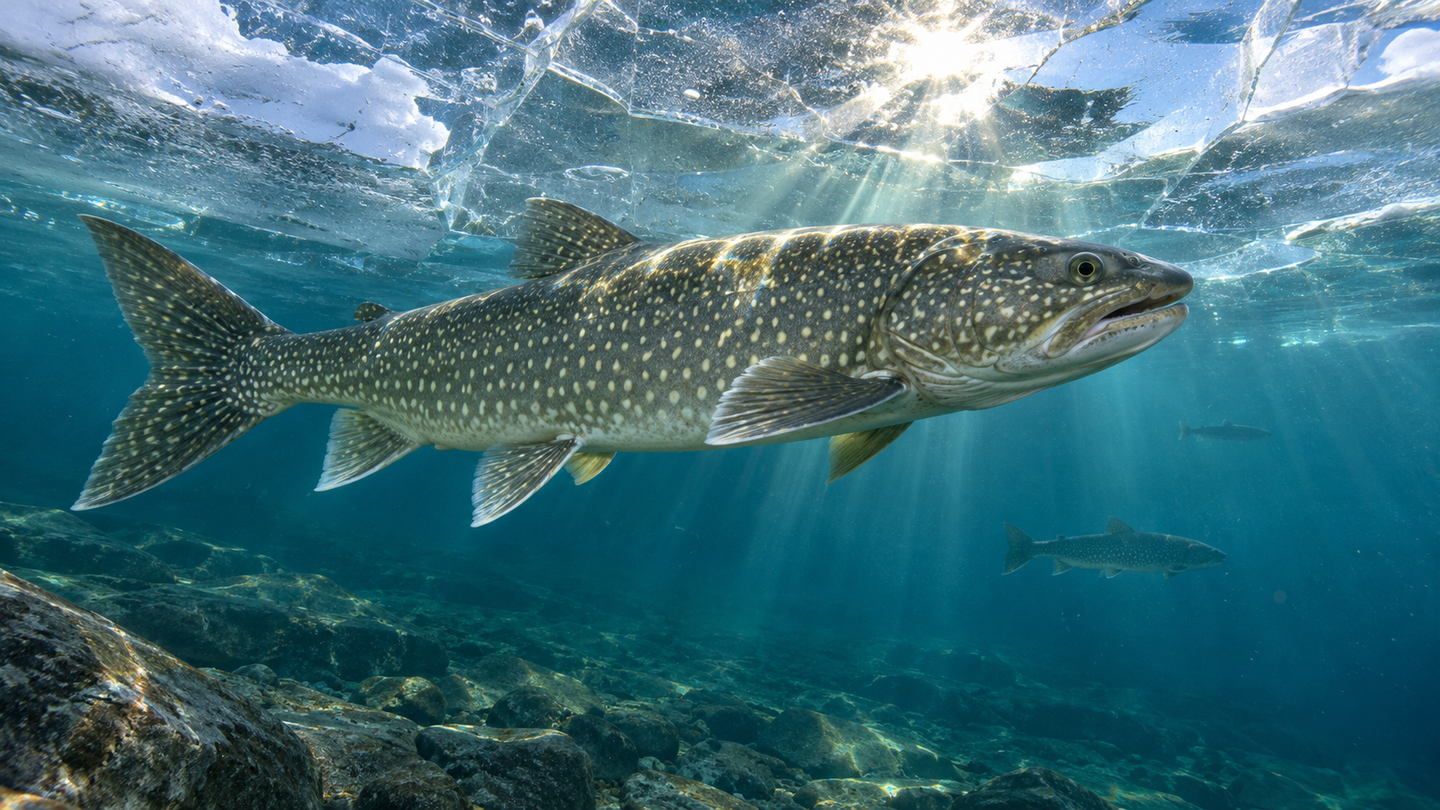
A lake trout swims just below sunlit winter ice in this illustration. Tracking fish in 11 Canadian lakes, researchers found that lake trout tended to swim near water around 2°C, at depths that varied with the shape of the lake. (CREDIT: The Brighter Side of News)
- Across 11 Canadian lakes, lake trout tended to spend winter near the depth where water was about 2°C.
- In sheltered lakes that retained more warmth at depth, the fish often stayed near the surface. In broad, wind-exposed Lake Simcoe, they generally swam deeper.
- A model applied to roughly 66,500 lakes in Canada and Alaska suggests that about 73% of lake trout lakes have the winter temperature structure associated with shallower habitat.
Lake trout retreat to cold, deep water when summer heats up a lake. Once ice forms, they can turn up in a less obvious place. In some Canadian lakes, tagged trout spent much of the winter near the surface. In others, the fish stayed far below the ice.
The difference largely came down to where the water was about 2°C, or 36°F. Lidi Shi and Mathew Wells of the University of Toronto Scarborough and their colleagues found that the depth of this temperature zone helped explain where the fish spent winter. They reported the findings in Proceedings of the National Academy of Sciences.
That puts a lake’s shape in the picture. Depth and surface area help determine how much water the wind can mix before freeze-up. The window for that mixing can change as ice conditions change. From the surface, a frozen lake can look quiet and uniform, even though its freshwater habitat varies with depth.
How lake trout find the right winter temperature
In summer, sunlight warms the upper water while deeper layers stay cold. For lake trout, swimming down can be a way to leave warmer water behind. In winter, the temperature gradient can run the other way. Fresh water is densest at about 4°C. As water cools below that point, it becomes less dense and tends to remain above slightly warmer water.
By the time the surface freezes, the exact temperature at each depth depends partly on what happened before the ice arrived. In a narrow, sheltered lake, the wind typically has less opportunity to stir the water. Deeper layers can hold on to more heat while the water near the ice approaches freezing. A trout can reach the zone around 2°C by swimming in the upper part of the lake.
A broad, exposed lake can cool differently. Wind has a longer stretch of open water across which to build waves and stir the surface. Mixing can carry cold water deeper before the lake freezes. In that setting, the water closest to 2°C may be much farther down, sometimes close to the lakebed.
The shape of a basin matters because it influences both the reach of wind and the volume of water available at each depth. Seasonal changes in weather influence how much time a lake has to mix. By the time a cover of ice shuts off direct wind mixing, lakes with similar surface conditions can have different temperatures beneath them.
Listening for trout beneath the ice
Tracking fish through winter means following them when people have limited access to the water. The team drew on acoustic tracking data from 11 Canadian lakes, from small sheltered basins to Lake Simcoe. Tags sent out signals that underwater receivers could identify. Depth readings showed where the fish were in the water column.
Temperature sensors at different depths recorded the conditions those fish could encounter. Matching the two records allowed the researchers to estimate the temperature associated with each depth the fish occupied. In Lake of Two Rivers in Ontario’s Algonquin Provincial Park, for example, trout averaged about 3.3 meters below the surface. In Lake Simcoe, where the water remained colder overall during ice cover, fish generally selected deeper habitat.
The team accounted for how much water each depth band contained. That matters because a fish could show up frequently at a particular depth simply because that band offers more space. Comparing use with availability strengthened the link between the depths trout selected and the depth of the 2°C layer. As in other work using acoustic surveys, the instrument data revealed behavior that a view of the surface could miss.
Finding the same temperature at a different depth changes the habitat a fish encounters. The water above a shallow shelf and the water over a deep basin can offer different prey and different access to the bottom. The study focused on depth and temperature, leaving questions about how feeding affects those movements. Work on other cold-water habitats also illustrates how closely the water beneath ice depends on local conditions.
The temperature is a guide
Across lakes and years, the depth of the 2°C layer closely matched the average depths occupied by trout. Individual fish still used a range of temperatures. In the warmer lakes, trout averaged about 2.6°C. In colder Lake Simcoe, they averaged about 1.5°C across the study’s ice-covered observations, with some variation among years.
The reason for the pattern remains open. Cold water can reduce a fish’s metabolic costs, and the researchers suggest that water around 2°C might let trout conserve energy while avoiding conditions closer to freezing. That explanation would require separate tests of fish physiology and feeding. The tracking data show where the fish went and how that choice related to the water around them.
The finding also changes how to think about winter space. A deep temperature band can have less volume than a shallow band if the lake basin narrows toward its bottom. Fish concentrated in a smaller volume could encounter more competition, depending on prey and other conditions. The study did not measure that outcome, but it gives researchers a way to identify lakes where it may be worth testing.
The pattern also helps explain why depth alone can give a misleading picture of what the fish prefer. A depth that is suitable in one freshwater system can be colder or warmer in another. Measuring temperature alongside depth gives researchers a common scale for comparing the choices fish make.
Practical implications
The researchers used a geometry-based model to estimate winter conditions across roughly 66,500 known lake trout lakes in Canada and Alaska. About 73% fell into the category expected to retain warmer water at depth and develop stronger temperature layering after freeze-up. Those are conditions associated with shallower trout habitat in the monitored lakes. The percentage comes from applying the model to lake dimensions across the region.
Fisheries managers could use the approach to decide where winter monitoring would add the most information. A lake with plenty of suitable summer water could offer less of the preferred temperature range in winter. Changes in freeze-up and wind could shift where that water lies. The effect would depend on how the local basin responds.
Managers could test predictions by combining acoustic monitoring with temperature measurements at several depths and comparing the results across years. That would show whether a shift in the timing of ice cover changes the position of the 2°C layer and whether fish follow it. For a species important to Indigenous, recreational and commercial fisheries, those measurements would give winter habitat a place alongside the summer conditions managers already track.
Dig deeper into winter lake ecology
These studies explain how lake ice, temperature and basin shape influence life under the surface.
A New Thermal Categorization of Ice-Covered Lakes: Connects pre-freeze mixing and lake geometry to differences in under-ice temperature structure. (Geophysical Research Letters, 2021)
Widespread loss of lake ice around the Northern Hemisphere in a warming world: Examines how warming could make winter ice cover less reliable. (Nature Climate Change, 2019)
Ecology under lake ice: Reviews winter food webs and biological activity beneath frozen lake surfaces. (Ecology Letters, 2017)
Seasonal habitat selection by lake trout in a small Canadian Shield lake: Uses tracking data to compare trout distributions in summer and winter. (Aquatic Sciences, 2009)
Historical Trends in Lake and River Ice Cover in the Northern Hemisphere: Compares long records of lake and river ice to show how freeze and breakup timing have shifted. (Science, 2000)
Research findings are available online in the journal PNAS.
The original story "Canadian researchers discover where fish go in the winter" is published in The Brighter Side of News.
Related Stories
- Freshwater fish can make human bones appear centuries older
- New model flags Red Sea fish that could invade the Mediterranean
- TikTok video leads scientists to a new species of transparent fish in India
Like these kind of feel good stories? Get The Brighter Side of News' newsletter.
Joseph Shavit
Writer, Editor-At-Large and Publisher
Joseph Shavit, based in Los Angeles, is a seasoned science journalist, editor and co-founder of The Brighter Side of News, where he transforms complex discoveries into clear, engaging stories for general readers. With vast experience at major media companies like The Los Angeles Times, Times Mirror and Tribune Publishing, he writes with both authority and curiosity. His writing focuses on space science, planetary science, quantum mechanics, geology. Known for linking breakthroughs to real-world markets, he highlights how research transitions into products and industries that shape daily life.