SpaceX Falcon 9 rocket stage is about to slam into the Moon on August 5
Astronomers will watch a discarded rocket stage hit the moon at 5,400 mph in a rare controlled lunar impact.

 Edited By: Joseph Shavit

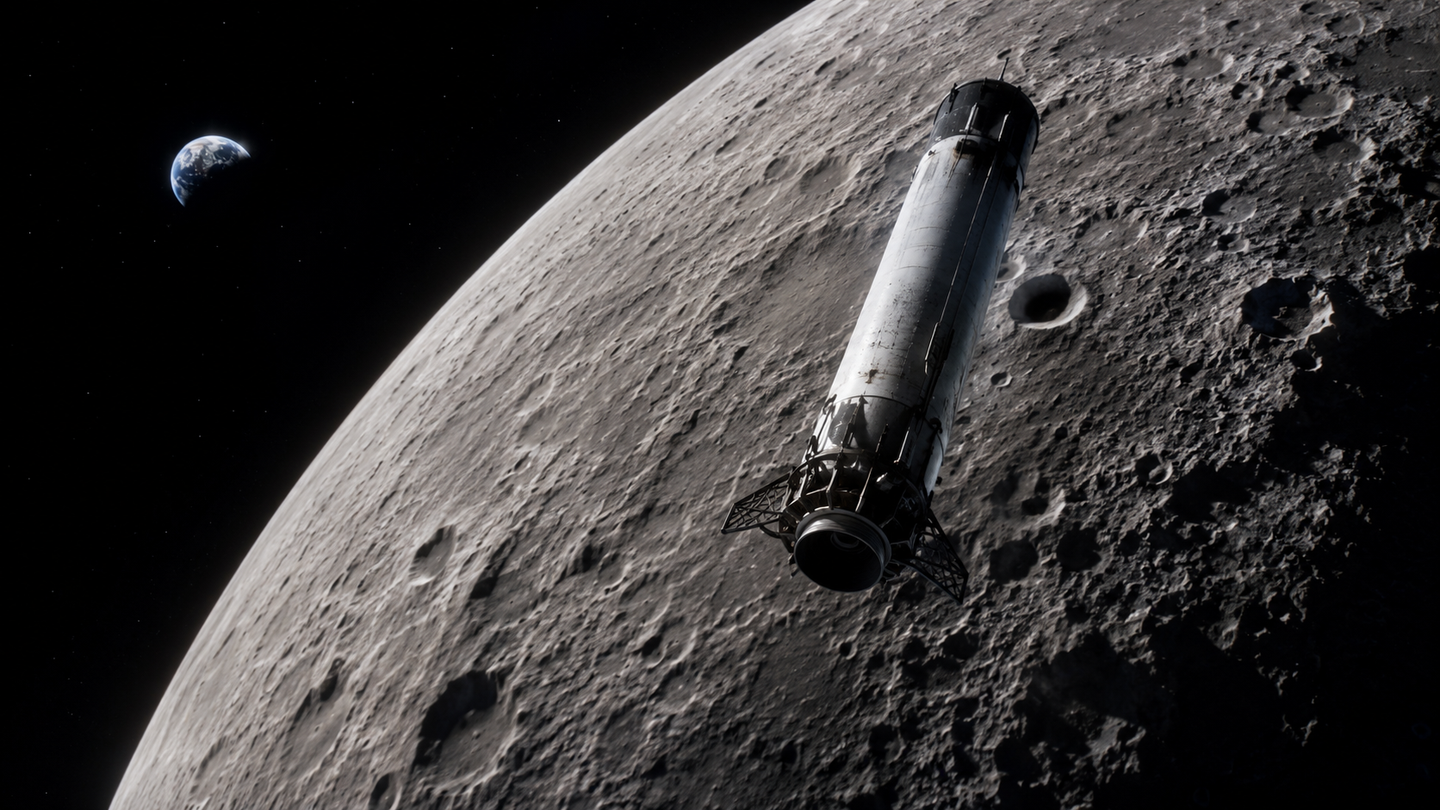
The Falcon 9 moon impact may create a visible flash, towering dust plume and new crater near Einstein Crater on Aug. 5. (CREDIT: Wikimedia / AI-Generated / CC BY-SA 4.0)
- A discarded rocket stage is expected to hit the moon near Einstein Crater on Aug. 5 at about 5,400 mph.
- The collision could create a momentary flash, a dust cloud several kilometers high and a crater up to 30 meters wide.
- Scientists hope the event will improve impact models, future moonquake experiments and tracking of debris between Earth and the moon.
A discarded Falcon 9 rocket stage is expected to strike the moon, creating a brief flash, a towering dust plume and a new crater. The collision may offer scientists a rare controlled impact to study from Earth.
The object, cataloged as 2025-010D, helped launch Firefly’s Blue Ghost-1 and ispace’s Hakuto-R Resilience landers in January 2025. After completing that job, the upper stage lacked enough fuel to escape into deep space or return to Earth.
It has remained in a moon-crossing high-Earth orbit ever since.
The impact is predicted for 06:35 UTC on Aug. 5. Tracking calculations place the collision near Einstein Crater at about 88 degrees west and 15 degrees north, on the side of the moon visible from Earth.
The rocket stage measures about 12 meters long and 4 meters wide. Its estimated mass is roughly 4,000 kilograms. It should hit at 2.43 kilometers per second, or about 8,750 kilometers per hour, at an angle of 34 degrees from vertical.
A hollow rocket meets solid ground
Unlike a dense asteroid, the Falcon 9 stage is mostly a hollow metal structure. That difference could shape the collision and the crater left behind.
The impact should crush the rocket body while excavating lunar soil and rock. Models point to a crater about 20 to 30 meters wide, with one estimate near 27 meters and roughly 5 meters deep.
A double crater is also possible. China’s Chang’e 5 upper stage produced one after striking the moon’s far side in 2022, probably because the object broke apart before or during impact.
Researchers used the Hybrid Optimization Software Suite, or HOSS, to simulate the coming collision. The model treated the event as a vertical, end-on impact into lunar regolith, the loose material covering the surface.
That simplified case does not capture the expected oblique collision or the rocket’s uncertain orientation. However, it allowed the team to estimate how much material could be thrown upward.
The simulation suggests the impact may excavate about 1.12 million kilograms of lunar material. A separate crater-scaling method produced a similar estimate of 1.2 million kilograms.
That equals roughly 150 to 200 times the rocket stage’s own mass.
A plume could rise for minutes
Most excavated particles should move relatively slowly and fall back within seconds. About half of the particles resolved by the simulation returned to the surface within five seconds, potentially forming secondary craters.
Only 2 percent remained in flight after 30 seconds. However, the model could not resolve the smallest fragments, which are expected to travel fastest and remain airborne longest.
The highest particles resolved in the simulation reached about 1.5 kilometers. Smaller fragments could rise several kilometers and remain aloft for minutes, perhaps around 10 minutes in some cases.
That plume is one of the most promising targets for observers. Sunlight scattered by fine dust may make it detectable near the lunar limb, although the moon will be about 56 percent illuminated.
The expected crater will be too small for telescopes on Earth to resolve directly. NASA’s Lunar Reconnaissance Orbiter and Korea’s Pathfinder Lunar Orbiter are expected to collect before-and-after images.
The Korean spacecraft is also expected to pass within a few kilometers of the rocket stage about two minutes before impact.
The flash may be bright, faint or absent
The impact flash presents a harder challenge. It should last less than one second, and no natural or artificial impact flash has yet been detected on the moon’s illuminated side.
“Potential observables from this event include the flash at the time of impact ... and the ejecta plume,” the authors wrote.
Brightness estimates vary enormously. The flash could reach visual magnitude +3 at the bright end, but it could also be fainter than +15 and effectively invisible.
The target surface is a major uncertainty. A collision with loose regolith could produce a shock wave and a brighter flash. A strike on exposed bedrock may produce much less light because the rocket is moving slowly compared with natural meteoroids.
High-speed imaging will be essential. The authors recommend cameras recording at least 20 frames per second so the flash is not lost between exposures.
Past lunar impact campaigns have used telescopes as small as 10 centimeters across. Still, even large instruments may record nothing if the impact falls near the dim end of the predicted range.
Visible and infrared observations could both help. The J infrared band may offer an advantage for observers dealing with daylight. Some professional observatories also plan to search for sodium, potassium and hydroxyl emissions.
A coordinated watch across the Americas
The moon must be above the horizon at 06:35 UTC, and darkness will improve the odds of success. Conditions should favor much of South America and low-to-mid latitude North America.
Hawaii and Alaska will not have the moon above the horizon. Within North America, locations away from the West Coast should generally see the moon higher in the sky.
Professional observing time has been allocated at Apache Point Observatory, the Lowell Discovery Telescope and the Very Large Telescope. Amateur participation is being coordinated through the NASA-affiliated Impact Flash! project and the Lunar Impact Flash Network.
The authors recommend a practice session on the preceding night. That gives observers a chance to test camera speed, telescope alignment, exposure settings and image-processing methods under a similar lunar phase.
Even a non-detection could be useful if observers report their equipment, timing and viewing conditions. A recorded flash location and light curve would be especially valuable.
Practical implications of the research
Artificial lunar impacts are rare, but they carry scientific advantages. Researchers know more about the object’s size, mass, speed and expected arrival time than they do for a random meteoroid.
That makes the Falcon 9 stage a controlled source for testing impact models. A detection could help calibrate the relationship between impact energy, flash brightness, plume behavior and crater formation.
The event may also test methods for locating impacts precisely from their flashes. That could support future lunar seismic networks, which would use known collisions to study how vibrations travel through the moon.
The impact also highlights the growing challenge of debris in the space between Earth and the moon. As lunar activity increases, artificial collisions are expected to become more common.
Tracking this event from orbit and Earth could improve monitoring of that region. It may also sharpen estimates of the hazards that fast-moving debris and impact ejecta could pose to future astronauts and lunar infrastructure.
Research findings are available online in the journal arXiv.
The original story "SpaceX Falcon 9 rocket stage is about to slam into the Moon on August 5" is published in The Brighter Side of News.
Related Stories
- Astronomers are finding space junk too small to track, and it's getting dangerous
- NASA’s risky bid to save Swift telescope before solar drag pulls it into Earth's atmosphere
- To the Moon and beyond: Artemis II and humanity's reach into space
Like these kind of feel good stories? Get The Brighter Side of News' newsletter.
Joshua Shavit
Writer and Editor
Joshua Shavit is a NorCal-based science and technology writer with a passion for exploring the breakthroughs shaping the future. As a co-founder of The Brighter Side of News, he focuses on positive and transformative advancements in technology, physics, engineering, robotics, and astronomy. Having published articles on AOL.com, MSN, Yahoo News, and Ground News, Joshua's work highlights the innovators behind the ideas, bringing readers closer to the people driving progress.