Researchers studying the Assyrian Empire’s history discover three new kings
A damaged clay tablet, an overwritten stone monument, and a headless royal statue tell the same unsettling story. Three Assyrian kings may have been deliberately removed from the record, challenging…

 Edited By: Joseph Shavit

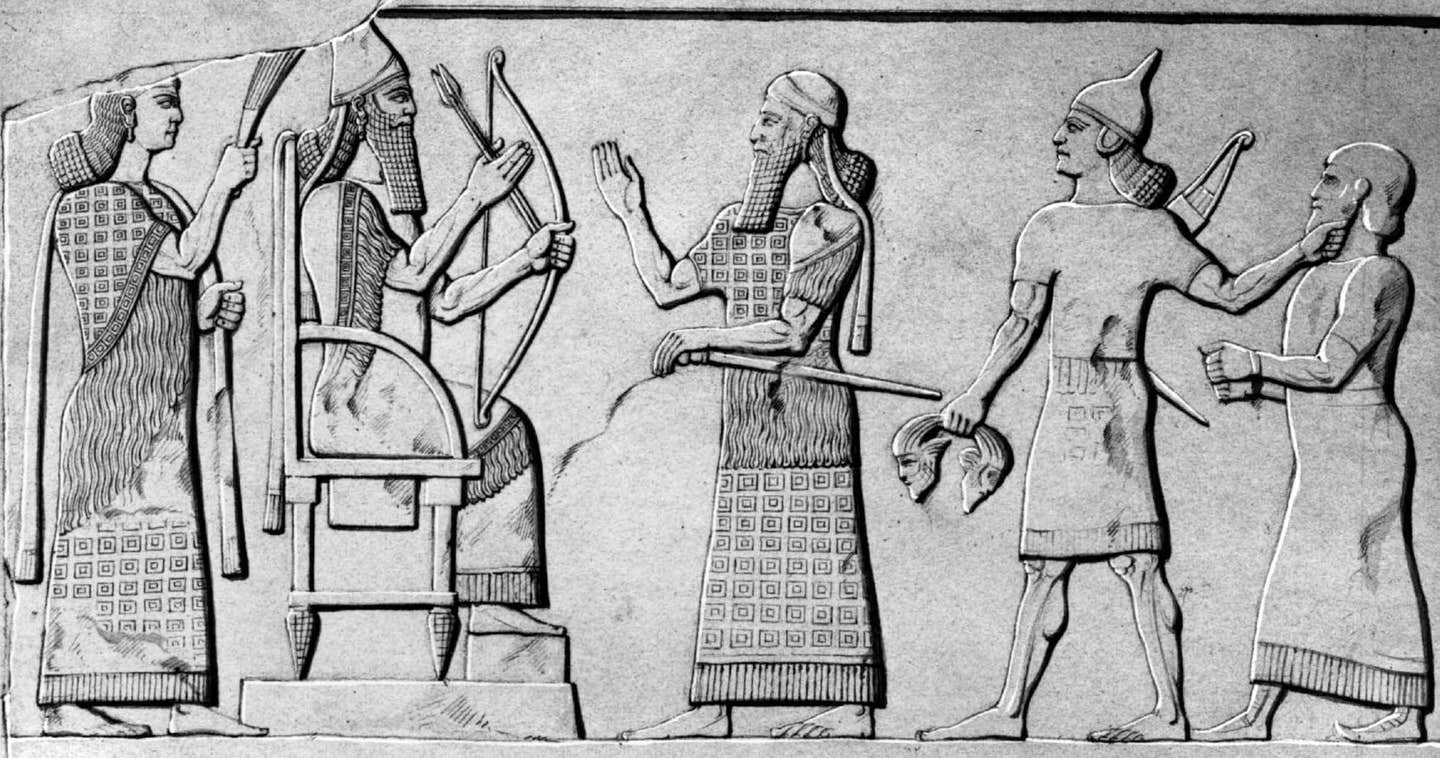
Relief of high officials and a soldier wearing Kassettenmuster-fabric from the Central Palace, left by Rassam in situ. (CREDIT: Trustees of the British Museum)
- Three short-lived Assyrian rulers may have been excluded from the official record after they lost power.
- Their existence survives through damaged tablets, altered inscriptions, annual records, and a deliberately defaced royal statue.
- The discovery suggests Assyrian succession involved more rebellions and rival kings than the traditional timeline acknowledges.
A damaged clay tablet, an overwritten stone monument, and a headless royal statue tell the same unsettling story. Three Assyrian kings may have been deliberately removed from the record, challenging a chronology trusted for roughly a century.
Alexander Johannes Edmonds from University of Münster and Eckart Frahm from Yale University identify the forgotten rulers in “Three New Kings of Assyria,” published in the Journal of Cuneiform Studies. Their evidence suggests that the Assyrian King List was not a complete, impartial record.
Instead, the list may have acted as a political canon. Short-lived rulers, parallel kings, and defeated rivals could disappear from its official account of royal succession.
The three proposed additions are a Tiglath-pileser who ruled around 763 to 762 BCE, a Shalmaneser who preceded Tiglath-pileser III around 747 to 745 BCE, and an Aššur-uballiṭ who may have ruled around 913 to 912 BCE.
An eclipse and a rival king
The clearest case begins with a poorly preserved royal grant found at Nineveh and now held by the British Museum. Earlier interpretations attributed the document to Adad-nārārī III, although its date created an obvious contradiction.
The tablet was dated to 762 BCE, more than 20 years after Adad-nārārī III’s death. It also mentioned a Tiglath-pileser, previously identified as Tiglath-pileser III, who did not take the throne until 745 BCE.
Edmonds and Frahm offer a different reading. They argue that the grant was issued by another Tiglath-pileser, a previously unknown son of Šamšī-Adad V.
This ruler appears to have taken power in Aššur during a rebellion against his nephew, Aššur-dān III. His grant carried impressions of the Assyrian royal seal, indicating that he considered himself king and had supporters who recognized him.
The revolt followed a total solar eclipse in June 763 BCE. Assyrians regarded such an event as a dangerous omen for the reigning monarch. One astrological tradition warned that an eclipse during that month meant the king would die and a royal son would seize the throne.
The Assyrian Eponym Chronicle records rebellions in Aššur during both 763 and 762 BCE. A horizontal ruling before the 763 entry may also preserve the outline of an earlier reference to a new reign.
The rebel adopted the name Tiglath-pileser, possibly invoking the memory of the powerful Middle Assyrian ruler Tiglath-pileser I. He may have governed for no more than 20 or 21 months before forces loyal to Aššur-dān III removed him.
What happened afterward remains uncertain. Rebellions continued elsewhere in Assyria until 758 BCE, but the evidence does not establish whether the deposed ruler remained involved.
A royal name carved over another
The second missing monarch emerges from a stela discovered at Tell ‘Abta, Iraq, in 1894. It depicts Bēl-Ḫarrān-bēlu-uṣur, a senior Assyrian official who later served as the annual eponym in 741 BCE.
The monument’s inscription originally identified the reigning king as Shalmaneser. Someone later erased that name and replaced it with Tiglath-pileser.
That alteration has troubled scholars because the accepted king list does not place a Shalmaneser immediately before Tiglath-pileser III. Earlier explanations required the monument to be decades older than its artistic style suggested or assumed an unexplained later revision.
Edmonds and Frahm argue that the simplest answer is another omitted king. A previously unknown Shalmaneser may have taken the throne around 747 BCE, shortly before Tiglath-pileser III seized power in 745 BCE.
Several chronological irregularities support that reconstruction. Surviving versions of the Assyrian Eponym List disagree about exactly where Tiglath-pileser III’s reign began. His inscriptions also credit him with 19 full regnal years, while later accounts give him 18.
A later Greek record, the Ptolemaic Canon, adds another clue. Some versions strangely connect the name Shalmaneser with the Babylonian king Nabû-nāṣir, whose reign began in 747 BCE.
The authors propose that an Assyrian Shalmaneser began ruling that same year. A later copyist may have misunderstood a record synchronizing the two kings and turned Shalmaneser into an alternative name for Nabû-nāṣir.
Under this reconstruction, Tiglath-pileser III overthrew Shalmaneser in May 745 BCE. Bēl-Ḫarrān-bēlu-uṣur then replaced the defeated king’s name on his stela with that of the new ruler.
A king remembered by a silver vessel
The third case reaches back nearly two centuries. A cuneiform tablet from Aššur describes how Tukultī-Ninurta II restored a silver vessel used to pour beer for the god Aššur.
The text says Tukultī-Ninurta I originally made the vessel. An Aššur-uballiṭ later added silver to it before Tukultī-Ninurta II restored it again.
The problem is chronological. The accepted king list contains no Aššur-uballiṭ between Tukultī-Ninurta I, who ruled in the 13th century BCE, and Tukultī-Ninurta II, who ruled from 891 to 884 BCE.
Earlier explanations treated the name as a scribal mistake or identified Aššur-uballiṭ as a private citizen. Edmonds and Frahm argue that neither interpretation fits the inscription’s royal and religious context.
A damaged statue from Aššur may show what happened. The sculpture once depicted an Assyrian king, but someone removed its head, erased its arms and royal symbols, and converted it into a monument associated with Adad-nārārī II.
The transformation appears deliberate. It may have displayed Adad-nārārī II’s victory over his immediate predecessor, whom the authors identify as the missing Aššur-uballiṭ.
Aššur-uballiṭ may have ruled briefly around 913 to 912 BCE before Adad-nārārī II overthrew him. Tukultī-Ninurta II’s later inscription could not erase his role in repairing the sacred vessel, but it withheld his titles and ancestry.
Practical implications of the research
The three proposed rulers do not overturn Assyrian chronology after 911 BCE, when surviving annual records provide continuous coverage. They do make earlier dates based mainly on the king list less certain.
More importantly, the evidence changes how historians may read the list itself. Its omissions could reveal which rulers later Assyrian authorities considered legitimate and which memories they chose to suppress.
“Early Neo-Assyrian political history was much messier, but also more interesting, than has so far been recognized,” Edmonds and Frahm write.
Future work may identify other short reigns concealed during poorly documented periods. The discoveries also raise broader questions about how Assyrians defined a lawful king, maintained royal memory, and turned contested history into an orderly line of succession.
Research findings are available online in the Journal of Cuneiform Studies.
The original story "Researchers studying the Assyrian Empire’s history discover three new kings" is published in The Brighter Side of News.
Related Stories
- 3,000-year-old biblical structure unearthed in Jerusalem's City of David
- Scientists reveal the conflict-ridden history of an important biblical city
- Important scientific finding confirms ancient biblical events
Like these kind of feel good stories? Get The Brighter Side of News' newsletter.
Rebecca Shavit
Writer
Based in Los Angeles, Rebecca Shavit is a dedicated science and technology journalist who writes for The Brighter Side of News, an online publication committed to highlighting positive and transformative stories from around the world. Having published articles on MSN, AOL News, and Yahoo News, Rebecca's reporting spans a wide range of topics, from cutting-edge medical breakthroughs to historical discoveries and innovations. With a keen ability to translate complex concepts into engaging and accessible stories, she makes science and innovation relatable to a broad audience.