Spanish rock shelter preserves rare evidence of Neanderthal woodworking
A Spanish rock shelter preserves rare evidence of Neanderthal woodworking, from spears to possible household objects.

 Edited By: Joseph Shavit

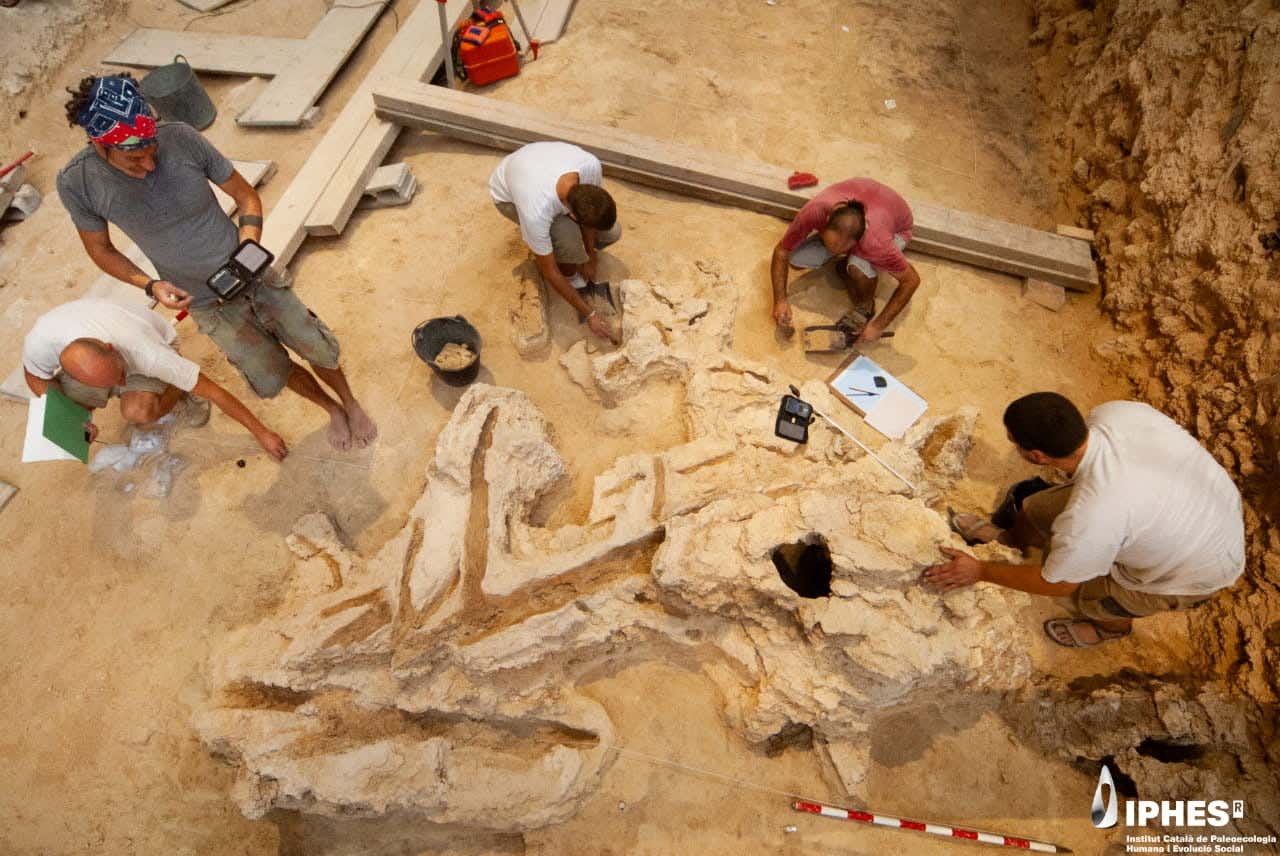
Drawing and recording work during the excavation of the wooden object at Abric Romaní. (CREDIT: Gerard Campeny / IPHES-CERCA)
- Wooden remains from a Spanish rock shelter reveal Neanderthal spears, a shaped club and possible household objects.
- Mineral molds preserve a rarely surviving part of Neanderthal technology across roughly 22,000 years.
- Researchers identified 13 worked or used artifacts among 597 specimens; several proposed functions remain uncertain.
A wooden object with a distinct handle and pointed head lay buried in a Spanish rock shelter for millennia. Scraping marks show that someone carefully shaped it. Its outline resembles a club, but exactly what its Neanderthal maker intended remains unknown.
The object belongs to a much larger collection from Abric Romaní, in Capellades near Barcelona. An archaeological analysis of 597 wooden specimens reveals weapons, possible household utensils and potential structural components, alongside abundant firewood.
Palmira Saladié of the Catalan Institute of Human Paleoecology and Social Evolution, IPHES-CERCA, and Universitat Rovira i Virgili led the study. Published in Science Advances, it examines finds from 16 archaeological levels dating to roughly 62,000–40,000 years ago.
The collection documents repeated wood use across thousands of years of occupation. It also exposes a major limitation of prehistoric archaeology: stone survives where much of everyday technology disappears.
Mineral molds preserve a missing material
Wood normally rots, leaving archaeologists with an uneven picture of ancient toolkits. Abric Romaní preserves something unusual: cavities that reproduce the shapes of wooden objects after their original material disappeared.
Calcium carbonate deposited around plant material during the formation of travertine, a limestone deposit. As the wood decomposed, it left negative impressions in the surrounding mineral. Some molds retain anatomical details down to the cellular level.
Other specimens survived as charred wood or partially burned remains associated with imprints. Together, these preservation pathways record objects that would rarely survive at another site.
The archaeological layers also contain hearths, stone tools and animal remains. Those neighboring finds help researchers interpret where wooden objects were used and how activities were arranged within the shelter.
Systematic excavations began in 1983 under Eudald Carbonell. More than four decades of fieldwork made this broad assessment possible, bringing scattered discoveries into a single account of wood use.
Most specimens were fuel, but 13 stood out
The 597 specimens are not 597 tools. Most are trunks, branches, twigs, roots or firewood accumulations, some deposited naturally and others brought by people.
Researchers identified 13 artifacts whose shapes, modification traces or archaeological settings indicated manufacture or use by Neanderthals. These came from eight of the studied levels and include pointed implements, two spears and the unusual club.
Fuel remained wood’s dominant role. Charcoal studies identified Scots pine as the principal wood burned in the hearths, accounting for more than 90% of identified charcoal.
Firewood ranged from small twigs to large logs. Its distribution included isolated pieces and reserves near the shelter wall or around combustion areas. Differences in size suggest varying approaches to gathering and transporting fuel.
Most worked artifacts also correspond to Scots pine, although some possible containers involved juniper. The record suggests that Neanderthals used wood for different purposes, rather than treating every branch as interchangeable fuel.
The proposed manufacturing sequence begins with selecting suitably sized trunks or branches. Removing side branches, peeling surfaces and scraping points would produce different final forms. Those steps are inferred from surviving features, so they describe a general process rather than a complete record of each object’s manufacture.
Spears and a club reveal deliberate shaping
Two wooden spears came from Level R. One measures 2.45 meters, while the second preserves 1.99 meters across three fragments. Both have features consistent with deliberate preparation, including shafts without projecting branches.
The longer specimen’s dimensions and pointed shape support its interpretation as a thrusting spear. That would imply close-range use, although the researchers caution against overly precise comparisons with incomplete or distorted weapons elsewhere.
Red deer remains accompanied the longer spear. Three adult male skulls retained antlers, suggesting hunting during autumn or winter. Their association provides context, but no direct weapon marks establish how those particular animals died.
The club-like object from Level P offers a different kind of evidence. Made from a single piece of wood, it has a 16-centimeter handle and a distinctly expanded working end. Parallel scraping traces indicate controlled shaping.
Its asymmetrical, pointed head seems better suited to striking than repeated digging, according to the analysis. Still, its function cannot be settled from shape alone. Uses involving hides, plant materials or other tasks remain possibilities.
Burning on its surface adds another qualification. The team attributes that damage to likely exposure after discard, rather than evidence that its maker deliberately hardened it with fire.
Trays and poles suggest a furnished living space
Four charred objects have flattened or concave forms resembling trays, plates or shallow scoops. Three came from Level H and one from Level O. Their shapes and proximity to hearths support a possible domestic role.
Distinguishing shaped bark containers from naturally detached fragments is difficult. Regular dimensions and the use of juniper strengthen the interpretation for at least some specimens, but their exact functions remain uncertain.
They might have carried food or collected embers and ashes. Comparisons with containers used by recent foraging communities offer possibilities, rather than proof of equivalent Neanderthal practices.
Wood may also have helped organize the shelter. In Level I, fragments of three poles included two crossed sticks above a thick hearth. Researchers suggest they could have belonged to an elevated structure associated with food processing.
A separate, branch-free pole from Level N stretches 5.10 meters. Found near an arrangement of hearths interpreted as a resting area, it may have supported a windbreak or light shelter. One surviving pole cannot establish the complete structure’s form.
Other pointed objects may have served as digging sticks. Possible tasks include obtaining underground foods or excavating hearth basins and refuse hollows, with the evidence insufficient to distinguish those uses.
A broader toolkit, with limits to interpretation
The assemblage adds household and spatial evidence to the better-known record of prehistoric wooden weapons. Finds at sites including Schöningen in Germany and Poggetti Vecchi in Italy already demonstrated early woodworking.
Abric Romaní contributes a long sequence of domestic occupations, showing wood’s recurring place beside stone and animal resources. Its diversity matters even though only a small fraction of the specimens qualify as artifacts.
Preservation also constrains the conclusions. Travertine molds complicate reconstruction of manufacturing steps, while altered stone-tool surfaces limit evidence linking particular cutting tools to woodworking. Small wood chips suggest production, but cannot independently resolve that gap.
The study supports a flexible toolkit involving different levels of effort and skill. It does not establish identical planning behind every implement. What emerges is a richer account of Neanderthal daily life, preserved through impressions of a material usually lost.
Dig deeper into prehistoric woodworking
These studies explore wooden tools, material selection and the challenges of reconstructing early technology.
The wooden artifacts from Schöningen’s Spear Horizon and their place in human evolution: An analysis of a major wooden assemblage examines weapons, tools and manufacturing techniques. (Proceedings of the National Academy of Sciences, 2024)
Wooden hafting technology in the early Neanderthal site of Poggetti Vecchi (Italy): Wooden handles and stone-tool traces offer evidence for possible composite implements. (Quaternary Science Reviews, 2024)
Evidence for the earliest structural use of wood at least 476,000 years ago: Interlocking logs at Kalambo Falls document structural woodworking long before the Abric Romaní occupations. (Nature, 2023)
Wooden tools and fire technology in the early Neanderthal site of Poggetti Vecchi (Italy): Boxwood implements reveal how early Neanderthals used fire during tool production. (Proceedings of the National Academy of Sciences, 2018)
A Middle Palaeolithic wooden digging stick from Aranbaltza III, Spain: Manufacturing and use-wear evidence illuminate a rare surviving Neanderthal digging tool. (PLOS ONE, 2018)
Research findings are available online in the journal Science Advances.
The original story "Spanish rock shelter preserves rare evidence of Neanderthal woodworking" is published in The Brighter Side of News.
Related Stories
- Neanderthals began life more like humans than scientists thought
- Neanderthals practiced dental care 59,000 years ago
- 146,000-year-old tools suggest human ingenuity thrived during the ice age
Like these kind of feel good stories? Get The Brighter Side of News' newsletter.
Joshua Shavit
Writer and Editor
Joshua Shavit is a NorCal-based science and technology writer with a passion for exploring the breakthroughs shaping the future. As a co-founder of The Brighter Side of News, he focuses on positive and transformative advancements in technology, physics, engineering, robotics, and astronomy. Having published articles on AOL.com, MSN, Yahoo News, and Ground News, Joshua's work highlights the innovators behind the ideas, bringing readers closer to the people driving progress.