Faint black hole ‘ringing’ provides a sharper test of Einstein’s gravity
A new method teases out faint black hole vibrations after mergers, giving sharper tests of Einstein’s gravity.

 Edited By: Joshua Shavit

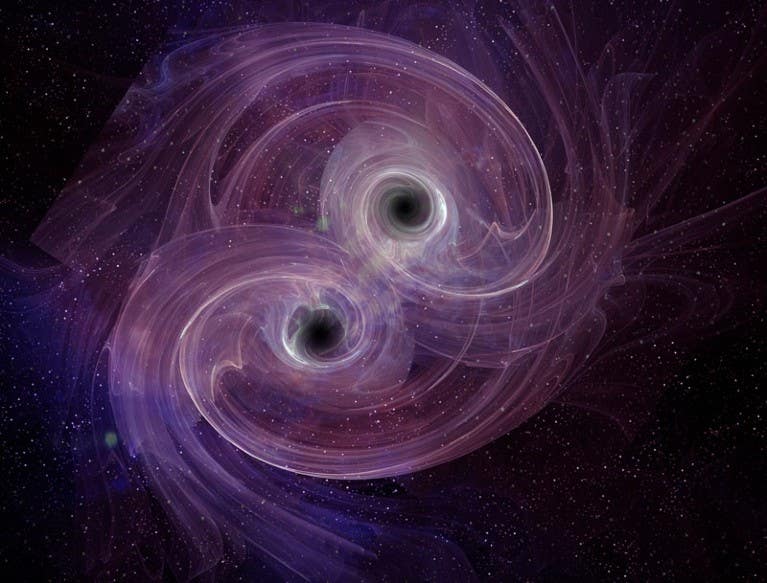
New Bayesian analysis reveals hidden detail in black hole ringdowns, including overtones and nonlinear gravitational-wave modes. (CREDIT: Wikimedia / CC BY-SA 4.0)
When two black holes crash together, the violence does not end at impact. The newly formed black hole keeps shaking, shedding energy as gravitational waves while it settles down. Physicists call that phase the ringdown, and it carries some of the cleanest clues available about what a black hole really is under Einstein’s theory of gravity.
A team at the University of Cambridge has now built a new way to read that ringing in much finer detail. Their method picks out not only the strongest signal, but also weaker harmonics and more exotic vibrations that can hide inside the aftermath of a merger. The work, published in Physical Review Letters, could sharpen how scientists test general relativity using data from observatories such as LIGO and Virgo.
Those fading vibrations are known as quasinormal modes. Each one depends on the final black hole’s mass and spin, giving the object a kind of gravitational fingerprint. The strongest of these modes is already a familiar feature in gravitational-wave observations. The harder problem has been deciding which quieter modes are truly present, and when they begin to dominate the signal.
“While the loudest mode is routinely observed in gravitational wave data, many quieter modes are much more difficult to detect, and there has been ongoing debate about which modes are present and when they appear,” said Richard Dyer of Cambridge’s Institute of Astronomy, the study’s first author. “Our method provides a systematic, data-driven way to resolve this uncertainty, and our results provide a reference for both theoretical studies and real observations.”
Reading the aftershock
The ringdown has long tempted researchers because it is simpler than the chaotic inspiral and merger that come before it. Once the two black holes have fused, the remnant can be treated as a perturbed black hole settling into a stable Kerr state. This state is the solution Einstein’s equations predict for a rotating black hole. That makes the late-time signal a natural place to look for cracks in the theory.
But clean in principle does not mean easy in practice.
One problem is timing. It is not obvious exactly when the ringdown begins. Start too early and the signal still carries messy merger effects that do not fit a simple quasinormal mode description. Start too late and some of the most interesting short-lived features, especially high-order overtones, may already be gone.
A different route
Older efforts often relied on least-squares fitting of individual waveform pieces, along with more improvised checks to decide whether a mode was real. Dyer and co-author Dr. Christopher Moore took a different route. They used Bayesian analysis, which weighs how strongly the data support one model over another while penalizing models that become too complicated.
That matters because the danger here is not just missing real modes, but also overfitting noise.
The Cambridge team tested candidate modes one by one, asking which addition most improved the model at each possible ringdown start time. Their algorithm then used Bayes factors to decide whether a candidate mode was significant enough to keep. A separate posterior predictive check tested whether the resulting model actually matched the waveform well. This helped rule out fits that looked impressive on paper but failed against the underlying data.
Beyond the main note
The researchers applied the method to a public catalog of 13 highly accurate numerical simulations produced with spectre Cauchy characteristic evolution. These simulations track black hole mergers all the way to future null infinity, where the gravitational-wave signal is cleanly defined. The waveforms were analyzed across many start times and across systems with different mass ratios and spin setups.
In one detailed example, a nonspinning binary with a mass ratio of 1:4, the method found overtones as high as n = 6 at early times in several waveform harmonics. For ringdown start times greater than about 4M, where M is the black hole mass scale used in the model, the statistical fit passed the team’s quality test. At very early times, up to roughly 3M, the fit failed that check. This was a reminder that not every early post-merger signal should be treated as clean ringdown physics.
As the start time moved later, the overtones dropped out in a broadly orderly way. That is what theory would lead researchers to expect, since these higher harmonics fade faster than the fundamental mode. One overtone in the (6,6) sector behaved oddly and reappeared around 20M. The authors note this pattern has been seen before.
Even stranger results
Alongside the familiar linear quasinormal modes, the analysis identified nonlinear modes generated when fundamental frequencies interact with each other. The authors compare them to the richer tones an electric guitar can produce under heavy distortion. These nonlinear signals showed up clearly in the (4,4) and (5,5) sectors, and several appeared in the quieter (6,6) harmonic as well. This included a cubic mode built from the dominant (2,2,0,+) vibration.
“The ringdown is one of the most direct probes of black holes we have,” said Dyer. “But extracting all the information it contains is hard. We wanted a principled, data-driven way to do that.”
Those nonlinear modes are especially interesting because they can last longer than overtones. The reason is simple: they are sourced by fundamental modes that decay more slowly. In the 1:4 simulation, the dominant quadratic modes persisted longer than any overtone, consistent with earlier work.
A cleaner test of Einstein
The results also speak to a long-running dispute over overtones. Critics have argued that these short-lived modes can look unstable when fits are repeated with different start times or when their frequencies are allowed to float. The new analysis does not end that debate, but it gives stronger evidence that high-order overtones are not just fitting artifacts. At a fixed start time, the Bayesian method repeatedly found clear support for including them. This was especially true where perturbation theory says they should matter most.
The team also ran a consistency check by letting the final black hole’s mass and spin vary rather than fixing them to the simulation values. If the chosen set of modes is sensible, the inferred mass and spin should agree with the known remnant properties. Across the catalog, the mismatch stayed very small. In fact, the root-mean-square errors were of order 10^-4 in the Regge-plane measure the authors used.
Not every predicted feature appeared. The researchers also searched for late-time power-law tails, another expected part of black hole relaxation. They did not detect them in the target harmonics of the main simulation. That absence was not surprising, since the simulations used here do not include the kind of exterior backreaction thought necessary to generate visible tails.
What the team has produced is less a final verdict than a better map. By cataloging which modes appear, in which harmonics, and at which times, the work gives gravitational-wave astronomers a more precise target list for real observations. If detectors can identify multiple ringdown frequencies from a merger, researchers can test whether the final black hole behaves exactly as general relativity predicts.
Practical implications of the research
This method gives scientists a more disciplined way to decode the aftermath of black hole mergers, which could improve how current and future detectors analyze gravitational-wave events.
It offers guidance on which faint frequencies are worth searching for in a given collision, including overtones and nonlinear modes that might otherwise be missed or mistaken for noise.
That, in turn, could lead to tougher tests of Einstein’s theory in extreme gravity, and more confident checks that the final black hole’s mass and spin match the values the theory allows.
Research findings are available online in the journal Physical Review Letters.
The original story "Faint black hole 'ringing' provides a sharper test of Einstein’s gravity" is published in The Brighter Side of News.
Related Stories
- Strange ripples in space may point to dark matter near merging black holes
- Gravitational wave detectors can now tune themselves using black holes
- The biggest black holes grow by crashing into each other over and over again
Like these kind of feel good stories? Get The Brighter Side of News' newsletter.
Joseph Shavit
Writer, Editor-At-Large and Publisher
Joseph Shavit, based in Los Angeles, is a seasoned science journalist, editor and co-founder of The Brighter Side of News, where he transforms complex discoveries into clear, engaging stories for general readers. With vast experience at major media companies like The Los Angeles Times, Times Mirror and Tribune Publishing, he writes with both authority and curiosity. His writing focuses on space science, planetary science, quantum mechanics, geology. Known for linking breakthroughs to real-world markets, he highlights how research transitions into products and industries that shape daily life.