The 364-day Qumran calendar may solve an ancient Dead Sea Scrolls mystery
A new reconstruction explains how Qumran’s sacred calendar shifted from a working system into a lasting religious ideal.

 Edited By: Joseph Shavit

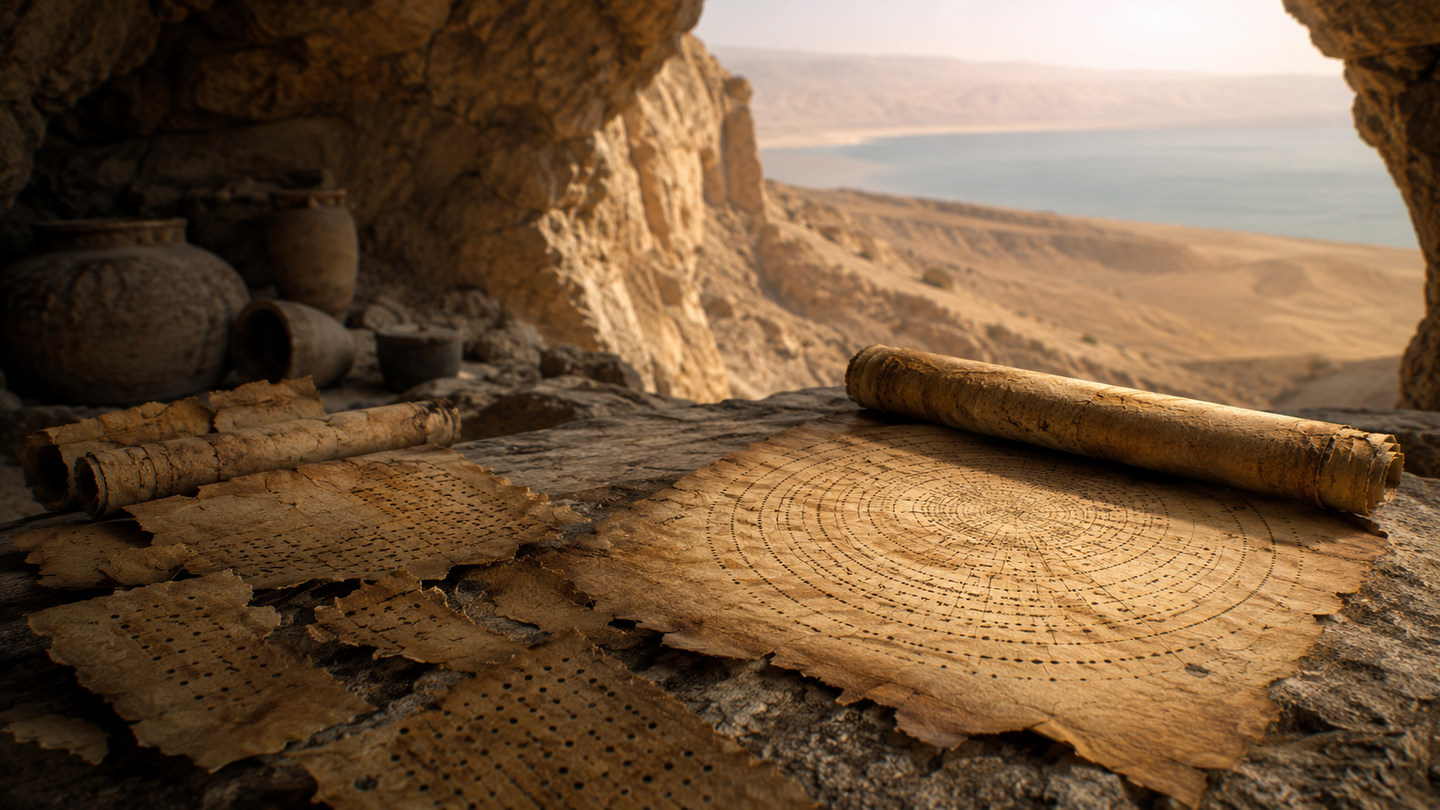
The Qumran 364-day calendar may have divided the sect from Jerusalem before seasonal drift and political change ended its use. (CREDIT: Wikimedia / AI-Generated / CC BY-SA 4.0)
The calendar at the center of Qumran life offered something rare: a year that never changed its weekly rhythm. Every festival returned on the same weekday, every priestly cycle followed a fixed order, and the entire system appeared to reflect divine precision.
But the same design carried a serious flaw.
A 364-day year falls about one day and a quarter short of the astronomical year. Over time, that gap would push spring festivals into winter and agricultural observances away from the seasons they were meant to mark.
A study from Tel Aviv University now proposes that this contradiction explains one of the most persistent questions surrounding the Dead Sea Scrolls. The calendar was probably used during the Qumran community’s early period, then gradually abandoned as its seasonal drift worsened and relations with Hasmonean King Alexander Jannaeus improved.
Prof. Eshbal Ratzon of Tel Aviv University developed the historical reconstruction. She works in the Department of Jewish Philosophy and the Cohn Institute for the History and Philosophy of Science and Ideas. The paper appeared in the Tarbiz Quarterly for Jewish Studies.
A calendar built around sacred order
Jewish life during the Second Temple period generally followed a lunisolar calendar. The Qumran system instead contained exactly 364 days, divided into 52 complete weeks.
Because 364 is divisible by seven, holidays always fell on the same weekday. That regularity reflected more than convenience. For the Qumran sect, it represented a perfect order established by God at Creation.
The calendar also challenged the political and religious leadership in Jerusalem. Temple authorities determined the dates governing Jewish worship and communal life.
The Qumran community rejected that authority. Its members believed God had already fixed those dates and that humans should not interfere.
Nearly 20 scrolls found at Qumran discuss calendars and astronomy. That unusually large collection shows how deeply the subject shaped the community’s religious identity.
The Book of Jubilees, a central work in the Qumran library, fiercely criticizes the prevailing lunar calendar. It presents the 364-day system as the original calendar received by Moses on Mount Sinai.
Other writings, including MMT, the Community Rule and Pesher Habakkuk, place calendrical ideas within broader disputes over religious law, worship and Temple authority.
Mathematical perfection meets the seasons
The calendar’s neat structure could not solve its astronomical problem. A solar year lasts roughly 365 and one-quarter days, leaving the Qumran year about 30 hours short.
After 20 years, festivals would shift by almost four weeks relative to the seasons. After several decades, a spring celebration could occur in winter or fall.
That drift mattered because many festivals were tied to harvests, first fruits and agricultural cycles. A calendar separating those observances from the natural year would become increasingly difficult to use.
The problem resembles a clock that loses one minute every day. Its error seems minor at first, but eventually the clock no longer reflects the actual time.
Researchers have long debated how the Qumran community handled this growing discrepancy. Some proposed that the sect periodically added days or weeks to keep the system aligned.
Others argued that the calendar never functioned in daily life and existed only as a theoretical model.
Ratzon contends that neither explanation fits the available writings. The Dead Sea Scrolls provide no compelling evidence that the community regularly inserted additional time into the calendar.
At the same time, the system appears too central and too controversial to dismiss as an abstract idea. It structured festivals, priestly rotations and long chronological schemes throughout the Qumran library.
A dispute that helped shape the sect
The reconstruction places the calendar within the political struggles of the second century BCE. Ratzon proposes that it emerged in pre-sectarian intellectual circles and became a working system during the Qumran movement’s formative years.
In that period, disagreements over the calendar may have deepened the community’s conflict with Jerusalem’s religious leadership.
Control over festival dates also meant control over Temple worship, priestly service and communal practice. The disagreement concerned not only how people counted days, but who possessed the authority to define sacred time.
The calendar therefore served two connected purposes. It organized religious life while marking the community’s separation from the authorities it opposed.
That practical role may not have lasted. As the seasonal error accumulated, the calendar became harder to reconcile with the agricultural year.
Political conditions also changed.
Alexander Jannaeus altered the equation
Alexander Jannaeus ruled from 103 to 76 BCE. According to the study, his religious legal positions resembled some of the Qumran sect’s own views, while he opposed the Pharisaic leadership.
That alignment may have eased hostility between the sect and the Hasmonean state. A calendar that had symbolized resistance to Jerusalem may have become less necessary as relations improved.
The community could then adopt the more practical calendar used at the Temple without entirely surrendering its older beliefs.
Under this reconstruction, the 364-day system remained authoritative in Qumran literature after losing its everyday function. It still represented the ideal calendar established during Creation and one that might return in the End of Days.
This shift could explain why the system occupies such a prominent place in the scrolls yet gradually disappeared from historical practice.
“The Qumran calendar has long been regarded as one of the Qumran sect's defining features, but also as one of the most baffling mysteries of the Dead Sea Scrolls,” Ratzon said. “This study proposes an alternative for the seeming contradiction between a functional calendar and a theoretical one.”
“It is quite possible that the calendar was in fact used for a certain period of time, but then, losing its practical role due to both inherent problems and political changes, became a religious ideal and a symbol of identity. This would explain both its centrality in the Qumran scrolls and its gradual disappearance from historical reality.”
Practical implications of the research
The reconstruction offers scholars a way to reconcile two interpretations that have often seemed incompatible. The calendar could have been both practical and theoretical, but at different stages of Qumran history.
That approach may help researchers understand how religious communities respond when sacred ideals collide with astronomy, agriculture and political change.
It also provides a framework for reading calendrical writings alongside legal and historical evidence. Rather than treating the calendar as an unchanging feature, the study presents it as part of a developing community.
Its adoption and abandonment may clarify how the Qumran movement negotiated Temple authority, group identity and political survival during a turbulent period of Jewish history.
Research findings are available online in the journal Tarbiz Quarterly for Jewish Studies.
The original story "The 364-day Qumran calendar may solve an ancient Dead Sea Scrolls mystery" is published in The Brighter Side of News.
Related Stories
- Satellites solved a 50-year mystery about Israel’s 'Stonehenge'
- Pompeii DNA study shatters myths about their ancient lives
- 21 year-old student cracks 2,000 year-old code to win prestigious international award
Like these kind of feel good stories? Get The Brighter Side of News' newsletter.
Rebecca Shavit
Writer
Based in Los Angeles, Rebecca Shavit is a dedicated science and technology journalist who writes for The Brighter Side of News, an online publication committed to highlighting positive and transformative stories from around the world. Having published articles on MSN, AOL News, and Yahoo News, Rebecca's reporting spans a wide range of topics, from cutting-edge medical breakthroughs to historical discoveries and innovations. With a keen ability to translate complex concepts into engaging and accessible stories, she makes science and innovation relatable to a broad audience.