The moon could support permanent settlements, just not the giant cities Elon Musk envisions
Lunar ice could sustain small settlements for centuries, but researchers find a million-person metropolis would face a severe water limit.

 Edited By: Joseph Shavit

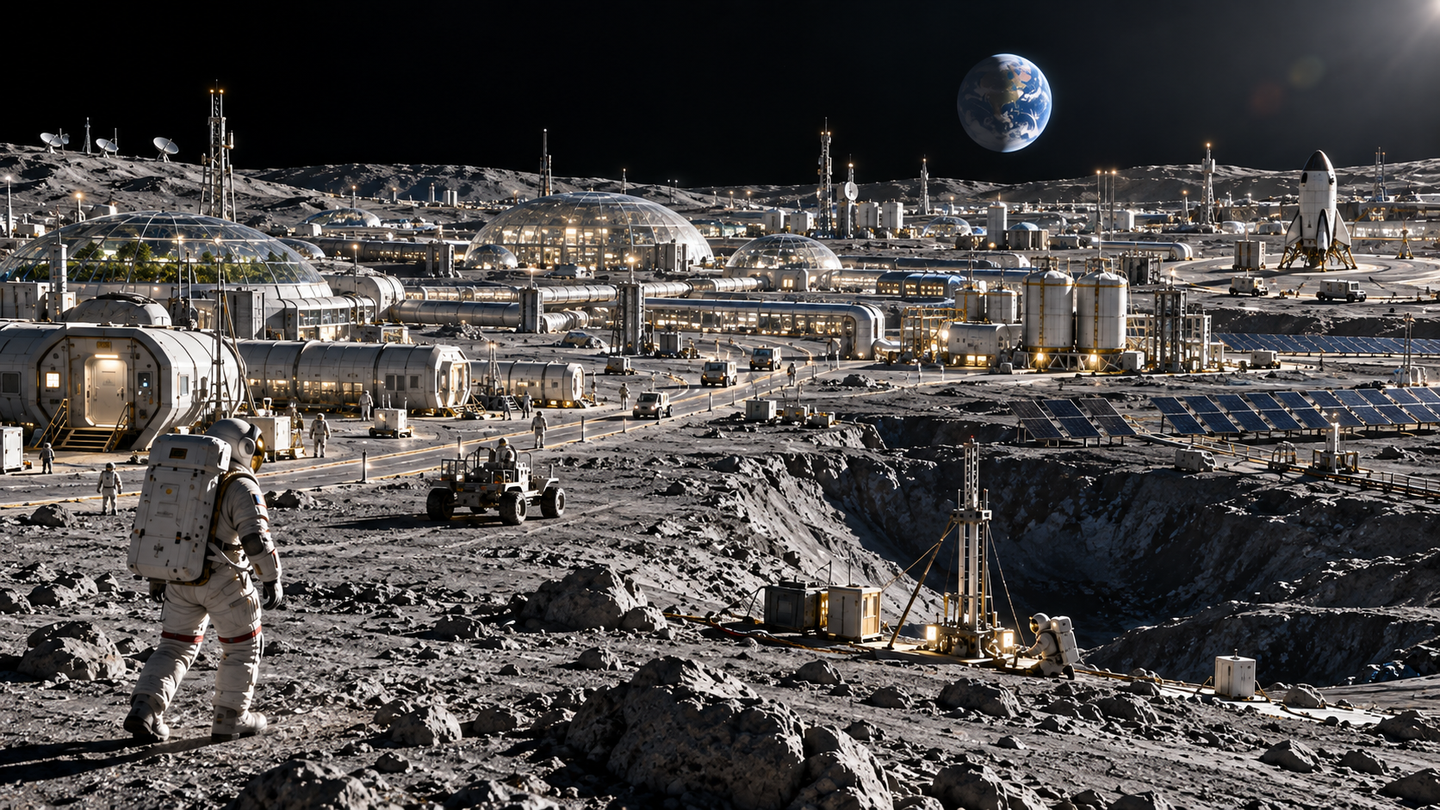
A million-person Moon city could exhaust even a generous lunar water supply in about a century despite 98% recycling. (CREDIT: Shutterstock)
- A new analysis finds that even a generous estimate of one billion tons of accessible lunar water would support a city of one million people for only about 2.4 years without recycling, or roughly a century with International Space Station-level recovery.
- Smaller settlements appear far more sustainable: a population of about 100,000 could potentially stretch the same water supply for roughly 1,000 years at 98% recycling, while a village of 1,000 people could use lunar water much more freely.
- Power appears to be a weaker constraint than water, making better prospecting, highly efficient recycling and the discovery of additional underground ice critical if large permanent lunar settlements are ever attempted.
The Moon contains water, but that does not necessarily mean it contains enough to support the vast cities sometimes imagined for humanity’s future in space.
A new analysis estimates that even under generous assumptions, a lunar metropolis containing one million people could consume its available water surprisingly quickly. Without recycling, a billion-ton supply would last only about 2.4 years. Even with recycling efficiency comparable to the International Space Station, that lifetime stretches to only a little over a century.
Published in Frontiers in Space Technologies, the study by Harvard University astrophysicists Martin Elvis and Jonathan McDowell explores whether water and energy resources could support permanent space settlements ranging from small villages to large industrial cities.
The researchers conclude that electricity is unlikely to be the first hard limit. Water is another matter.
Their calculations suggest modest settlements could remain viable for centuries or millennia. A city of millions, however, would require exceptional recycling, much lower water consumption, imports from elsewhere in the Solar System or much larger lunar reservoirs than scientists have confirmed.
Lunar ice changed the dream of permanent settlement
Much of the excitement surrounding lunar settlement comes from ice trapped near the Moon’s poles.
Some polar crater floors have remained out of direct sunlight for billions of years. These permanently shadowed regions can stay colder than about 110 kelvin, cold enough for water ice to remain stable over geological timescales.
That water could potentially supply drinking water, agriculture and industrial processes. It could also be split into hydrogen and oxygen for life support or rocket propellant.
The problem is that scientists still do not know precisely how much usable water exists.
Estimates vary significantly depending on the measurements and assumptions used. Elvis and McDowell therefore adopted one billion metric tons as a deliberately generous baseline for their calculations.
That figure may substantially exceed what is actually accessible. Current estimates discussed by the researchers could be 20 to 30 times lower, while the fraction that future mining systems could realistically recover remains unknown.
Before a large settlement could safely depend on lunar ice, extensive prospecting would therefore be necessary.
A million residents would consume enormous quantities
A billion tons sounds almost limitless until the water demands of an entire city are considered.
Personal consumption represents only one part of the total. Water would also be required for food production, sanitation, industry and potentially other large-scale activities.
The study uses a direct personal-water estimate of about 125 tons per person each year. Agriculture can require far more, with estimated water use for food production reaching hundreds or more than a thousand tons per person annually depending on the system.
Under the researchers’ modeled assumptions, one million lunar residents could therefore exhaust one billion tons of water in about 2.4 years if the resource were simply consumed.
Such a settlement would obviously recycle water, making the efficiency of a closed-loop system one of the most important variables in its survival.
At 94% recycling, an efficiency previously reached aboard the International Space Station, the billion-ton reserve would last roughly 40 years for one million people.
At 98%, the calculation improves dramatically. The same lunar population could continue for about 100 years because only 2% of the circulating water would continually need replacing.
Even 98% recycling leaves a long-term problem
The International Space Station has demonstrated that recovering approximately 98% of some water streams is technically possible.
Scaling that achievement from a small orbital crew to a city containing one million people would be a radically different engineering challenge. A permanent population would require showers, laundry, food processing, toilets, agriculture and industrial systems that do not exist on the ISS at metropolitan scale.
Small losses would also become enormous when multiplied across a million residents and decades of operation.
This is why population matters so much.
With the same billion-ton starting assumption and highly efficient recycling, a settlement of roughly 100,000 people could theoretically stretch the supply toward 1,000 years. The researchers argue that such a timescale begins to resemble a genuinely sustainable settlement.
A village of about 1,000 people would face far less pressure. That population is comparable to the number of people who winter at Antarctic research stations and could potentially use lunar water for extremely long periods without approaching the resource limits faced by a major city.
The calculations therefore draw a sharp distinction between establishing a permanent human presence and building an enormous self-sufficient lunar metropolis.
Electricity may be easier than finding enough water
Surprisingly, the study identifies energy as a relatively weak constraint.
The permanently shadowed craters containing ice sit near elevated areas that can receive sunlight for long periods. Tall photovoltaic arrays positioned around well-lit crater rims could generate significant amounts of electricity.
The Moon also contains abundant silicon, raising the possibility that future industries could eventually manufacture some solar infrastructure locally rather than importing every component from Earth.
The researchers estimate that solar and nuclear fission systems could support substantial populations. At scales of several million residents, nuclear power would become increasingly important.
Water cannot be generated as easily.
Possible solutions include reducing consumption, improving recycling beyond current levels, adopting water-efficient agriculture such as vertical farming and importing icy material from asteroids.
The most straightforward solution, however, may be finding much more lunar water than present surveys reveal.
The real lunar water inventory remains unknown
Current orbital instruments mostly probe the surface and relatively shallow subsurface. Lunar regolith can extend many meters deep, leaving open the possibility that significant ice deposits remain undetected.
Finding those deposits could transform the calculation. Doubling accessible water roughly doubles the lifetime of a settlement, while discovering reservoirs many times larger could fundamentally change what population levels are practical.
Extraction efficiency will matter just as much as total abundance. Ice mixed thinly through regolith may be technically present but expensive to mine, process and transport.
That makes robotic prospecting one of the most important steps before large-scale settlement.
The research does not argue that people cannot live permanently on the Moon. Instead, it suggests scale matters enormously. A village or small town could operate within lunar resource limits for a very long time, while a city of one million residents would turn water management into a defining constraint.
The Moon may contain enough water to support humanity’s first permanent communities beyond Earth. Whether it contains enough for a true metropolis remains a much harder question.
Dig deeper into lunar water and closed-loop survival
These resources examine where lunar ice is located, how stable it may be and how efficiently future settlements could recycle one of their most critical resources.
Direct evidence of surface exposed water ice in the lunar polar regions: Provides direct spectroscopic evidence of exposed water ice in permanently shadowed regions near both lunar poles. (Proceedings of the National Academy of Sciences, 2018)
Micro cold traps on the Moon: Shows that small shadows dramatically increase the number and area of lunar cold traps capable of preserving water ice. (Nature Astronomy, 2021)
Evidence for surface water ice in the lunar polar regions using reflectance measurements from the Lunar Orbiter Laser Altimeter and temperature measurements from the Diviner Lunar Radiometer Experiment: Links unusually reflective south-polar terrain below roughly 110 kelvin with conditions consistent with stable surface ice. (Icarus, 2017)
Detection of water in the LCROSS ejecta plume: Reports direct detection of water after the LCROSS impact excavated material from the permanently shadowed Cabeus crater. (Science, 2010)
NASA Achieves Water Recovery Milestone on International Space Station: Describes the station’s demonstration of approximately 98% water recovery, the recycling benchmark used in many long-duration settlement calculations. (NASA, 2023)
Research findings are available online in the journal Frontiers in Space Technologies.
The original story "The moon could support permanent settlements, just not the giant cities Elon Musk envisions" is published in The Brighter Side of News.
Related Stories
- China's Chang’e-7 targets the Moon’s South Pole in search of usable water ice
- Moon dust from Chang’e-6 mission reveals asteroids carried water to Earth
- New research finds water on icy moons defies the laws of physics
Like these kind of feel good stories? Get The Brighter Side of News' newsletter.
Joshua Shavit
Writer and Editor
Joshua Shavit is a NorCal-based science and technology writer with a passion for exploring the breakthroughs shaping the future. As a co-founder of The Brighter Side of News, he focuses on positive and transformative advancements in technology, physics, engineering, robotics, and astronomy. Having published articles on AOL.com, MSN, Yahoo News, and Ground News, Joshua's work highlights the innovators behind the ideas, bringing readers closer to the people driving progress.