Tiny black holes may form out of a crystal-like state in spacetime
Physicists found an exact formula for the unstable spacetime pattern that can collapse into a tiny black hole.

 Edited By: Joshua Shavit

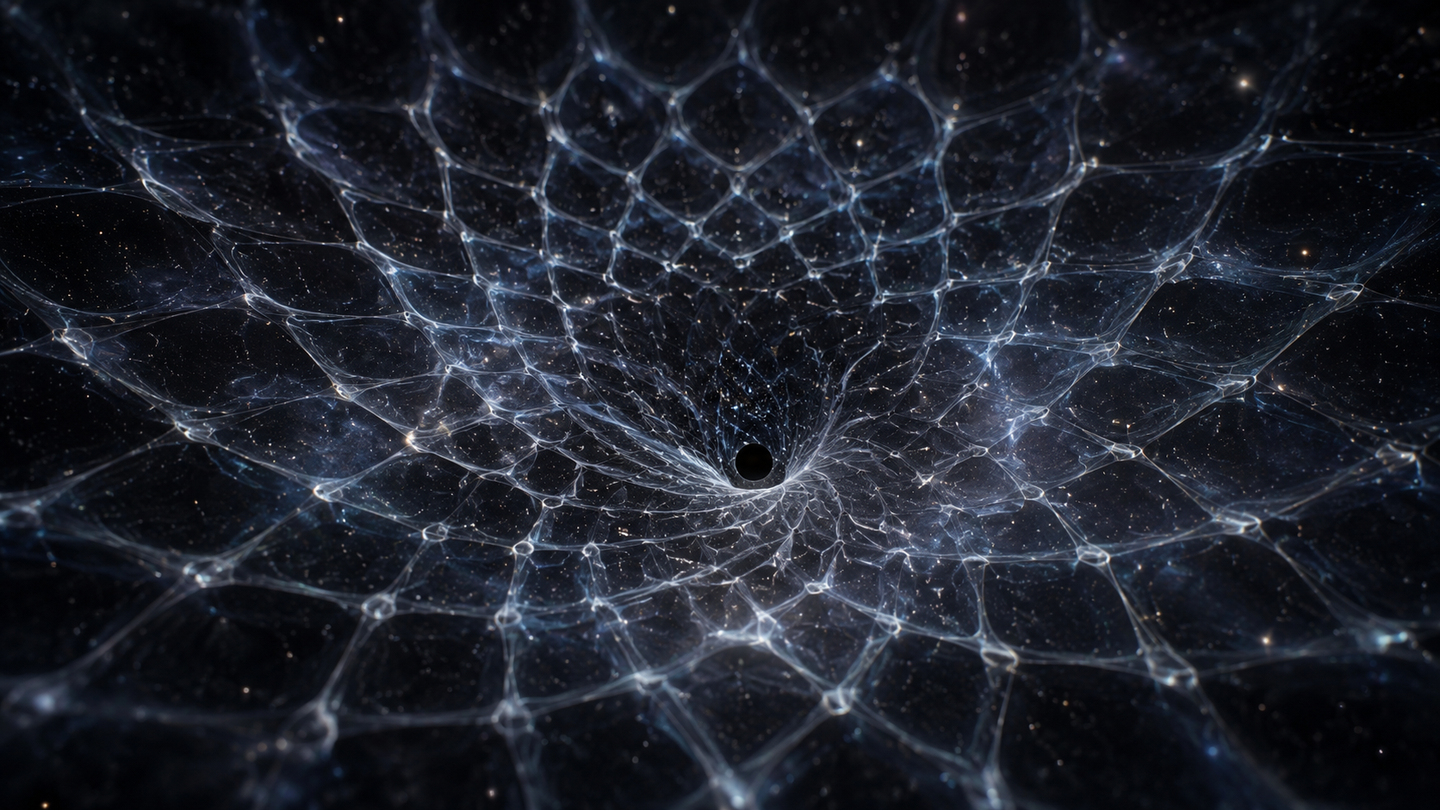
New math shows how a crystal-like critical state in spacetime can tip into a microscopic black hole. (CREDIT: Wikimedia / CC BY-SA 4.0)
Microscopic black holes have long hovered at the edge of theory, forming only in exquisitely balanced states. Now physicists have pinned down that threshold with an exact formula, showing how a crystal-like pattern in spacetime can briefly appear before collapsing into darkness.
A black hole does not have to begin with a dying star. In some corners of Einstein’s theory, it can start much smaller, from a delicate state so finely balanced that the slightest extra energy tips it over the edge.
That strange threshold has fascinated physicists for decades because it seems to sit between two very different outcomes. On one side, spacetime settles down and matter disperses. On the other, a black hole forms. Now a team from Goethe University Frankfurt and TU Wien says it has found an exact mathematical way to describe that knife-edge behavior, a result that had resisted closed-form analysis for years.
The work tackles one of the more elusive ideas in gravitational physics: critical collapse, a process in which matter and spacetime organize themselves into a repeating pattern just before black hole formation.
A narrow ledge between collapse and escape
The basic picture is oddly familiar. “Sometimes a tiny, seemingly insignificant cause is enough to trigger a huge and dramatic change,” said Prof. Daniel Grumiller of TU Wien. He compared it to water at the freezing point, where a tiny shift can lock molecules into the ordered pattern of ice.
The new work argues that spacetime can behave in a related way. Matter always bends spacetime, whether it is a star or something much smaller. Under critical conditions, that curvature can briefly settle into a regular repeating structure in space and time, something the researchers describe as a kind of spacetime crystal.
“This spacetime crystal is a very peculiar and fascinating object,” Grumiller said. “It is a kind of intermediate state, an unstable point that can evolve in two different directions.”
One possibility is that it fades away, leaving ordinary spacetime and freely moving particles behind. The other is more dramatic. “But if a tiny amount of energy is added, the evolution takes a completely different path,” he said. “The inconspicuous spacetime crystal turns into a black hole.”
That possibility matters because the early universe may have passed through similar extreme conditions. If such critical states existed shortly after the Big Bang, they could have produced primordial black holes, hypothetical objects that remain a live topic in cosmology.
A 1993 clue, and a long mathematical stall
The broad idea is not new. Numerical work dating back to 1993 showed that black holes could appear spontaneously from these critical states. Those simulations revealed a repeating, self-similar structure near the threshold of collapse, with the same pattern echoing on smaller and smaller scales.
What proved much harder was turning that behavior into an exact analytic description.
Black hole formation is notoriously difficult to write down in closed form, even in simplified setups. In this case, the researchers focused on spherical symmetry and Einstein gravity coupled to a massless scalar field, a stripped-down model that still captures the essential collapse dynamics. Even then, the equations remain a tangled set of nonlinear partial differential equations.
For years, the best route was numerical construction, often with the repeating symmetry imposed from the start. The new study takes a different path.
The trick was to leave the real universe, briefly
“Our universe has four dimensions, three dimensions of space and one dimension of time,” said Christian Ecker from the Institute for Theoretical Physics at Goethe University Frankfurt. “But in principle, nothing prevents us from writing down physical equations for a larger number of dimensions, five dimensions, forty-two dimensions, or even infinitely many.”
That sounds like a move toward greater complexity. Instead, it became a shortcut.
The team studied the problem in the limit of very many dimensions, where a quantity proportional to 1 divided by the number of dimensions becomes a small control parameter. In that regime, some of the hardest parts of the equations simplify enough to solve analytically.
Rather than trying to attack the four-dimensional problem head-on, the researchers detoured through a hypothetical universe with infinitely many dimensions and then organized corrections step by step. At leading order, they found an entire family of exact discretely self-similar solutions. At higher orders, those solutions start to recover more of the detailed behavior already seen in simulations.
That matters because the earlier numerical work suggested a very specific geometry near the threshold of collapse: an ingoing null surface, a naked singularity at the center, and an outgoing Cauchy horizon. The new formulas reproduce the regularity of the critical state in the region between the center and the self-similar horizon, while also showing how the approximation can be sharpened order by order.
From elegant freedom to tighter constraints
At first, the leading-order solution is surprisingly flexible. It allows infinitely many repeating patterns, each determined by a free periodic function. If that were the end of the story, the theory would be too loose to match the expectation that the critical solution at finite dimension is effectively unique.
But the freedom does not survive unchanged.
Once the team included next-to-leading corrections, the equations began to impose a consistency condition on the echoing period, the interval over which the self-similar pattern repeats. By the time they pushed the expansion further, they were able to recover qualitative features known from numerical studies, including the downward bending of certain geometric lines tied to the null energy condition and the way the horizon-related function drops below its idealized maximum.
“Our technique turns out to be remarkably stable,” said Florian Ecker of TU Wien. “Depending on the desired precision, we can systematically improve our formulas using additional approximation methods.”
The researchers do not claim the series is convergent. Like other large-dimension expansions in gravity, it is expected to be asymptotic, meaning it may not settle into a final exact sum. Still, asymptotic methods can be very powerful if each added term improves the description over the range of interest.
The present framework also stays mostly within the “past patch” of the critical spacetime, the region up to the self-similar horizon. Extending the solution farther, toward and beyond the future Cauchy horizon, remains part of the open work.
A clearer analytic foothold
The result does not mean physicists can now write down every feature of black hole formation on a single page. It does mean they have something they lacked before: a controllable analytic foothold in a problem long dominated by numerics.
That foothold could help clarify how the repeating critical state changes as the number of dimensions varies, whether higher-order conditions squeeze the family of solutions down toward a unique form, and how quantities such as the echoing period and the Choptuik exponent behave in the large-dimension limit.
For a problem built on the brink between dispersal and collapse, that is a meaningful gain. The new formulas suggest that the threshold itself is not just a numerical curiosity, but a structure that can be studied, refined, and perhaps eventually understood with much greater precision.
Practical implications of the research
This research does not predict that microscopic black holes are about to be found in a lab or in space. Its value is more foundational. It gives physicists a new analytic tool for studying one of general relativity’s most delicate tipping points, the threshold where collapse either fizzles out or becomes a black hole.
That could sharpen theoretical work on critical collapse, primordial black holes, and the mathematical structure of Einstein’s equations under extreme conditions. It also offers a way to connect numerical simulations with exact formulas, which is often where deeper physical insight begins.
Research findings are available online in the journal Physical Review Letters.
The original story "Tiny black holes may form out of a crystal-like state in spacetime" is published in The Brighter Side of News.
Related Stories
- Gravitational wave detectors can now tune themselves using black holes
- Microscopic wormholes may be warping reality all around us
- Black hole GW190521 may be a wormhole from another universe
Like these kind of feel good stories? Get The Brighter Side of News' newsletter.
Joseph Shavit
Writer, Editor-At-Large and Publisher
Joseph Shavit, based in Los Angeles, is a seasoned science journalist, editor and co-founder of The Brighter Side of News, where he transforms complex discoveries into clear, engaging stories for general readers. With vast experience at major media companies like The Los Angeles Times, Times Mirror and Tribune Publishing, he writes with both authority and curiosity. His writing focuses on space science, planetary science, quantum mechanics, geology. Known for linking breakthroughs to real-world markets, he highlights how research transitions into products and industries that shape daily life.