Underwater robotic exoskeleton suit could help scuba divers use nearly 30% less air
Soft robotic exosuits could assist divers’ kicks and lower breathing demand, but practical deployment needs better gear integration and open-water trials.

 Edited By: Joseph Shavit

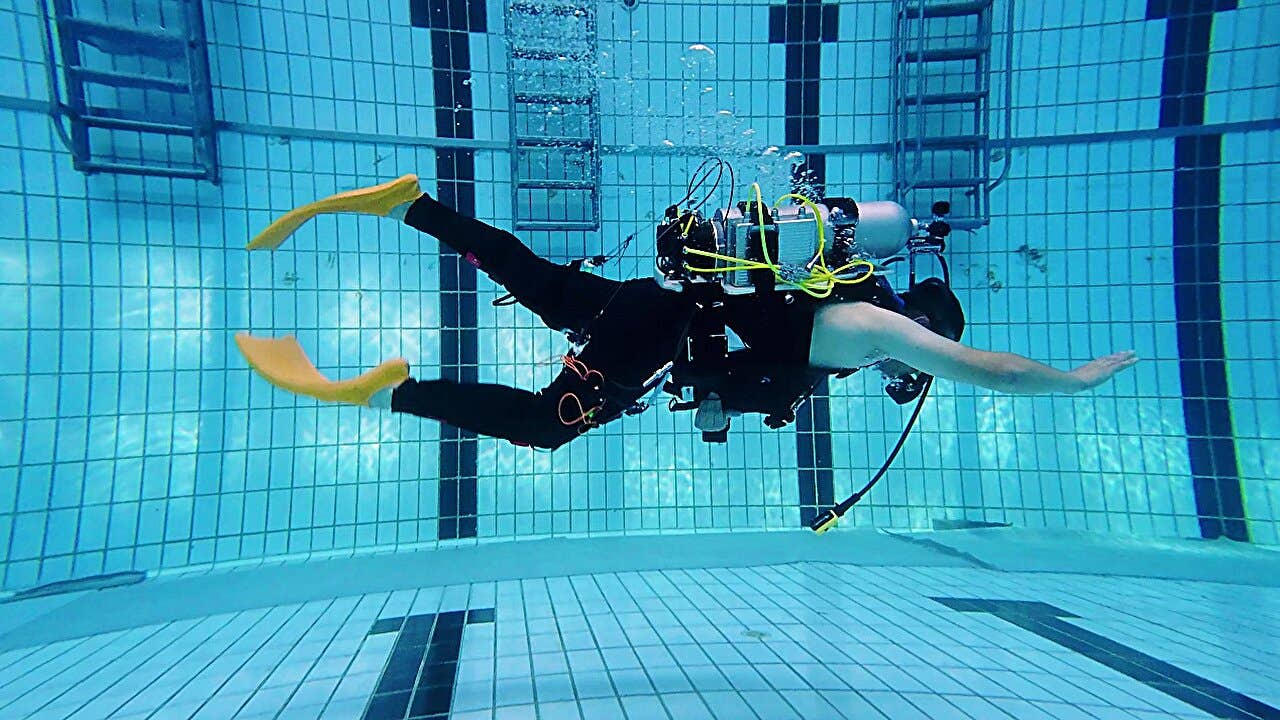
A scuba diver wearing the PEAKED soft underwater exosuit, which provides lower-limb assistance during underwater locomotion. (CREDIT: SIAT)
- Wearable underwater robots can assist divers’ leg movements while leaving the diver in direct control of the task.
- Earlier PEAKED experiments reduced breathing volume per minute by 29.77% during flutter kicks, 25.70% during frog kicks and 18.35% during underwater walking.
- Practical deployment still requires realistic trials, reliable integration with diving gear and rapid removal in emergencies.
Every fin stroke costs a scuba diver effort and breathing gas. Water resists movement, equipment adds to the workload, and the gas carried in a tank places a practical limit on time underwater. Wearable robots could help reduce that burden by assisting the diver’s own leg movements.
A team led by Wu Xinyu at the Shenzhen Institute of Advanced Technology, part of the Chinese Academy of Sciences, is developing underwater exoskeletons for that purpose. An article in Science Robotics examines the field’s progress, design choices and remaining challenges. It draws on earlier experiments rather than reporting all the performance figures as a new trial.
The approach extends wearable robotic assistance into an environment where land-based designs need substantial rethinking. Unlike a scooter or uncrewed underwater vehicle, an exoskeleton assists the person who remains physically engaged, perceiving conditions and making decisions as the task unfolds. That role can matter in confined spaces, poor visibility or changing conditions, where the diver must respond directly to what is happening. The assistance supports body-driven movement while leaving those judgments with the person.
A soft exosuit supports several underwater movements
One representative system is PEAKED, short for Performance-Enhancing Assistive Kicking Exosuit for Diving. The soft hip exosuit assists both flexion and extension, supporting movement in each direction. Its compliant structure accommodates large lower-limb movements while supplying mechanical assistance.
The system supports flutter kicking, frog kicking and underwater walking. Those activities involve different patterns of joint coordination and resistance, so assisting one movement does not automatically establish usefulness for another. A device must accommodate the motion a diver actually needs to perform.
Soft designs offer flexibility across those movements, echoing the appeal of compliant robotic structures. Buoyancy reduces the need to support body weight, giving designers more scope to use an exosuit that follows the wearer. However, cable routing can introduce entanglement risks that engineers must address.
Rigid exoskeletons offer a different balance. They can transmit torque more directly, but may restrict natural motion and movement variety. The Focus article describes them as better suited to regular forward-and-back movements such as flutter kicking, illustrating why wearable robot design must follow the intended task.
Underwater exoskeletons reduced breathing demand in earlier tests
In previous PEAKED experiments, assistance reduced respiratory minute volume by 29.77% during flutter kicking. The reductions reached 25.70% during frog kicking and 18.35% during underwater walking. These results show that the measured benefit varied with the activity, rather than providing one universal performance figure.
Respiratory minute volume, or RMV, measures the volume of gas breathed per minute. It is closely connected to a diver’s use of a finite breathing-gas supply. That makes it practically relevant, even though RMV is not a direct substitute for measuring metabolic energy expenditure. Earlier swimming-oriented systems often assessed muscle activation instead. Using breathing volume adds a measure tied to one of scuba diving’s immediate constraints, while leaving the distinction between ventilation, muscle activity and metabolic cost intact.
A separate underwater knee exoskeleton also produced encouraging results. The Focus article cites a 22.7% reduction in RMV for that system. The hip and knee results concern different devices, so their percentages should not be treated as interchangeable or combined into a larger claimed saving.
The evidence supports further work on assistance that reduces physical demands, but does not establish a particular increase in safe dive duration. As with other experimental exoskeletons, the measured outcome and the conditions of testing matter when judging what the device can deliver.
Water changes the mechanics of robotic assistance
An underwater exoskeleton cannot simply copy a system built for walking or running. On land, body-weight support and the changing demands of different steps shape the assistance required. In water, buoyancy reduces weight-support needs while drag resists much of the leg’s movement.
That resistance acts during both hip extension and flexion. Assistance in both directions can therefore suit kicking better than help limited to one part of the cycle. Recent biomechanical evidence also points to the hip’s important role in efficient swimming with fins.
The system’s form, assisted joint and timing must work together. Divers use multiple finning techniques with different movement planes and coordination patterns. The choice between a soft suit and rigid structure therefore cannot be separated from how the diver intends to move.
This reflects a broader challenge in underwater robotics: useful motion depends on interaction with the surrounding water. For a wearable system, that interaction also includes the person, making coordination between human movement and robotic control central to whether assistance feels natural and arrives when needed.
Diving equipment and emergency removal shape the design
Mechanical performance is only one requirement for practical use. The exoskeleton must fit alongside scuba tanks, ballast and other equipment without blocking the space those components need. Its layout must accommodate the complete diver and gear arrangement, rather than treating the legs in isolation.
Actuation, sensing and electronic components also need protection from water under pressure. Waterproofing is therefore part of the system’s basic operating requirements. A device that assists effectively in a controlled experiment still needs to function reliably within the conditions of an intended dive.
Rapid removal matters as well. The article describes breakaway cables and quick-release buckles in some systems, allowing the diver to separate from the equipment during an emergency. These features address a different requirement from propulsion assistance, but remain essential to practical integration.
The point is to preserve human control while adding useful support. Research on wearable interfaces for underwater robots addresses a related need for dependable human interaction. Meanwhile, robots performing underwater tasks illustrate a separate approach that does not require the person to remain directly at the work site.
Personalized assistance and steadier posture are next goals
Current assistance patterns remain far from fully optimized. Some derive from terrestrial systems, while others are tuned to specific movements. The researchers identify personalization as a promising way to match assistance more closely to each diver, movement pattern and task.
Human-in-the-loop optimization could help identify those settings by incorporating the wearer’s response into the adjustment process. That is a direction for future development, rather than evidence that current underwater suits automatically optimize themselves for every diver. Experience with personalized walking assistance provides context for the idea, while the underwater conditions remain distinct.
Posture stabilization offers another possibility. Uneven ballast or equipment placement can create roll imbalance. Different assistance to the two legs might help correct that imbalance while maintaining forward thrust, extending the device’s role beyond propulsion alone. Such adaptive robotic support remains an engineering goal to investigate underwater.
The field still needs more mature systems and realistic diver trials, including open-water and sea tests. Earlier reductions in breathing demand provide a reason to pursue that work, without establishing every practical limit. The next step is to show how well the assistance holds up when the diver, equipment and surroundings present demands beyond controlled experiments.
Dig deeper into underwater exoskeletons and personalized assistance
These resources cover earlier diving experiments, movement synchronization and methods for tailoring wearable robotic assistance.
New Method Proposed for Ultrarobust Underwater Kicking Phase Estimation for Robotic Exosuit-assisted Diving: Explains research on synchronizing PEAKED’s assistance with changing underwater kicking patterns. (Chinese Academy of Sciences, March 2026).
PKU Breakthrough: Innovative Underwater Exoskeleton Boosts Diving Efficiency: Describes the knee-assistance system and earlier tests with six experienced divers. (Peking University, November 2025).
System Design of a Soft Underwater Exosuit to Reduce Metabolic Cost Across Multiple Aquatic Movements During Diving: Presents the PEAKED design and experiments measuring breathing-gas reductions during three underwater movement patterns. (IEEE Transactions on Robotics, February 2025).
Personalizing exoskeleton assistance while walking in the real world: Examines wearable-sensor methods for optimizing assistance outside laboratory walking conditions. (Nature, October 2022).
Human-in-the-loop optimization of exoskeleton assistance during walking: Provides foundational research on tuning robotic assistance using measurements of the wearer’s response. (Science, June 2017).
Research findings are available online in the journal Science Robotics.
The original story "Underwater robotic exoskeleton suit could help scuba divers use nearly 30% less air" is published in The Brighter Side of News.
Related Stories
- New exoskeleton teaches stroke patients to walk with therapist guidance
- New upper-limb exoskeleton adapts to stroke patients in real time
- Lifechanging robotic exoskeleton walks autonomously and puts itself on
Like these kind of feel good stories? Get The Brighter Side of News' newsletter.
Joshua Shavit
Writer and Editor
Joshua Shavit is a NorCal-based science and technology writer with a passion for exploring the breakthroughs shaping the future. As a co-founder of The Brighter Side of News, he focuses on positive and transformative advancements in technology, physics, engineering, robotics, and astronomy. Having published articles on AOL.com, MSN, Yahoo News, and Ground News, Joshua's work highlights the innovators behind the ideas, bringing readers closer to the people driving progress.