Underwater neutrino telescope puts Einstein’s theory of relativity to a new test
An underwater neutrino telescope tested a foundation of Einstein’s relativity and tightened limits on certain possible departures from standard physics.
 Sissa Medialab Writer: Federica Sgorbissa

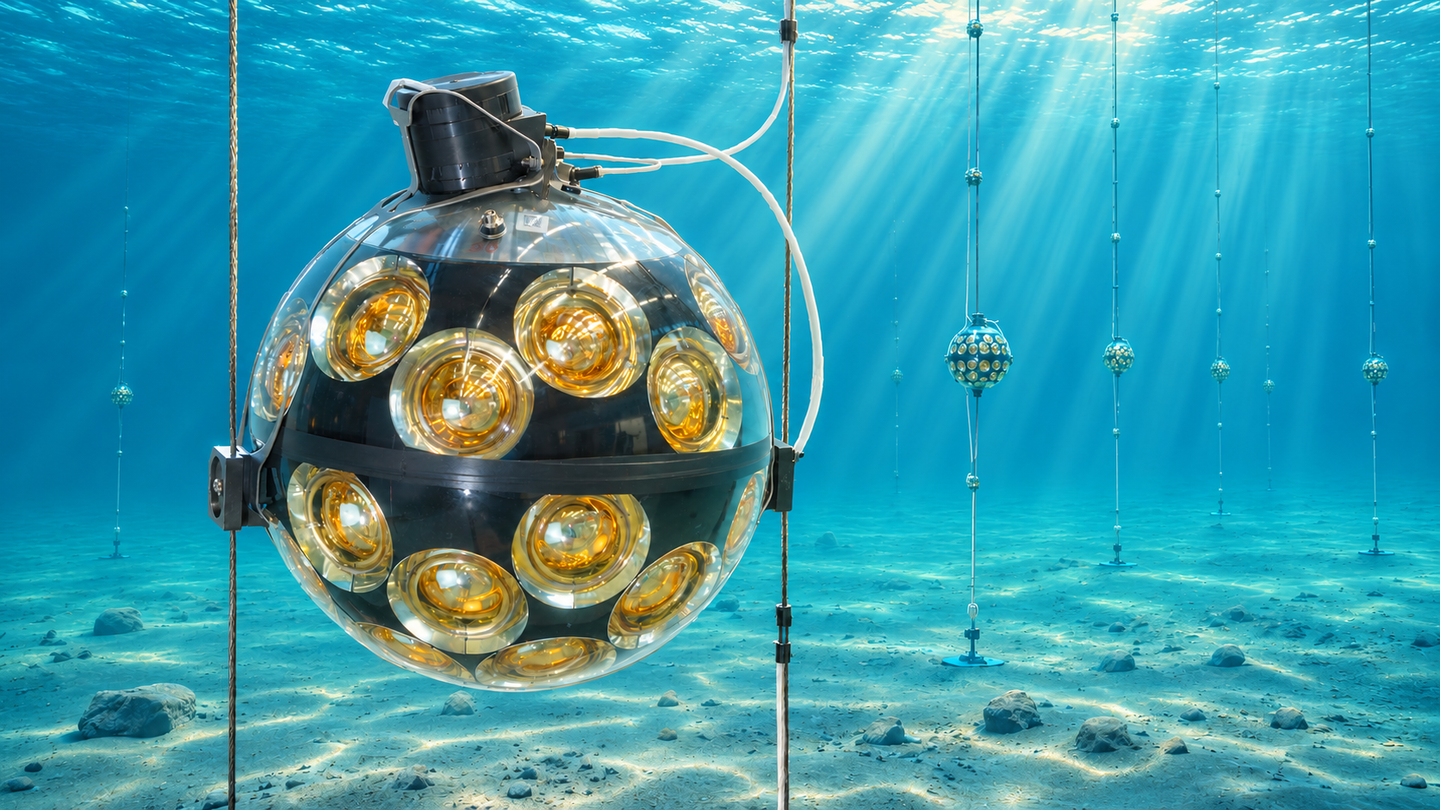
Artist’s visualization using the supplied detector photograph shows KM3NeT optical modules above the Mediterranean seabed. ORCA’s neutrino observations helped researchers test Lorentz invariance, a cornerstone of Einstein’s relativity. (CREDIT: The Brighter Side of News)
- KM3NeT/ORCA analyzed 5,828 atmospheric neutrino candidate events and found no evidence of Lorentz invariance violation.
- The results set new limits on possible departures from standard behavior, including specific effects involving muon and tau neutrinos.
- The early detector configuration used only six detection units, leaving room for more sensitive searches as the telescope expands.
Deep beneath the Mediterranean Sea, a neutrino telescope has tested a principle central to Einstein’s relativity. The result did not reveal a breakdown in the expected physics. Instead, it narrowed the room for certain possible departures, using particles that can travel through Earth with remarkably little interference.
The international KM3NeT collaboration analyzed 5,828 atmospheric neutrino candidate events recorded by its ORCA detector. The study, published in the Journal of Cosmology and Astroparticle Physics, found no evidence of Lorentz invariance violation. Its measurements nevertheless established new experimental limits, including first direct constraints on particular effects involving muon and tau neutrinos.
The search connects two major questions: how well Einstein’s principles survive experimental tests and whether neutrinos can reveal new physics. Here, the useful information comes from agreement with predictions, rather than a discovery that overturns them.
What a Lorentz invariance test actually asks
Lorentz invariance concerns the laws of physics retaining their form when observers change orientation or move uniformly relative to one another. It underpins relativity and plays a central role in modern particle physics. Testing that symmetry asks whether nature follows those expectations within the conditions an experiment can examine.
The motivation reaches into the search for quantum gravity, a framework that would reconcile general relativity with quantum physics. Some theoretical approaches suggest spacetime might consist of extremely small, discrete units rather than a continuous structure. Certain possibilities could produce departures from Lorentz invariance, giving experiments something measurable to seek.
“We still don't know whether our spacetime is continuous or might be discrete,” said Alba Domi, one of the study’s corresponding authors. Domi researches at the Erlangen Centre for Astroparticle Physics, part of Friedrich-Alexander-Universität Erlangen-Nürnberg. “Looking for violations of Lorentz invariance is one way to investigate this possibility.”
That leaves an important distinction. A search for departures from Lorentz symmetry does not assume such departures exist. Nor would this single result settle every question about the structure of spacetime; it tests particular effects that the observations could reveal.
Neutrinos carry a changing identity
Neutrinos rarely interact with matter, allowing them to travel enormous distances and pass through Earth. They also change between types, known as flavors, as they travel. Scientists call that behavior neutrino oscillation, and its predicted pattern gives researchers a way to look for unexpected effects.
The probability of those transformations depends on the physical description used to calculate them. Researchers can compare the expected pattern with observations and ask whether an additional effect improves the explanation. A departure might point toward new physics, although an unexplained difference would still require careful investigation.
For this analysis, the team used 1.4 years of observations from ORCA’s first six detection units. They compared the candidate events’ reconstructed energies and arrival directions with theoretical predictions. Together, those measurements allowed them to investigate possible distortions of the usual oscillation pattern.
The approach uses neutrino behavior as an experimental probe, rather than relying on a direct picture of spacetime. It also illustrates why a neutrino detector can investigate questions beyond simply establishing that particles passed through its surroundings. Their collective behavior carries the information needed for the test. The analysis is therefore about a pattern across candidate events, not an unusual particle singled out as proof of a broken law. Researchers ask whether the energy and directional distributions require something beyond the standard description, while retaining the distinction between a candidate sample and individually certain identifications.
No violation, but less room for certain effects
The analysis found no evidence that Lorentz invariance failed. That outcome sets upper limits on how large certain departures could be while remaining compatible with the observations. It does not demonstrate that every possible violation is impossible, or that future experiments must produce the same answer.
One result concerns particular effects associated with muon and tau neutrinos. The collaboration reports first upper limits on specific isotropic diagonal coefficients, quantities describing possible flavor-dependent departures in the model. In plain terms, these constrain certain differences in how the proposed new effects would influence those two flavors.
The atmospheric-neutrino approach also avoids assumptions about the starting flavor proportions of neutrinos from astronomical sources. That gives these particular limits a different foundation from constraints that depend on such assumptions. The claim of a first result therefore applies to those specific quantities, rather than every test involving muon and tau neutrinos.
This is the measured value of a null result in neutrino research: it restricts a possible explanation without claiming to close the subject. Other tests of Lorentz invariance examine different observations, making the broader search a combination of complementary measurements.
Six detection units already offer useful sensitivity
The findings are competitive with results from established experiments including IceCube and Super-Kamiokande. That comparison is encouraging because ORCA was operating with a partial configuration when these data were collected. Its six detection units represented an early stage of a telescope still under construction.
“These results show the potential of KM3NeT/ORCA to test fundamental principles of physics, even with a relatively small detector,” said Lukas Hennig. A PhD student at ECAP, Hennig is the other corresponding author. “With more data and an expanding detector, we will be able to search for even smaller effects.”
More observations and a larger instrument offer a path toward improving sensitivity. However, that prospect should remain distinct from the present result: the published analysis concerns the six-unit configuration and its 1.4-year dataset. The limits describe what those measurements establish, rather than what a completed detector might eventually achieve.
The work adds another use for instruments already advancing neutrino astronomy. While telescopes can use neutrinos to investigate their astrophysical sources, ORCA’s atmospheric sample addresses a different question: whether the particles follow the expected transformation pattern.
ARCA could extend the search to higher energies
The researchers hope to take this investigation to KM3NeT/ARCA, which targets much higher-energy neutrinos from distant astrophysical sources. Some proposed Lorentz-violating effects become more pronounced at higher energies and over longer distances. Such particles could therefore offer another route to testing the same fundamental symmetry.
“ARCA could be particularly well suited to this kind of research, but we don't yet have enough astrophysical neutrino events to perform such an analysis,” Domi said. That limitation matters even after record-energy neutrino observations: a striking detection and a sufficient sample for this analysis are different achievements.
The wider field received recognition through the 2026 Nobel Prize in Physics, awarded to Francis Halzen for contributions to IceCube and discovering high-energy astrophysical neutrinos. Those particles have opened a way to study the universe through neutrino signals, alongside their potential for fundamental tests.
The ORCA analysis formed part of Domi’s Marie Skłodowska-Curie Postdoctoral Fellowship, QGRANT, funded through the European Union’s Horizon Europe program. Its result leaves Lorentz invariance standing within the tested conditions. The next task is to gather enough information to examine smaller effects, without mistaking a tighter limit for a final answer.
Dig deeper into neutrinos and Lorentz invariance
These resources explain the wider neutrino field, earlier symmetry tests and the detector measurements behind this research.
The Nobel Prize in Physics 2026: Elusive particles from the universe captured at the South Pole: Explains Francis Halzen’s recognition and the development of high-energy neutrino astronomy. (Royal Swedish Academy of Sciences, October 2026).
Observation of an ultra-high-energy cosmic neutrino with KM3NeT: Describes an exceptionally energetic neutrino event and its reconstruction with the underwater telescope. (Nature, February 2025).
Measurement of neutrino oscillation parameters with the first six detection units of KM3NeT/ORCA: Examines standard oscillation measurements using ORCA’s early six-unit configuration. (Journal of High Energy Physics, October 2024).
Neutrino interferometry for high-precision tests of Lorentz symmetry with IceCube: Reports an earlier search for anomalous atmospheric-neutrino oscillations as evidence of Lorentz violation. (Nature Physics, July 2018).
Test of Lorentz invariance with atmospheric neutrinos: Presents a Super-Kamiokande investigation of possible Lorentz-violating neutrino oscillations. (Physical Review D, March 2015).
Featured image caption: Artist’s impression of underwater neutrino detector units, illustrating the Mediterranean telescope used to test Lorentz invariance with atmospheric neutrinos.
15 tags
Research findings are available online in the Journal of Cosmology and Astroparticle Physics.
The original story "Underwater neutrino telescope puts Einstein’s theory of relativity to a new test" is published in The Brighter Side of News.
Related Stories
- New high-res black hole images challenge Einstein's theory of relativity
- Scientists rework Schrödinger's cat equation to unite Einstein's relativity and quantum mechanics
- Breakthrough theory links Einstein’s relativity and quantum mechanics
Like these kind of feel good stories? Get The Brighter Side of News' newsletter.
Joseph Shavit
Writer, Editor-At-Large and Publisher
Joseph Shavit, based in Los Angeles, is a seasoned science journalist, editor and co-founder of The Brighter Side of News, where he transforms complex discoveries into clear, engaging stories for general readers. With vast experience at major media companies like The Los Angeles Times, Times Mirror and Tribune Publishing, he writes with both authority and curiosity. His writing focuses on space science, planetary science, quantum mechanics, geology. Known for linking breakthroughs to real-world markets, he highlights how research transitions into products and industries that shape daily life.