3D scans reveal surprising differences between Neanderthal and Homo sapien feet
A 3D comparison of seven Neanderthal heels and 64 human counterparts suggests a distinctive foot posture suited to heavy loads, while revealing how lifestyle may influence skeletal shape.
 Università di Bologna Writer: Matteo Benni

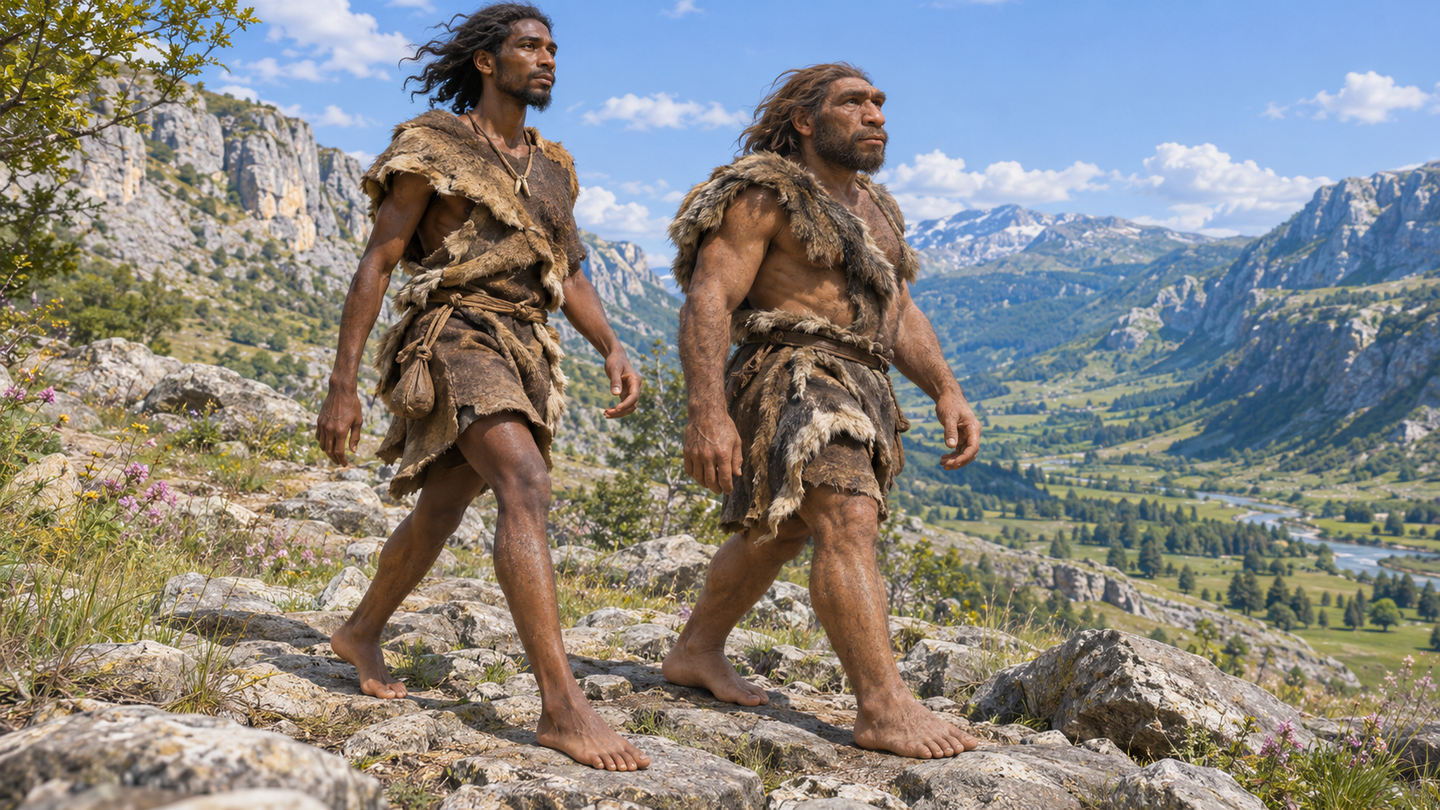
Artist’s reconstruction of an early Homo sapiens (left) and a Neanderthal (right) crossing rocky terrain. Heel-bone comparisons suggest differences in how their feet supported body weight and adapted to demanding movement. (CREDIT: The Brighter Side of News)
- Three-dimensional scans of seven Neanderthal heel bones suggest feet suited to heavy loads and demanding terrain.
- Joint shapes support habitual pronation and possibly lower arches, although the researchers say the arch hypothesis needs further testing.
- Comparisons with 64 Homo sapiens individuals also point to the influence of activity and footwear on heel anatomy.
Neanderthals may have met rough ground with feet that rolled inward and had lower arches than ours. A new analysis suggests that this configuration helped their stocky, highly active bodies handle heavy loads and uneven terrain. The familiar label “flat feet” captures part of the idea, but the evidence concerns ancient bone shape and probable function.
Researchers compared the three-dimensional external shape of seven Neanderthal heel bones with those of 64 Homo sapiens individuals. Their study in the Journal of Human Evolution identifies a distinctive combination of proportions and joint surfaces. It adds to evidence that Neanderthal anatomy reflected demanding lives, while challenging outdated pictures of our ancient relatives.
Rita Sorrentino, now at the University of Palermo, led the research, which Maria Giovanna Belcastro coordinated at the University of Bologna. Belcastro is a professor in its Department of Biological, Geological, and Environmental Sciences. The work examines how evolutionary inheritance and everyday physical demands combined to shape a bone central to walking.
Neanderthal heel bones reveal a distinctive shape
The heel bone, or calcaneus, absorbs forces and helps transmit them as the body moves forward. Its proportions and connections with neighboring bones offer clues to locomotion. Like research on the evolution of the human pelvis, the analysis connects skeletal structure with the mechanics of moving on two legs.
The team used digital models derived from laser, structured-light and computed tomography scans. Three-dimensional geometric morphometrics allowed comparisons of the whole bone and specific regions, including joint surfaces and the rear projection where the Achilles tendon attaches. This approach examines spatial relationships that a few conventional measurements can miss.
Compared with the Homo sapiens groups, Neanderthals had a relatively shorter, wider and taller calcaneus. Their overall bone size nevertheless fell within the human range. The distinction therefore involves proportions and shape, rather than simply a larger heel, a useful point when interpreting differences among ancient human fossils.
“The robustness of the heel reflects the overall body structure of Neanderthals, which is characterized by a remarkable muscular and bone mass and an extremely intense level of physical activity,” Belcastro said. The researchers interpret the robust configuration as consistent with greater rearfoot loading and high mobility.
What the findings suggest about flat feet
The most striking clues involve the joints above and in front of the heel. Neanderthal joint surfaces differed in shape and orientation from those of many human comparisons. Together, these features support a foot posture that was habitually pronated, meaning the foot tended to roll inward during weight bearing.
The researchers also suggest a lower lateral longitudinal arch, which runs along the outside of the foot. A different arrangement of the joint connecting the heel and cuboid bones may have allowed a different balance between mobility and stability. Such variation matters because human walking mechanics depend on coordinated movements across several joints.
That interpretation does not establish that Neanderthals had the same condition as a living patient diagnosed with flatfoot. The paper describes the arch hypothesis as suggestive and calls for further investigation combining shape analysis with three-dimensional movement modeling. Fossil anatomy provides indirect evidence of posture, rather than a recording of an actual step.
This distinction fits a broader lesson from ancient footprints: different kinds of evidence answer different questions. Heel shape can support a functional explanation, but it cannot independently establish every movement, the complete arch profile or whether an individual experienced symptoms.
Flexible feet could help on uneven ground
A foot must provide support while also adjusting to the surface beneath it. On irregular terrain, some freedom to tilt and accommodate changing contact points can help maintain balance. The study proposes that Neanderthals achieved this through a configuration suited to their body mass and habitual mechanical demands.
“These physical characteristics indicate an adaptation aimed at promoting a greater load-bearing capacity on the back of the foot and a high mobility on uneven ground,” Belcastro said. The proposed benefit concerns stability and force management, rather than a claim that one foot type performs best in every setting.
That matters when placing the findings beside evidence of Neanderthal activities. Bone form can illuminate the physical context of daily life, but it cannot identify a particular hunting trip, distance traveled or mountain crossed. The researchers instead infer patterns of loading accumulated through life.
The foot also acts as a lever during push-off, so flexibility has to coexist with effective force transmission. The paper discusses possible compensating features that could support stability despite differences in arch structure. As research on different forms of early upright walking shows, bipedal locomotion can involve varied anatomical solutions.
Human heels also carry signs of lifestyle
The comparison group spans prehistoric hunter-gatherers, Iron Age farmers and foragers, and a postindustrial population from Bologna’s Certosa Cemetery. Some features in highly mobile human groups resembled Neanderthal traits more closely than those in the relatively sedentary urban group. The pattern suggests that species identity alone does not explain heel variation.
The postindustrial group had more gracile, or lightly built, calcanei. The researchers associate this pattern with reduced mobility and habitual footwear use. Rigid footwear can limit side-to-side movements, changing the mechanical demands experienced by bones. These associations offer context for the wider history of human walking.
However, the study did not experimentally assign shoes or activity levels. Ancestry, nutrition and environment can also contribute to shape differences. Describing modern heels as universally “weaker” would go beyond the measurements, which examined external morphology rather than directly testing how much force each bone could withstand.
Comparisons across populations are therefore essential. A recent urban skeleton cannot automatically stand in for every Homo sapiens individual across time. Just as new fossil discoveries revise human evolutionary history, a broader range of human reference samples can change how researchers interpret ancient anatomy.
A clearer picture still needs more evidence
The study’s seven Neanderthals provide a limited window into an entire species. Some missing fossil regions required reconstruction, and the sample did not allow a statistical assessment of sex differences within groups. These constraints matter when deciding how widely the observed patterns apply. Larger fossil samples and better-preserved specimens would help researchers separate variation among individuals from features shared more broadly across Neanderthals.
The authors also distinguish features potentially inherited from earlier ancestors from those reflecting Neanderthal-specific evolution or responses to loading. Their findings add another anatomical perspective to the early history of bipedalism, without reducing every trait to one explanation.
“The morphology of our skeleton is not only the product of a strict genetic program, but also the consequence of physical stimuli and our daily life habits,” Belcastro said. Further movement modeling could test how the proposed joint configuration affected stability and force transmission.
The result is a more detailed view of how Neanderthals moved through their surroundings. Alongside research on their family and community lives, it helps replace a generic portrait with evidence about bodies shaped by particular demands, while keeping the unresolved questions visible.
Dig Deeper
How shoes change our bones, and what that tells us about how our ancestors walked: CT comparisons of ankle bones from barefoot and shoe-wearing populations show how behavior can alter internal bone structure and influence fossil interpretation. University of Chicago, October 2026.
Heel-strike mechanics reveal evolutionary trade-offs in hominin bipedalism: Measurements of humans and chimpanzees examine how heel-first steps affect impact forces and the mechanical demands of upright walking. Proceedings of the National Academy of Sciences, September 2026.
Morphological and evolutionary insights into the keystone element of the human foot’s medial longitudinal: archComparative analysis of the navicular bone explores variation in the inner arch, including features observed in Neanderthals and modern human foot types. Communications Biology, October 2023.
Unique foot posture in Neanderthals reflects their body mass and high mechanical stress: An overview of earlier talus research explains evidence for pronated Neanderthal feet and the possible roles of body mass, mobility and evolutionary history. University College London, February 2022.
Stiffness of the human foot and evolution of the transverse arch: Experiments and modeling investigate how the arch across the foot contributes to stiffness, broadening the discussion beyond longitudinal arches. Nature, February 2020.
Research findings are available online in the Journal of Human Evolution.
The original story "3D scans reveal surprising differences between Neanderthal and Homo sapien feet" is published in The Brighter Side of News.
Related Stories
- Neanderthals began life more like humans than scientists thought
- Neanderthals practiced dental care 59,000 years ago
- Humans and Neanderthals share ancient DNA linked to human language
Like these kind of feel good stories? Get The Brighter Side of News' newsletter.
Joseph Shavit
Writer, Editor-At-Large and Publisher
Joseph Shavit, based in Los Angeles, is a seasoned science journalist, editor and co-founder of The Brighter Side of News, where he transforms complex discoveries into clear, engaging stories for general readers. With vast experience at major media companies like The Los Angeles Times, Times Mirror and Tribune Publishing, he writes with both authority and curiosity. His writing focuses on space science, planetary science, quantum mechanics, geology. Known for linking breakthroughs to real-world markets, he highlights how research transitions into products and industries that shape daily life.