ETH Zurich’s new FlexiQuad drone can survive collisions and fly at up to 80 km/h
FlexiQuad replaces a rigid drone body with a flexible ring that absorbs impacts, grasps objects and packs compactly for transport.
 ETH Zurich Writer: Deborah Kyburz

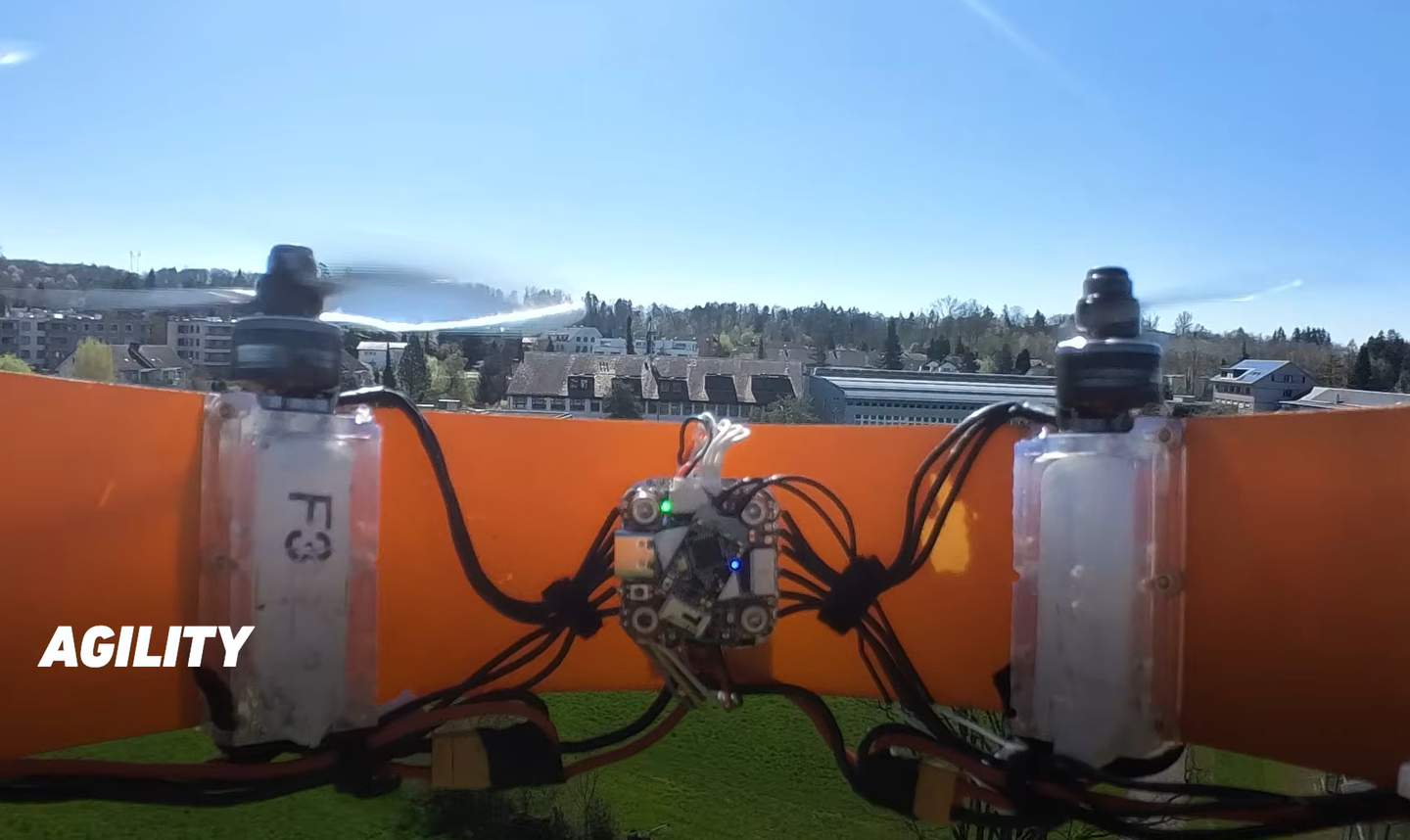
FlexiQuad’s flexible ring frame deforms during contact, helping the aircraft absorb impacts while preserving the stiffness needed for flight. (CREDIT: ETH Zurich)
- FlexiQuad’s flexible ring frame absorbs impacts, allowing the drone to keep flying after laboratory collisions.
- The prototype flies at up to 80 km/h, while collision tests reached approximately 25 km/h.
- Researchers envision rescue and inspection missions, but reliable autonomous operation outside the laboratory still needs development.
A collision with a wall can end a drone’s mission in an instant. FlexiQuad takes a different approach: its frame bends, absorbs part of the impact and allows the aircraft to keep flying. The design could make unexpected contact less costly for drones working in crowded surroundings.
Developed at ETH Zurich, the aircraft replaces a conventional rigid central body with a soft ring. Its rotors, batteries and control module sit along that frame. The open center and deformable structure give it options beyond the usual demands of agile flight and robotic navigation.
Luca Girardi and Stefano Mintchev developed FlexiQuad at the Environmental Robotics Lab. Girardi now researches at ETH’s Mobile Robotics Lab, while Mintchev holds a professorship in Agricultural Robotics at the University of Bonn. They have filed a patent application, and the invention has received a nomination for the 2026 Spark Award.
A flexible drone that bends in selected directions
A soft frame might seem an unlikely foundation for precise flight. The researchers addressed that problem by making the ring flexible in some directions and stiffer in others. Its response depends on which way a force acts, allowing the structure to serve two different purposes.
The design takes inspiration from birds and insects, whose wings combine support with controlled bending. FlexiQuad flexes laterally during contact, where deformation can absorb collision energy. Vertically, it remains stiffer so the rotors can transmit the forces needed to keep the aircraft airborne.
That balance connects two familiar robotics goals: drawing ideas from living creatures and making machines physically adaptable. FlexiQuad applies those ideas to the aircraft’s structure, using its frame to manage contact rather than leaving the entire problem to obstacle detection.
A technical preprint describing FlexiQuad provides further detail on the design. The central question is how much flexibility a flying robot can use while retaining control. Like other work on softer robotic structures, the approach treats material behavior as part of what the machine can do.
Fast flight and collision tests measure different abilities
Flexibility has not prevented the prototype from moving quickly. “Our drone is very agile and can fly at speeds of up to 80 km/h. It reaches linear and angular accelerations comparable to those of rigid drones. Soft doesn’t automatically mean slow,” Girardi said.
The collision experiments involved lower speeds, reaching approximately 25 km/h. Researchers flew FlexiQuad into obstacles and observed the frame deform briefly, reducing the forces acting on the aircraft. It could then continue flying, demonstrating a benefit beyond simply surviving contact without breaking.
Those two speeds describe separate tests. The reported 80 km/h figure concerns flight performance, while approximately 25 km/h describes the collision trials. Girardi said the available space to accelerate before impact mainly limited the collision-test speed; that does not establish performance at higher impact speeds.
The distinction matters when considering fast-moving aerial robots in difficult surroundings. A drone’s speed, ability to withstand contact and control in unfamiliar environments remain separate parts of a successful mission. FlexiQuad addresses the physical consequences when avoidance fails. Girardi points to missions that require covering long distances quickly: sensors may recognize a tree too late to prevent contact. A frame that tolerates the resulting impact could permit flight speeds that would otherwise put the mission at greater risk. That potential depends on more than detecting obstacles; it also depends on what happens when the aircraft reaches one.
Squeezing through openings and carrying supplies
The patent describes possible uses in ships’ ballast tanks, collapsed buildings and dense forests. These environments combine obstacles with reasons to send instruments or cameras somewhere people may struggle to reach. Flexibility could help a drone pass through openings narrower than its normal shape allows.
That could offer an advantage during inspections. A larger aircraft might carry additional sensors and remain airborne longer, while still deforming to negotiate a tight passage. The researchers present that as a potential benefit, rather than an established capability of a deployed inspection service.
The ring can also grasp objects. In tests, FlexiQuad picked up, carried and placed down a soft first-aid kit, and it lifted a payload heavier than itself. Those demonstrations suggest a possible role in rescue operations as well as robotic handling of objects.
Girardi also proposes placing a net inside the hollow center to capture unwanted drones. That remains a possible application, distinct from the demonstrated transport tests. The same open structure therefore supports several ideas, but each would need development for its intended working environment.
A low-cost frame that packs into a suitcase
FlexiQuad’s airframe materials cost less than 15 Swiss francs, with scope for further reductions. That figure concerns the frame materials, rather than the price of an entire functioning aircraft. The rotors, batteries and control electronics are additional components of the system.
The design also allows compact transport. Opening the ring lets its flat frame elements pack into a smaller space. Girardi has already carried a prototype in a medium-sized suitcase, offering a practical demonstration of that storage arrangement.
Quick-release fasteners and slide-in batteries could eventually allow rapid assembly at a mission site. The emphasis on modular construction fits the proposed work in difficult places, where equipment must first reach the operating location. However, the suggested assembly system remains a future possibility.
Portability alone would not make the drone ready for autonomous inspection or search-and-rescue work. The aircraft also needs dependable perception and navigation. Those requirements lead directly to another challenge created by its flexible body.
Learning to settle down after an impact
After contact, the frame can oscillate, blurring camera images and making navigation harder. Surviving a collision therefore leaves a second task: recovering a stable enough state to continue useful autonomous flight. The body’s ability to bend creates both the advantage and the control problem.
In their latest work described by ETH Zurich, Girardi and colleagues used reinforcement learning to teach a recovery sequence inspired by natural reflexes. FlexiQuad first stabilizes itself using onboard motion sensors after an impact. It then returns to autonomous flight, separating the immediate recovery from the next stage of navigation.
The team is also investigating whether bending and vibration could become useful feedback. Inspired by insects sensing changes in their wings, researchers are exploring measurements of the frame itself. This possibility connects biologically inspired sensing with the broader challenge of robots learning to control their motion.
Girardi has worked on the drone for around five years. “At first, I was sceptical whether the drone would fly without the central reinforcement. But I really liked the approach. Then we tried it – and it worked.” Reliable operation beyond the laboratory is still ahead, but that first flight established the design’s starting point.
Dig deeper into flexible drones and autonomous flight
These resources explore adaptable aircraft structures, insect-inspired flight and navigation through challenging surroundings.
MIT engineers design an aerial microrobot that can fly as fast as a bumblebee: Explains how a new controller enabled agile maneuvers in an insect-scale flying robot. (Massachusetts Institute of Technology, December 2025).
Champion-level drone racing using deep reinforcement learning: Examines learned control for high-performance autonomous drone racing. (Nature, August 2023).
Swarm of micro flying robots in the wild: Describes autonomous small drones navigating cluttered surroundings using onboard sensing and planning. (Science Robotics, May 2022).
Learning high-speed flight in the wild: Investigates learned navigation for fast flight through challenging environments. (Science Robotics, October 2021).
The Foldable Drone: A Morphing Quadrotor That Can Squeeze and Fly: Presents an earlier aircraft with folding arms for narrow passages, inspection and object transport. (IEEE Robotics and Automation Letters, December 2018).
The original story "ETH Zurich’s new FlexiQuad drone can survive collisions and fly at up to 80 km/h" is published in The Brighter Side of News.
Related Stories
- Researchers power drones using ground-based green laser light
- New Phantom Twist drone spins so quickly that it virtually disappears
- Tiny flapping drone matches insect speed with an AI brain
Like these kind of feel good stories? Get The Brighter Side of News' newsletter.
Joshua Shavit
Writer and Editor
Joshua Shavit is a NorCal-based science and technology writer with a passion for exploring the breakthroughs shaping the future. As a co-founder of The Brighter Side of News, he focuses on positive and transformative advancements in technology, physics, engineering, robotics, and astronomy. Having published articles on AOL.com, MSN, Yahoo News, and Ground News, Joshua's work highlights the innovators behind the ideas, bringing readers closer to the people driving progress.