Zinc-iodine cells could enable larger capacity, safer, water-based batteries
A redesigned electrolyte doubles iodine’s theoretical charge capacity and keeps zinc–iodine test cells working through thousands of cycles.
 UCL Writer: Mark Greaves

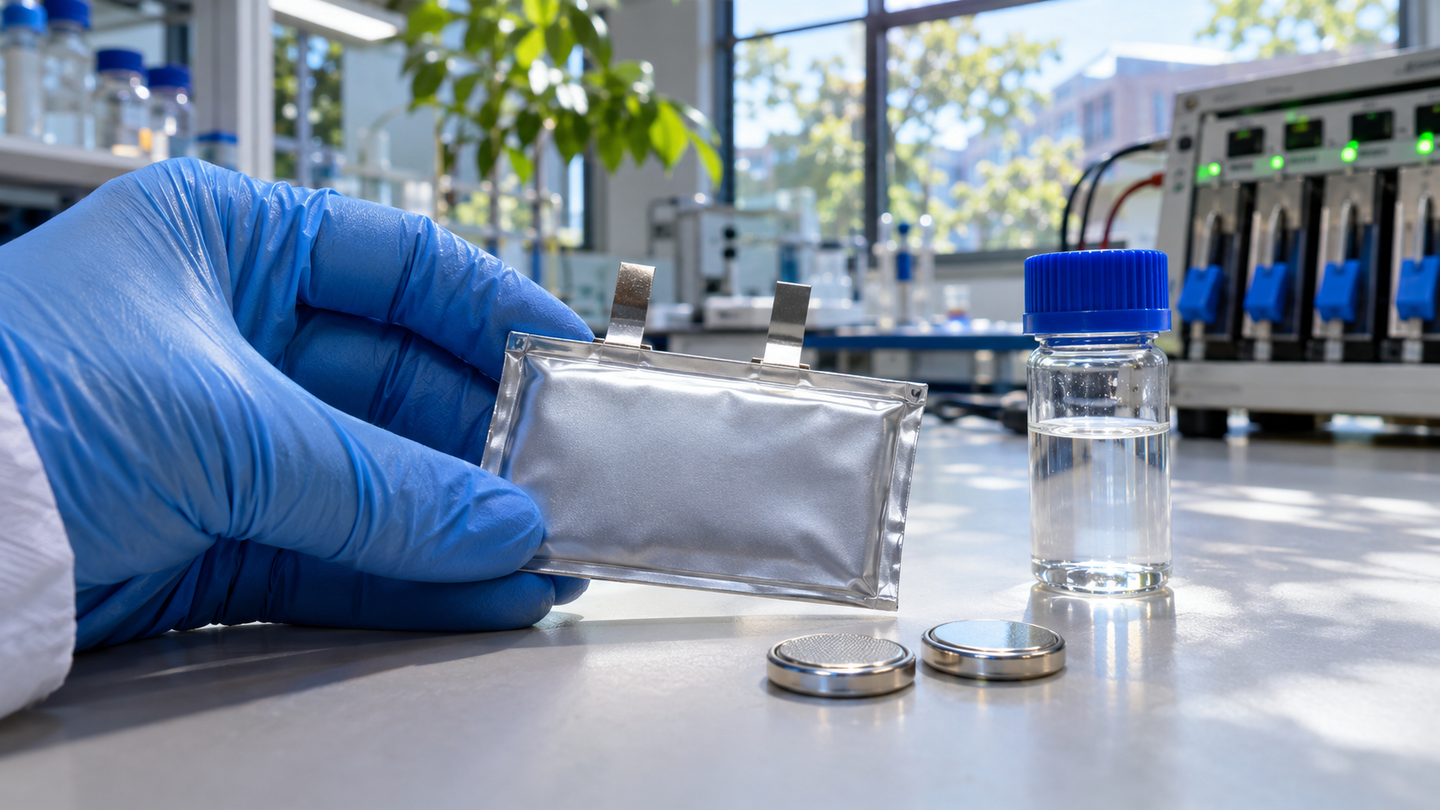
A University College London-led team tested its new iodine battery chemistry in both formats. In one lab test, zinc–iodine cells retained 94% of their charge capacity after 2,000 cycles. (CREDIT: The Brighter Side of News)
- A new water-based electrolyte lets iodine transfer four electrons per molecule over a full conversion, doubling the theoretical charge it can store.
- Zinc–iodine test cells retained 94% of their capacity after 2,000 charge and discharge cycles under one laboratory test condition.
- The chemistry worked in coin and pouch cells. Larger tests will determine whether it can meet the demands of grid storage.
A battery that stores surplus wind or solar power has to give much of that power back, day after day. Water-based batteries offer a way to do that with electrolytes that generally pose less of a flammability risk than the organic liquids used in conventional lithium-ion cells. But storing enough energy in a practical amount of material remains a challenge.
Researchers at University College London took aim at that problem by changing how iodine reacts inside a rechargeable battery. In Nature, first author Ruwei Chen, corresponding author Guanjie He and their colleagues reported an electrolyte that allows an iodine molecule to exchange four electrons across two reaction steps. The usual iodine reaction involves two.
The result opens a different path for water-based batteries. The team demonstrated the chemistry in small cells, including a pouch format, and showed that it could be adapted to a cell using an aluminum–zinc alloy. The experiments add to the search for lithium alternatives that could work for stationary storage.
How iodine stores more charge in water-based batteries
In a conventional zinc–iodine cell, the positive electrode cycles between molecular iodine and iodide, the negatively charged form of the element. One iodine molecule contains two atoms. Each can take up one electron as the molecule converts to iodide, so the reaction can exchange two electrons. Charging reverses the process.
The second step takes iodine past its neutral state into a positively charged form. That adds another two electrons of exchange per iodine molecule over the full conversion. The theoretical capacity rises from 211 to 422 milliampere-hours per gram of iodine. The additional reaction also occurs at a higher potential, which matters because energy depends on both charge and voltage.
Those figures describe the active iodine. A complete cell also has a negative electrode, a separator, current collectors, packaging and an electrolyte. All of them add weight and volume. When comparing battery technologies for the grid, engineers would need to compare how much energy entire systems deliver and how much those systems cost to build and operate.
Getting iodine to pass through that extra reaction is only part of the job. A battery needs iodine to return through the same stages during discharge, and it needs the process to work repeatedly. Earlier efforts to raise the voltage of aqueous batteries illustrate how much the choice of electrolyte can influence which reactions a cell can use.
Keeping water away from reactive iodine
The trouble starts when positively charged iodine encounters water. It can react with water in ways that undermine the battery’s ability to reverse the reaction. Earlier four-electron designs relied on concentrated chloride or bromide electrolytes to stabilize that form of iodine. High salt concentrations and corrosion complicate efforts to turn those designs into products.
Chen and colleagues changed the environment at the electrode surface, where the reaction takes place. One set of dissolved ions helped reduce the amount of water in that narrow region. Another weakened interactions between water and the molecules the team wanted to bind to iodine. Those molecules could then form bonds with the positively charged iodine and help keep it available for the reverse reaction.
The water-based liquid continued to carry charge through the cell. The changes mattered most at the point where the liquid met the electrode, where the team needed to control which molecules surrounded iodine. Spectroscopy during cycling helped the researchers follow the iodine complex as it formed and disappeared. This way of controlling reactions could be useful in other battery designs that have to operate in water.
“Our study shows that making iodine batteries rechargeable isn't just about keeping the key chemicals stable,” Chen said. “We also need to understand how they interact with the water-based electrolyte and how those interactions change as the battery charges and discharges.” Similar questions about the behavior of active materials arise in other energy storage research.
What happened after 2,000 cycles
In one lab test, zinc–iodine cells retained 96% of their capacity after 1,000 cycles. In another test at twice the current per gram of active material, cells retained 94% after 2,000 cycles. Capacity retention compares how much charge a cell can hold at the end of the test with the amount it could hold at the start.
In a separate set of lab tests, the researchers also tested different current collectors, the components that conduct electrons between an electrode and the external circuit. They demonstrated the electrolyte in coin and pouch configurations and extended the concept to an aluminum–iodine cell with an aluminum–zinc alloy at the negative electrode. Those tests show how the chemistry can work across different cell designs.
Some iodine still became unavailable for later cycles. The team found that irreversible iodine loss became more pronounced at higher iodine loadings. Loading more active material onto each unit of electrode area is one route to storing more energy in a cell of a given size. Retaining that iodine will matter if engineers want to put more material to work without sacrificing durability.
The reported cycle counts also need context. A cycle test tracks changes in capacity as a cell repeatedly charges and discharges. It leaves open how the same cell will age over years, especially when it spends long stretches at a high state of charge. It also measures a different property from energy efficiency, which compares how much energy comes out with how much went in.
For stationary storage, those differences matter because batteries may sit idle between periods of heavy use. The range of formats gives researchers a starting point for making larger test cells that can answer those questions.
Practical implications
For water-based batteries, grid operators need to weigh cost, lifetime, how much power a system can deliver and how much energy it gives back. For renewable power, they also need storage that works across changing patterns of demand. A useful next test would measure larger cells under schedules that include periods of charging, discharging and sitting idle.
The researchers modeled potential cost reductions from avoiding highly concentrated electrolytes and some expensive current collectors. Commercial costs would depend on whether manufacturers can produce the cells consistently and use them for long enough to recover the expense of installation. Safety and environmental comparisons with other rechargeable batteries would also need to account for the whole system, including materials, packaging and end-of-life handling.
The most consequential question for larger cells is whether they can hold more iodine and still cycle efficiently. If the electrolyte performs at higher loadings and under realistic operating conditions, the extra charge available from iodine could translate into more usable energy for stationary storage.
Dig deeper into aqueous iodine batteries
These resources explain the design of water-based cells and the work that led to rechargeable four-electron iodine chemistry.
Interfacial ion depletion at high concentration guides electrolyte design for aqueous aluminum–iodine batteries: Examines how electrolyte composition near the electrode influences aqueous aluminum–iodine reactions. (Joule, 2026)
A dilute kosmotropic eutectic electrolyte for practical four-electron aqueous Zn–iodine batteries: Tests a different electrolyte strategy for stabilizing reactive iodine while improving zinc electrode performance. (Energy Storage Materials, 2025)
Electroactive ferrocene/ferrocenium redox coupling for shuttle-free aqueous zinc–iodine pouch cells: Investigates how to keep iodine species from migrating through a pouch cell and contributing to capacity loss. (Nature Chemistry, 2025)
Designing modern aqueous batteries: Reviews the challenges of designing rechargeable batteries around water-based electrolytes. (Nature Reviews Materials, 2022)
A four-electron Zn–I₂ aqueous battery enabled by reversible I⁻/I₂/I⁺ conversion: Demonstrates an earlier route to the four-electron iodine reaction using a chloride-containing electrolyte. (Nature Communications, 2021)
Research findings are available online in the journal Nature.
The original story "Zinc-iodine cells could enable larger capacity, safer, water-based batteries" is published in The Brighter Side of News.
Related Stories
- Innovative 'water battery' produces safer, more affordable power for smart devices
- Scientists create fluid batteries that stretch without losing power
- Charging the future through better, safer and less expensive 'water batteries'
Like these kind of feel good stories? Get The Brighter Side of News' newsletter.
Shy Cohen
Writer