Laser-printed LEGO-like bricks offer a new way to build on the Moon
A laser turned simulated lunar dust into reusable blocks that fit together without glue. The prototype shows what needs to improve before lunar construction.
 University of Arkansas Writer: Todd Price

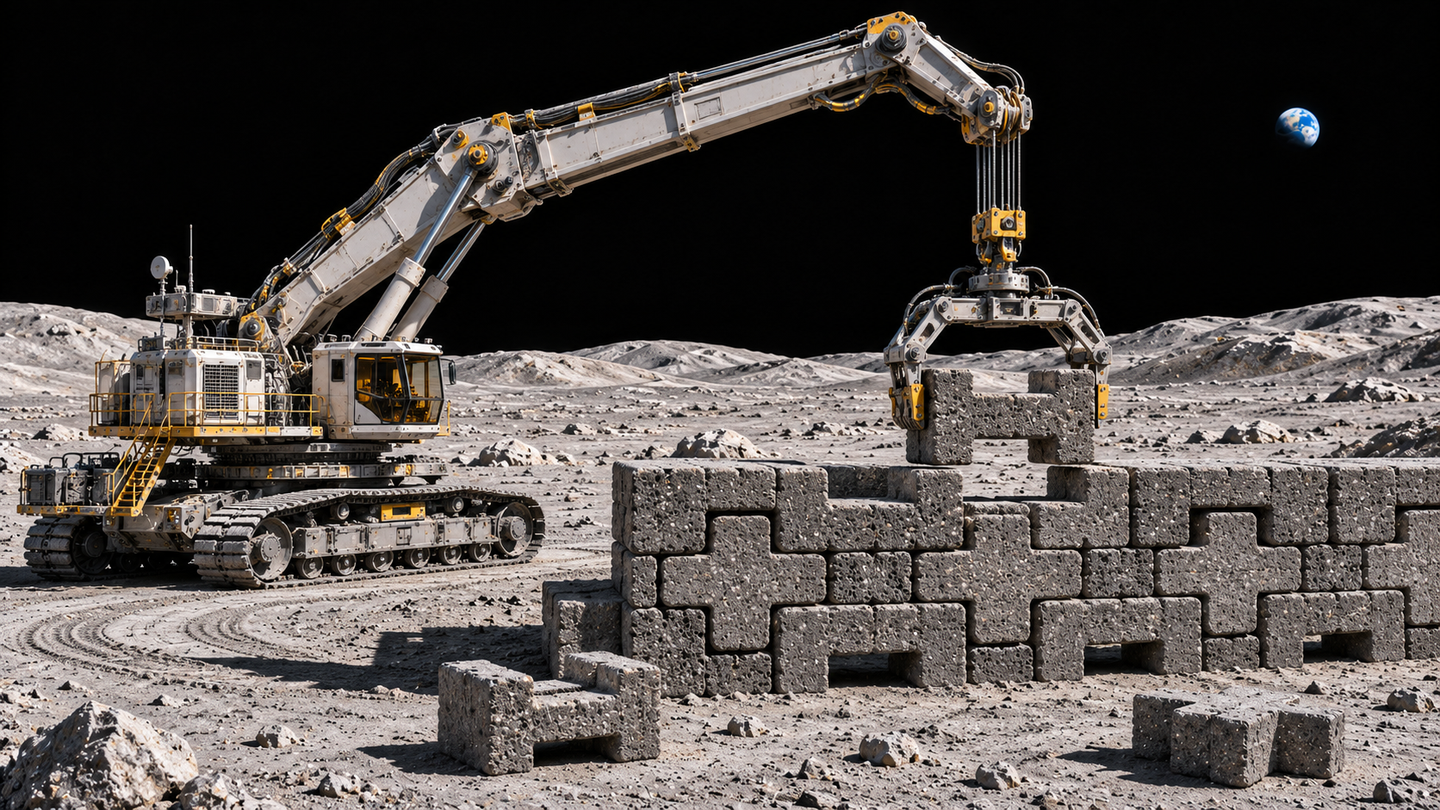
An artist’s impression shows a tracked lunar crane lowering an H-shaped brick into an interlocking wall on the Moon. The scene imagines a larger-scale use for the binder-free bricks University of Arkansas researchers made from simulated lunar dust on Earth. (CREDIT: The Brighter Side of News)
- Researchers used a laser to turn simulated lunar dust into interlocking bricks without adding a binder.
- The centimeter-scale blocks could be rearranged into small structures, while separate test cubes reached a peak compressive strength of about 3.4 megapascals.
- Making bricks from local material could cut shipments from Earth, but the process still needs testing in lunar conditions.
A wall on the Moon might start with a scoop of the gray material underfoot. In an Arkansas laboratory, researchers used a laser to fuse simulated lunar dust into small bricks. The pieces fit together to form a wall or shielding section, then came apart for reuse. No glue or cement went into the powder.
Cole McCallum, an undergraduate at the time, led the work with senior author Wan Shou at the University of Arkansas. Published in npj Advanced Manufacturing, the study explores a way to make modular parts for lunar habitats from material already on the Moon.
The team used a commercial powder formulated to mimic material from the lunar highlands. The difference matters because the composition of lunar regolith varies by location. What the experiment establishes is that the simulated material can hold together and form pieces that fit. How actual lunar material performs will depend partly on where it comes from.
How a laser turns loose powder into bricks
Lunar regolith forms as impacts break up the surface over billions of years. The result is a blanket of loose, often jagged mineral and rock fragments that can range from fine dust to larger particles. The experiment used Lunar Highlands Regolith Simulant, or LHS-1, straight from the supplier without adding another material or modifying its bulk composition.
The process begins with a thin bed of powder. A laser scans the shape of the first layer and heats the grains enough to join them. The bed then drops, more powder goes on top, and the laser repeats the pattern. Each pass creates another layer of the part. “There’s nothing else it’s binding to. The regolith powder is binding to itself,” McCallum said.
Some 3D printing methods mix a binding agent into the powder to make the finished material stronger or easier to shape. Skipping that step could reduce the supplies a mission has to bring. It also requires enough energy to fuse the mineral particles themselves. That trade-off is central to proposals that would put Moon dust to work at a future base.
The researchers varied the laser power and how quickly it moved. A slow pass can deliver more heat to the same spot, while a fast pass gives the grains less time to fuse. Finding settings that worked for a single layer gave the team a starting point for building thicker pieces. The tests also showed why keeping that process consistent matters. A new layer must hold together and attach securely to the layer beneath it.
Small pieces are easier to rearrange
The printed pieces were a few centimeters across. Some resembled crosses, while others looked like a capital H. Their shape lets one block engage with another without mortar. The team demonstrated assemblies in more than one direction, including examples of a wall and a shielding unit. Those were small demonstrations of how the pieces fit. The researchers did not measure how well the shielding assembly blocked radiation.
A modular approach could allow a crew or robot to print individual lunar components and assemble them where needed. If one piece breaks, the design could make it possible to replace that piece and keep the rest of the assembly. The same set of parts could also be rearranged as the needs of a worksite change.
The prototype exposed a problem that anyone who has handled loose-fitting toy bricks would recognize. Rough surfaces prevented some pieces from making close contact, so the joints could not engage as tightly as intended. Thermal protection for lunar structures raises other design demands. The bricks would have to work alongside whatever layers a future structure uses for insulation or other protection.
Making a wall from many small pieces changes what engineers need to test. The bricks must fit even when their dimensions vary slightly from one print to the next. A joint that works in a short demonstration could behave differently as more courses are stacked above it. Larger assemblies would offer a way to see how those small variations add up.
The strongest cubes still fell short
To measure strength, the team printed separate cubes about one centimeter on each side and squeezed them until they failed. The best result was about 3.4 megapascals in compression. The paper cites at least 10 megapascals as a practical target. The cube result describes the material under one kind of loading, and the strength of a full wall would also depend on how the joints behave.
Direction mattered, too. The study reports differences in mechanical properties of up to about fourfold depending on how researchers loaded the samples relative to the printed layers and scan directions. Some layers separated during fabrication or assembly. Those weak points could become especially important at the narrow sections of an interlocking brick, where the shape leaves less material to bear a load.
The team found that its higher-power sample had more connected material inside, even though overall porosity was similar. That suggests stronger bonds between neighboring scan lines and layers may matter as much as reducing the amount of empty space. A larger printer working with regolith simulant would need to maintain that consistency across a wider powder bed. Other printed lunar parts made with additives follow a different route to improving durability.
Practical implications
One way to evaluate the idea is to compare what a mission would ship for each approach. Printing locally would still require machinery, power and a way to collect and spread powder. The advantage would come from using that equipment repeatedly to turn material already on the surface into useful parts. Concentrated sunlight or a solar-powered laser could supply energy, an option the researchers identify for future work.
The team also proposes automating the steps between loading the powder and assembling the finished pieces. On the Moon, a printer would need to spread fresh layers reliably and keep delivering parts with predictable dimensions over many cycles. Those requirements may shape the equipment as much as the choice of laser.
Testing should also show how powder spreads in lunar gravity, how the process behaves in a vacuum and how the finished parts hold up through repeated heating and cooling. A laboratory demonstration under Earth conditions gives engineers a place to start those tests. Joint fit, layer strength and the repeatability of the printing process will all matter when builders move beyond blocks small enough to hold in one hand.
Early applications could be components that mainly need to support themselves. A wall carrying other loads would be a later test, and an occupied Moon base would bring requirements of its own. For now, the experiment answers a simpler question about building material on the Moon. A powder made to resemble it can become a set of reusable pieces with heat alone.
Dig deeper into lunar construction
These resources cover how researchers are testing lunar material for roads, bricks and other infrastructure.
Sintering of Lunar regolith: A review: Compares methods for fusing regolith and explains how mineral composition, grain size and packing affect the result. (Acta Astronautica, 2025)
Laser melting manufacturing of large elements of lunar regolith simulant for paving on the Moon: Researchers used a laser to make interlocking paving elements from simulated lunar material. (Scientific Reports, 2023)
How to make roads on the Moon: ESA describes how concentrated sunlight could fuse lunar dust into surfaces for roads and landing pads. (ESA, 2023)
NASA, ICON Advance Lunar Construction Technology for Moon Missions: Describes plans to develop construction systems that use local material at future lunar worksites. (NASA, 2022)
Printing bricks from moondust using the Sun’s heat: An earlier experiment used concentrated light to print bricks from lunar regolith simulant. (ESA, 2017)
Research findings are available online in the journal npj Advanced Manufacturing.
The original story "Laser-printed LEGO-like bricks offer a new way to build on the Moon" is published in The Brighter Side of News.
Related Stories
- The moon could support permanent settlements, just not the giant cities Elon Musk envisions
- Recycled plastic and moon dust become 3D-printed parts and structures for future lunar missions
- ISS test finds that moon dust could be effective as a lunar building material
Like these kind of feel good stories? Get The Brighter Side of News' newsletter.
Joseph Shavit
Writer, Editor-At-Large and Publisher
Joseph Shavit, based in Los Angeles, is a seasoned science journalist, editor and co-founder of The Brighter Side of News, where he transforms complex discoveries into clear, engaging stories for general readers. With vast experience at major media companies like The Los Angeles Times, Times Mirror and Tribune Publishing, he writes with both authority and curiosity. His writing focuses on space science, planetary science, quantum mechanics, geology. Known for linking breakthroughs to real-world markets, he highlights how research transitions into products and industries that shape daily life.