165-million-year-old mammal predecessor could chew and swallow like today’s mammals
The Megacauda sungei fossil reveals swimming adaptations and bones supporting an inferred mammal-like swallowing system.
 University of Bonn Writer: Johannes Seiler

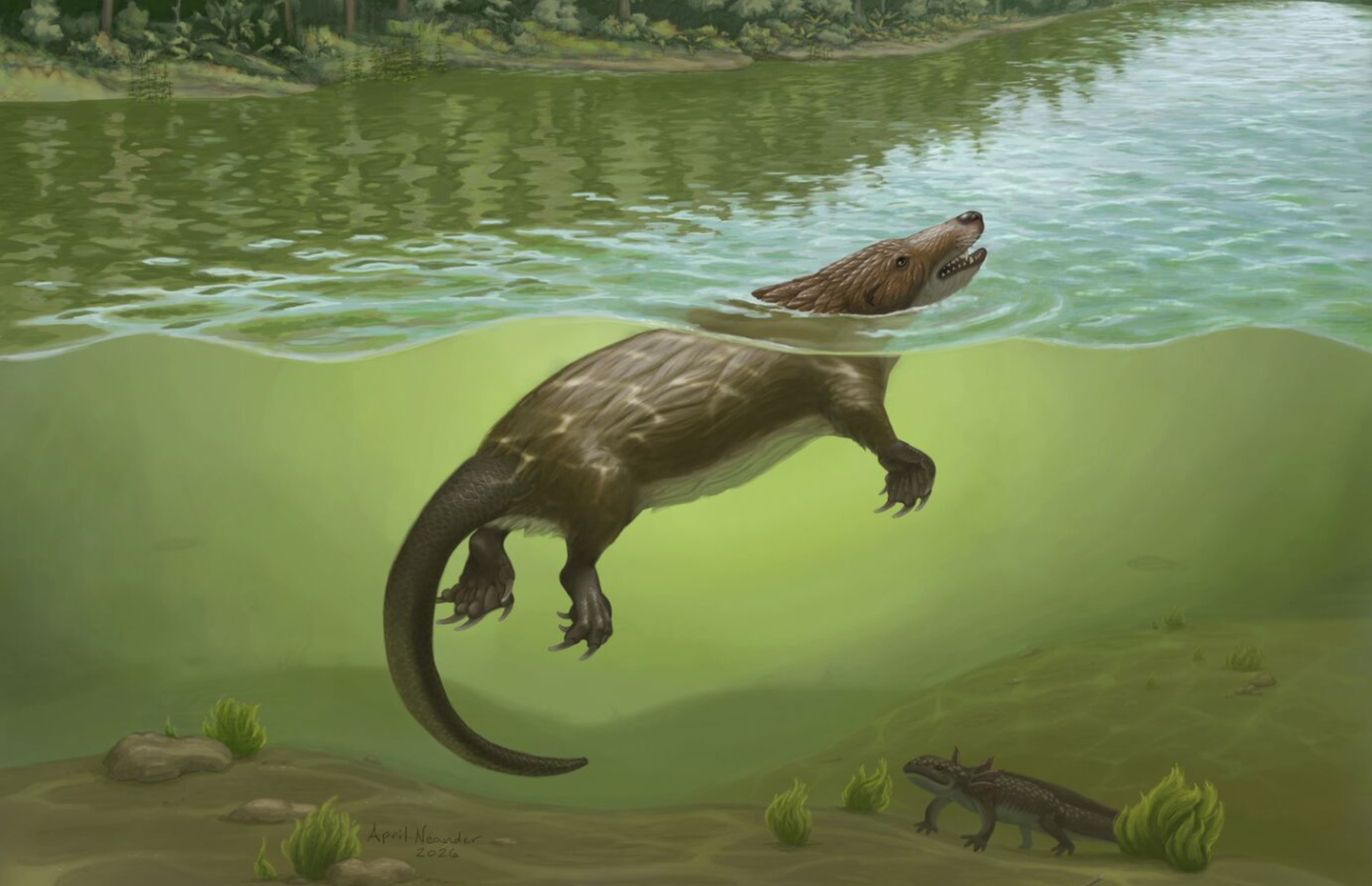
Megacauda sungei, a 165-million-year-old mammal predecessor from China, had strong hind limbs and a broad tail for swimming. (CREDIT: April I. Neander)
- A roughly 165-million-year-old fossil reveals a large Jurassic mammal relative with adaptations for swimming and catching animal prey.
- CT-based reconstructions of its skull, throat bones, limbs and tail support a semiaquatic lifestyle and an inferred mammal-like swallowing apparatus.
- The fossil helps trace feeding evolution, but its soft palate and muscles are reconstructions, and it does not directly demonstrate nursing behavior.
A broad tail, powerful teeth and delicate throat bones tell different parts of one Jurassic animal’s story. Megacauda sungei measured roughly half a meter long, yet ranked as a heavyweight among its early mammal relatives. Its skeleton connects life in water with changes in the machinery of mammalian evolution.
The fossil comes from Inner Mongolia, China, and dates to approximately 168 million to 163 million years ago. Researchers including Zhe-Xi Luo at the University of Chicago and Thomas Martin at the University of Bonn described in Nature. Its combination of features broadens the history of aquatic adaptations among mammal relatives.
The collaboration also included Yikun Li and Honggang Zhang from Shenyang Normal University, alongside Chang-Fu Zhou, Peishu Li and April Neander. Their work brought together fossil examination, imaging and comparative anatomy.
The most revealing structures include bones beneath the skull that supported feeding muscles. Their arrangement allowed researchers to infer parts of a soft palate and throat apparatus. Those soft tissues themselves did not survive as a complete, preserved swallowing system.
A heavyweight on a very small scale
The team identified Megacauda as a docodont, an extinct branch of mammaliaforms. That broader group includes mammals and their close extinct relatives. Calling it a relative avoids assuming this particular species directly gave rise to modern mammals, a distinction important when interpreting fossil relationships.
Researchers estimated a mass of one to two kilograms and a length of about 40 to 50 centimeters. They describe it as the largest known Jurassic mammaliaform. Its size was impressive within that group, even though dinosaurs included vastly larger animals in the same geological period.
The fossil came from the Daohugou area’s Haifanggou Formation. The Paleontological Museum of Liaoning acquired the specimen with other finds, and later examination revealed its significance. Its name combines a reference to its large tail with an honor for paleontologist Sun Ge.
Its upper canines carried three roots, an unusual reinforcement for gripping prey. Their crowns were approximately 60% taller and 30% wider at the base than the lower canines, emphasizing the asymmetry between the upper and lower teeth. Behind them, cutting teeth formed shearing surfaces called pseudo-carnassials. Comparing those structures with other fossil teeth helps separate a proposed feeding function from a claim of direct ancestry with modern carnivores.
Tail and feet point toward water
The animal’s broad, flattened tail offers the most visible swimming clue. Wide vertebrae, including H-shaped projections, provided attachment areas for muscles. Its overall form invites comparison with modern swimmers, including the platypus, while preserving its own distinctive anatomy.
Short, strong thigh bones and elongated feet supplied further evidence. The fourth and fifth toes were particularly long, and flexible ankles could turn the feet outward. Enlarged areas of the pelvis also indicate substantial attachments for muscles controlling the hindlimbs.
Together, these features support a semiaquatic interpretation: an animal capable of moving on land and hunting in water. Comparisons suggest coordinated contributions from the limbs and tail. The skeleton cannot reveal the precise stroke sequence or directly measure its speed, endurance or underwater maneuverability.
Forelimb features also suggest digging ability, raising the possibility of sheltering in burrows. That combination resembles solutions found in later mammals, rather than establishing identical behavior. Other work on swimming mammals likewise uses several skeletal clues to reconstruct how land and water use overlapped.
Reconstructing a throat from its supports
The fossil’s hyoid apparatus, a set of bones associated with the tongue and throat, adds a different evolutionary perspective. Its saddle-like arrangement provided attachment and support for soft tissues involved in feeding. These relationships make the specimen valuable beyond the information in its jaws and teeth.
A hook-shaped skull structure called the pterygoid hamulus supplied another clue. In living mammals, this region relates to muscles controlling the soft palate. Researchers compared the fossil with modern anatomy, including that of an opossum, to reconstruct likely muscle positions and functions.
The soft palate is the flexible extension behind the mouth’s bony roof. Its movements help separate the nasal passage from the route taken by food during swallowing. Coordinated throat muscles then move food toward the esophagus, the tube leading to the stomach.
Bones can preserve the attachment points for muscles long after the muscles disappear. Similar reasoning underlies reconstructions of early mammal hearing. Here, the comparisons support a swallowing apparatus with mammal-like features, while the precise soft-tissue arrangement remains an anatomical inference.
Why controlled swallowing matters
Modern mammalian swallowing does more than let food fall down the throat. Muscles move a chewed portion through a coordinated passage while protecting the airway. That capability supports different diets, allowing specialized teeth to process food before the throat transports it.
For Megacauda, reinforced canines and shearing teeth suggest a predator handling animal tissue. The fossil also contains small vertebrate bone fragments in the stomach region, supporting consumption of animal prey. Its exact menu remains uncertain, despite comparisons with other aquatic predators.
Controlled liquid feeding also matters for young mammals consuming milk. Reconstructing structures relevant to suckling therefore helps investigate an important stage in mammalian feeding evolution. It does not show a juvenile nursing, establish when milk production began or demonstrate the entire reproductive biology of this species.
Nor does the anatomy mean an adult can inhale normally throughout every swallow. Feeding and airway protection require coordination. The fossil’s significance lies in the inferred machinery, rather than a demonstrated direct chain from this animal’s palate to later mammalian traits or human brain development.
A broader picture beneath the dinosaurs
CT scanning and three-dimensional reconstruction made the delicate anatomy accessible. The specimen occupied matching rock slabs, and researchers separated sections along existing cracks for imaging.
The skull scan resolved three-dimensional units, called voxels, measuring 0.0352 millimeters on a side. That scale helped researchers examine small structures that conventional surface inspection could miss. Examining the skull, pelvis and tail together strengthens interpretations that would be difficult to support using teeth alone.
The discovery extends earlier work on swimming and throat anatomy in docodonts. The researchers grouped Megacauda and Castorocauda in a family called Megacaudidae, linking their anatomical similarities within a proposed evolutionary relationship. Castorocauda already supplied evidence of aquatic adaptations, while Microdocodon preserved mammal-like hyoid bones. Megacauda combines unusually informative skull and throat structures with substantial evidence from the rest of its body.
Docodont fossils also document climbing and digging adaptations. This diversity shows that close mammal relatives occupied several ecological roles during the dinosaur era. Similarities with later swimmers reflect evolutionary convergence, in which different lineages develop comparable solutions to comparable demands.
More fossils and comparative anatomy can test the reconstructed muscles and clarify when their component features emerged. The present specimen makes two histories clearer: specialization for water and changes in swallowing were already underway deep in the Jurassic. Their combination broadens our picture of prehistoric mammals without turning inferred behavior into direct observation.
Dig deeper into early mammal anatomy and lifestyles
These studies place the swimmer within the wider evidence for mammaliaform anatomy, development and ecological diversity.
- Is cranial anatomy indicative of fossoriality? A case study of the mammaliaform Hadrocodium wui: Comparative analysis examines how confidently skull anatomy can establish a burrowing lifestyle, illuminating the limits of ecological reconstruction. (The Anatomical Record, January 2025)
- Jurassic fossil juvenile reveals prolonged life history in early mammals: Juvenile and adult docodont fossils reveal growth patterns that differed from similarly sized living mammals. (Nature, July 2024)
- New Jurassic mammaliaform sheds light on early evolution of mammal-like hyoid bones: The description of Microdocodon documents earlier fossil evidence relevant to mammalian swallowing anatomy. (Science, July 2019)
- An arboreal docodont from the Jurassic and mammaliaform ecological diversification: A climbing docodont expands the range of lifestyles documented in the group that includes Megacauda. (Science, February 2015)
- A Swimming Mammaliaform from the Middle Jurassic and Ecomorphological Diversification of Early Mammals: Castorocauda provides a foundational comparison for swimming, digging and aquatic feeding adaptations among Jurassic docodonts. (Science, February 2006)
Research findings are available online in the journal Nature.
The original story "165-million-year-old mammal predecessor could chew and swallow like today's mammals" is published in The Brighter Side of News.
Related Stories
- Scientists find first-ever evidence of fossilized blood cells in 115-million-year-old dinosaur bones
- Scientists discover how crocodiles survived the asteroid that killed the dinosaurs
- 100-year-old museum fossil identified as Europe’s first known megaraptoran dinosaur
Like these kind of feel good stories? Get The Brighter Side of News' newsletter.
Joshua Shavit
Writer and Editor
Joshua Shavit is a NorCal-based science and technology writer with a passion for exploring the breakthroughs shaping the future. As a co-founder of The Brighter Side of News, he focuses on positive and transformative advancements in technology, physics, engineering, robotics, and astronomy. Having published articles on AOL.com, MSN, Yahoo News, and Ground News, Joshua's work highlights the innovators behind the ideas, bringing readers closer to the people driving progress.