9.5-million-year-old whale carcass reveals new brittle star species
Tiny skeletal plates found near an ancient whale reveal a new brittle-star species and clues to life around a shallow-water whale fall.
 Museum Sønderjylland Writer: Ida Henningsen

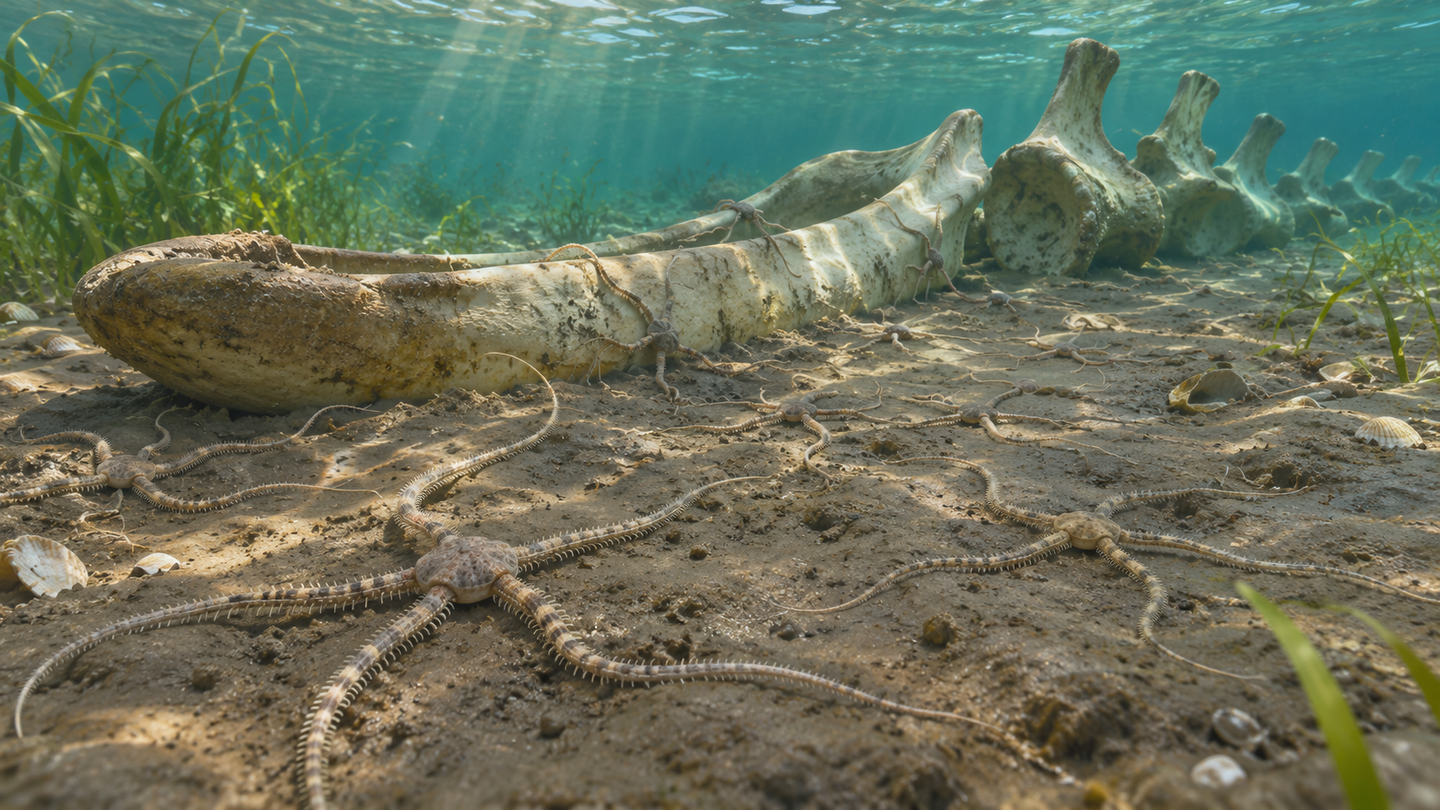
Artist’s reconstruction of brittle stars gathered around whale remains on a shallow seabed, inspired by fossils from Denmark dating back approximately 9.5 million years. (CREDIT: The Brighter Side of News)
- Tiny skeletal plates beside whale bones reveal a new brittle-star species from Denmark’s 9.5-million-year-old Gram Formation.
- Their concentration near the skeleton supports the interpretation that brittle stars gathered around an ancient shallow-water whale fall.
- The fossils leave their diet unresolved, while the species name honors the founders of Wacken Open Air.
A dead whale left more than bones on an ancient seabed in what is now southern Denmark. Around its remains, brittle stars appear to have gathered in numbers that left a small but revealing fossil record. Roughly 9.5 million years later, tiny skeletal plates have brought that gathering back into view.
The remains belong to a newly identified species, Ophiura huebnerjenseni, from the Gram Clay Pit. In their study, researchers suggest the discovery represents the first fossil record of brittle stars associated with a whale fall. Their interpretation rests on where the plates occurred, alongside comparisons with other fossils in the sediment.
Mette Elstrup and Trine Sørensen of the Museum of Southern Jutland joined Ben Thuy at Musée national d’histoire naturelle in Luxembourg. Lea D. Numberger-Thuy at Dinosaurierpark Teufelsschlucht in Germany also took part. Together, they searched the Gram Formation for brittle-star remains that previous work had not detected.
A familiar fossil site yields something smaller
Gram’s marine deposits already have a reputation for large discoveries. They preserve several fossil whale skeletons and exceptionally large megalodon vertebrae, alongside molluscs and other invertebrates. Yet the brittle stars remained absent from the site’s known fossil record until this investigation.
That contrast makes the discovery particularly striking. Whale bones and giant shark fossils draw attention through their size. Here, much smaller pieces offered the evidence needed to identify another inhabitant of the ancient sea.
The material came from sediment collected during a 2018 excavation. That dig recovered a beaked whale’s lower jaw and associated vertebrae. Keeping sediment from around those bones gave the team a chance to examine the smaller remains preserved beside them.
Researchers washed and sieved the samples, then searched for microfossils under a microscope. They examined selected pieces with scanning electron microscopy, which revealed distinctive features in the brittle stars’ skeletal plates. Those features supported identification of a species that scientists had not previously described. The work therefore added both a new species and the first detected brittle-star remains from this formation.
Brittle-star fossils clustered beside the whale
Identifying the animal answered only part of the question. The team also needed to establish whether the brittle stars had a meaningful connection to the whale. Fossils lying near one another do not automatically show that the animals lived together.
“Only three samples taken directly beside the whale bones contained brittle-star remains. Samples from the same layer farther from the skeleton, and other comparison samples, yielded none”, lead author Ben Thuy explained. The distribution put the whale’s immediate surroundings at the center of the investigation.
One possible explanation involved currents moving the plates into place. Another involved local chemistry preserving them beside the bones while comparable remains elsewhere disappeared. Either possibility would complicate an ecological reading of the fossil concentration. The comparison samples gave the team a way to test whether the pattern reflected something specific about the whale’s surroundings.
“We considered whether currents had simply concentrated the plates around the bones, or whether local chemical conditions had helped preserve them. However, sea-urchin fragments of comparable size and mineral composition occurred in every sample studied. This makes a preservation-only explanation less likely and supports the interpretation that the brittle stars lived on or close to the whale carcass”, Thuy added.
A food source, with unanswered questions
When a whale carcass reaches the seabed, it delivers a concentrated supply of food. Scientists call that setting a whale fall. Brittle stars commonly gather around such sites in modern oceans, making the Gram discovery a possible ancient counterpart to a familiar ecological association.
The Danish fossils suggest that this connection existed during the Late Miocene. However, they do not reveal exactly what Ophiura huebnerjenseni ate. Finding the animal near the carcass supports an association, but it does not establish its feeding behavior.
Nor does the evidence show that the species relied exclusively on dead whales. Drawing on living communities, the researchers favor a generalist that normally occupied the surrounding seabed. In their interpretation, the carcass attracted enough individuals to leave a detectable concentration of skeletal remains.
That distinction keeps the finding grounded. Like evidence of ancient interactions around whale remains, the location of these fossils helps reconstruct an encounter. It does not preserve every detail of the animals’ lives or explain all the reasons they gathered there.
A shallow-water gathering, rather than a deep-sea reconstruction
The researchers interpret the site as a shallow-water whale fall. That matters because their findings do not establish the full sequence of communities that can develop around carcasses in deeper water. The evidence points to animals responding to enrichment around the remains.
“We interpret the site as a shallow-water whale fall at a stage when enrichment from the carcass supported opportunistic animals”, Elstrup said. This reading places the brittle stars among animals taking advantage of a local resource, without requiring them to specialize in that habitat.
“We found no evidence for the later sulphide-based community stages that can develop at deep-sea whale falls. The discovery therefore adds a rare fossil perspective on how animals responded to a large food source on an ancient shallow-water seabed” Elstrup said. The absence of that evidence limits how far researchers can extend their reconstruction. It also helps distinguish the community they propose from other kinds of whale-fall habitats, rather than treating every carcass site as equivalent.
The discovery’s value lies in that specific window into the past. Large bones record the whale itself, while nearby microscopic remains preserve clues about its surroundings. Examining both lets researchers ask how other animals responded after the whale reached the bottom.
An ancient brittle star with a heavy-metal name
The new species also carries an unexpected cultural connection. Its name honors Holger Hübner and Thomas Jensen, founders of Wacken Open Air, in recognition of their commitment to the festival. Both expressed appreciation for the honor and the enduring place that published species names can provide.
There may also be a geological connection between the festival and the fossil site. The researchers suggest Wacken’s celebrated dark gray mud probably comes from the same geological deposits that preserved the brittle stars. That proposed link connects two very different uses of ancient marine clay.
“The clay that accumulated on the bottom of the ancient North Sea not only preserved the remains of a 9.5-million-years old brittle star, it also turns Wacken Open Air into the muddy battlefield renowned by metalheads worldwide”, Numberger-Thuy said. The connection gives the species name another layer beyond the tribute to the festival’s founders.
For paleontologists, though, the strongest clue remains the concentration beside the whale. A skeleton that already promised insight into an ancient marine mammal also preserved evidence of smaller neighbors. Their scattered plates suggest a gathering around a carcass, while leaving its precise menu and duration unresolved.
Dig deeper into ancient whale-fall communities
These resources explain whale-fall habitats, brittle-star anatomy and the wider research on animals living around whale remains.
A 5.3-million-year-old deep-sea whale necropolis in the Diamantina Zone: Examines modern whale-fall communities and fossil whales within an extensive deep-ocean accumulation. (Nature, June 2026).
What’s the Difference? Brittle Stars vs. Sea Stars: Explains the body features that distinguish brittle stars from their better-known relatives. (National Marine Sanctuary Foundation, January 2021).
Whale-Fall Ecosystems: Recent Insights into Ecology, Paleoecology, and Evolution: Reviews modern and fossil whale-fall research, including community succession and specialized animals. (Annual Review of Marine Science, January 2015).
How to get into bones: proton pump and carbonic anhydrase in Osedax boneworms: Investigates how bone-dwelling worms access nutrients, offering context for other whale-associated communities. (Proceedings of the Royal Society B, May 2013).
Osedax: bone-eating marine worms with dwarf males: Describes a distinctive group of worms discovered living on whale bones. (Science, July 2004).
Research findings are available online at Schweizerbart and Borntraeger science publishers.
The original story "9.5-million-year-old whale carcass reveals new brittle star species" is published in The Brighter Side of News.
Related Stories
- Whale fossils reveal evidence of ancient shark attacks
- A rare sperm whale birth captured how families rally around a newborn
- Indigenous communities in southern Brazil hunted large whales 5,000 years ago
Like these kind of feel good stories? Get The Brighter Side of News' newsletter.
Joshua Shavit
Writer and Editor
Joshua Shavit is a NorCal-based science and technology writer with a passion for exploring the breakthroughs shaping the future. As a co-founder of The Brighter Side of News, he focuses on positive and transformative advancements in technology, physics, engineering, robotics, and astronomy. Having published articles on AOL.com, MSN, Yahoo News, and Ground News, Joshua's work highlights the innovators behind the ideas, bringing readers closer to the people driving progress.