Scientists discover a new quantum state of matter that functions at room temperature
A room-temperature supersolid phase appears in a tunable light-matter condensate, with shifting stripes and vortices as evidence of quantum fluid behavior.
 niversity of Warsaw Writer: Agnieszka Fiedorowicz

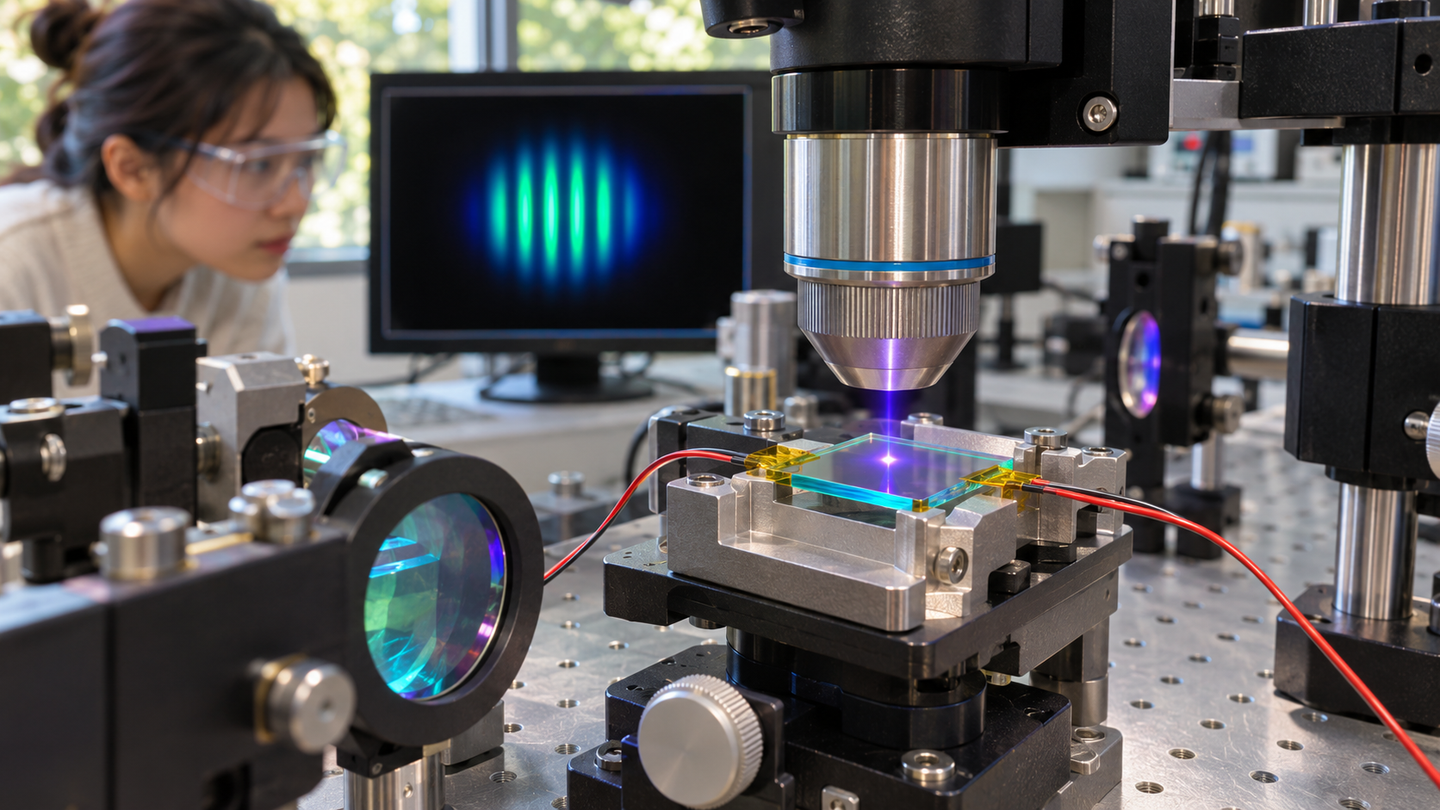
Artist’s illustration of a laser-excited liquid-crystal microcavity, with striped emission shown on a monitor. Researchers observed a room-temperature supersolid phase in the hybrid light-matter condensate formed inside such a device. (CREDIT: The Brighter Side of News)
- Researchers observed a room-temperature supersolid phase in a condensate made from hybrid light-matter particles called exciton polaritons.
- Randomly positioned density stripes, polarization patterns and occasional vortices support the interpretation.
- Voltage control makes the platform useful for exploring quantum phases, although its superfluid behavior needs further quantitative testing.
Regular stripes appeared in the light escaping a microscopic cavity, but their positions changed whenever a fresh laser pulse created the quantum state. The pattern was ordered without being fixed in place. That combination helped researchers identify a supersolid phase operating at room temperature, rather than in an ultracold atomic gas.
The work, published in Science Advances, involved researchers from the University of Warsaw, Poland’s Military University of Technology, IBM Research Zurich and France’s National Centre for Scientific Research, CNRS. The TopoLight collaboration used an electrically adjustable optical cavity containing liquid crystal and an organic semiconductor. Its quantum fluid consisted of exciton polaritons, particles that combine properties of light and matter.
The researchers describe the observed phase as a supersolid, which combines crystal-like spatial order with superfluid characteristics. Their evidence includes stripes that resist being locked to imperfections and vortices appearing in some experimental runs. The paper also states that the superfluid aspect requires further quantitative analysis, an important qualification when interpreting the result.
What makes a supersolid unusual
An ordinary crystal has a repeating arrangement of atoms or molecules. A superfluid, by contrast, can move without dissipating energy through friction under suitable conditions. A supersolid combines periodic structure with this unusual fluid behavior, bringing together properties that seem incompatible in everyday materials.
The ordered structure need not be a conventional lattice of solid atoms. In this experiment, it was a repeating variation in the density of the polariton condensate. The term does not mean the glass, polymer or liquid-crystal material suddenly became a substance that could pour like water while remaining rigid.
Earlier experiments established supersolid behavior in ultracold quantum gases, where extreme cooling allows atoms to act collectively. Here, strong coupling between light and electronic excitations provided another route to collective quantum behavior. Avoiding near-absolute-zero temperatures makes this approach attractive for laboratory studies, although it still requires carefully fabricated samples and optical excitation.
The polaritons themselves are short-lived, so the experiment is a driven system supplied with energy by a laser. Fresh excitation creates another condensate, allowing researchers to repeat the formation process. This distinction matters because the reported phase is a transient quantum fluid, rather than a permanent piece of material sitting on a laboratory bench.
A cavity with an electrical control knob
An exciton is an electronic excitation in a material. When it couples strongly to a photon confined inside a cavity, the resulting hybrid is an exciton polariton. Many polaritons can occupy a shared quantum state, forming a Bose-Einstein condensate whose behavior can be read through emitted light.
The team sandwiched a layer of liquid crystal between two thin films of an organic polymer called MeLPPP. Highly reflective multilayer mirrors confined the light, while electrodes allowed the researchers to apply voltage. Each polymer layer was 35 nanometers thick, placing the light-matter interaction inside a carefully controlled microscopic structure.
Voltage rotated the liquid-crystal molecules and changed how differently polarized light propagated through the cavity. This adjusted the available polariton states without requiring the researchers to manufacture a new structure for every setting. The liquid crystal therefore served as a tunable part of the optical environment.
At suitable settings, the system developed spin-orbit coupling, which links polarization with motion. Its energy landscape then had two equally low minima associated with opposite directions. Condensates occupying those two states interfered, producing the periodic stripes visible in the emitted light.
First author Marcin Muszyński and his colleagues also measured the emission’s brightness, energy and spectral width. A sharp intensity increase and narrowing spectrum supported condensation, while additional measurements showed that strong light-matter coupling persisted. Those checks established the underlying condensate before the team investigated the structure of its stripe phase.
Why the stripes chose a new position
Stripes alone would not establish that the system spontaneously formed a supersolid phase. A pattern could instead be imposed by defects or other features of the sample. The researchers therefore examined individual condensation events rather than relying only on images averaged across many laser pulses.
In the higher-density regime, each new condensate selected a different stripe position. Histograms covering 500 realizations showed a nearly uniform distribution of positions rather than one favored location. The stripes retained their periodic structure, but the pattern could shift relative to the underlying sample.
“This is a textbook example of spontaneous symmetry breaking,” said Guillaume Malpuech of Institut Pascal, CNRS. Before condensation, equivalent positions were available for the pattern. Each realization selected one, creating an ordered arrangement without a predetermined starting point.
The emitted light also displayed a persistent spin helix, a repeating variation in its polarization. Polarization describes the orientation of light’s oscillations, while intensity describes its brightness. Measuring both revealed two related forms of spatial order, giving the researchers more information than an intensity image alone.
Disorder and vortices sharpen the evidence
The sample was not perfectly uniform, making its imperfections an important part of the test. Close to the condensation threshold, lower-density condensates tended to place their stripes in preferred positions. The researchers interpreted that partial pinning as evidence that disorder still influenced the emerging pattern.
At higher condensate density, that preference largely disappeared. Simulations reproduced the difference when interactions between polaritons became comparable with the disorder’s influence. The agreement supported the interpretation that collective behavior allowed the pattern to overcome the sample’s tendency to fix it in place.
The researchers also observed vortices in about 10% of experimental realizations, with the probability depending on pumping power. These appeared as dislocations in the stripes and singularities in the reconstructed phase. They provided another sign of superfluid behavior, rather than ordinary visible whirlpools inside the liquid crystal.
The experiment assessed resilience to disorder during condensate formation, rather than directly measuring frictionless flow past an obstacle. The paper’s simulations also identify conditions affecting whether superfluidity would persist during motion. Establishing that transport behavior quantitatively remains a task for further investigation.
A useful platform with practical limits
Creating the samples required expertise from several institutions. The Military University of Technology fabricated liquid-crystal photonic structures, while key measurements took place at IBM Research Zurich. There, researchers deposited the organic semiconductor films and combined materials that had previously been investigated separately.
“This was the first time we combined it with a liquid-crystal microcavity,” said IBM Research scientist Thilo Stöferle. He was referring specifically to the MeLPPP material his group had studied for years. The combination brought that semiconductor’s ability to support condensation together with the cavity’s electrical tunability.
Material stability remains a constraint. The paper reports that optical quality degraded over periods ranging from days to weeks, probably because of interactions with the liquid crystal. Reproducible fabrication and longer-lasting samples will matter as researchers develop the platform beyond the present experiments.
The collaboration sees possibilities for optical sensing, ultrafast devices and light-based computing, but this study did not demonstrate those applications. Its immediate contribution is an adjustable environment for investigating how ordered quantum fluids form at room temperature. Further work must establish the superfluid response more quantitatively and determine how reliably voltage can control the phase in practical devices.
Dig deeper into supersolids and quantum fluids of light
These studies connect recent photonic experiments with foundational demonstrations of supersolid order and superfluidity.
Hybrid perovskite–nanograting photonic architecture enables supersolidity at room temperature
Reports a different room-temperature polariton platform using perovskites and a nanograting, providing context for the broader field. (Nature Nanotechnology, March 2026)
Emerging supersolidity in photonic-crystal polariton condensates
Explores supersolid behavior in a driven polariton system built around a photonic-crystal waveguide. (Nature, March 2025)
Observation of vortices in a dipolar supersolid
Examines vortices in an atomic supersolid, helping explain why these structures matter as evidence of superfluid behavior. (Nature, November 2024)
Room-temperature superfluidity in a polariton condensate
Demonstrates superfluid flow in an ambient-temperature polariton system, an important foundation for quantum fluids of light. (Nature Physics, June 2017)
A stripe phase with supersolid properties in spin–orbit-coupled Bose–Einstein condensates
Establishes stripe order and supersolid properties in an ultracold atomic condensate with spin-orbit coupling. (Nature, March 2017)
The original story "Scientists discover a new quantum state of matter that functions at room temperature" is published in The Brighter Side of News.
Related Stories
- Scientists propose a light-matter quantum state inside living cells
- Quantum spin study reveals a previously unknown state of matter
- Quantum liquid crystal: Scientists discover a new 5th state of matter
Like these kind of feel good stories? Get The Brighter Side of News' newsletter.
Shy Cohen
Writer