A hidden cosmic filter may decide which interstellar objects reach our solar system
An icy ‘Oumuamua may have lost enormous amounts of material during a journey lasting hundreds of millions of years between stars.

 Edited By: Joshua Shavit

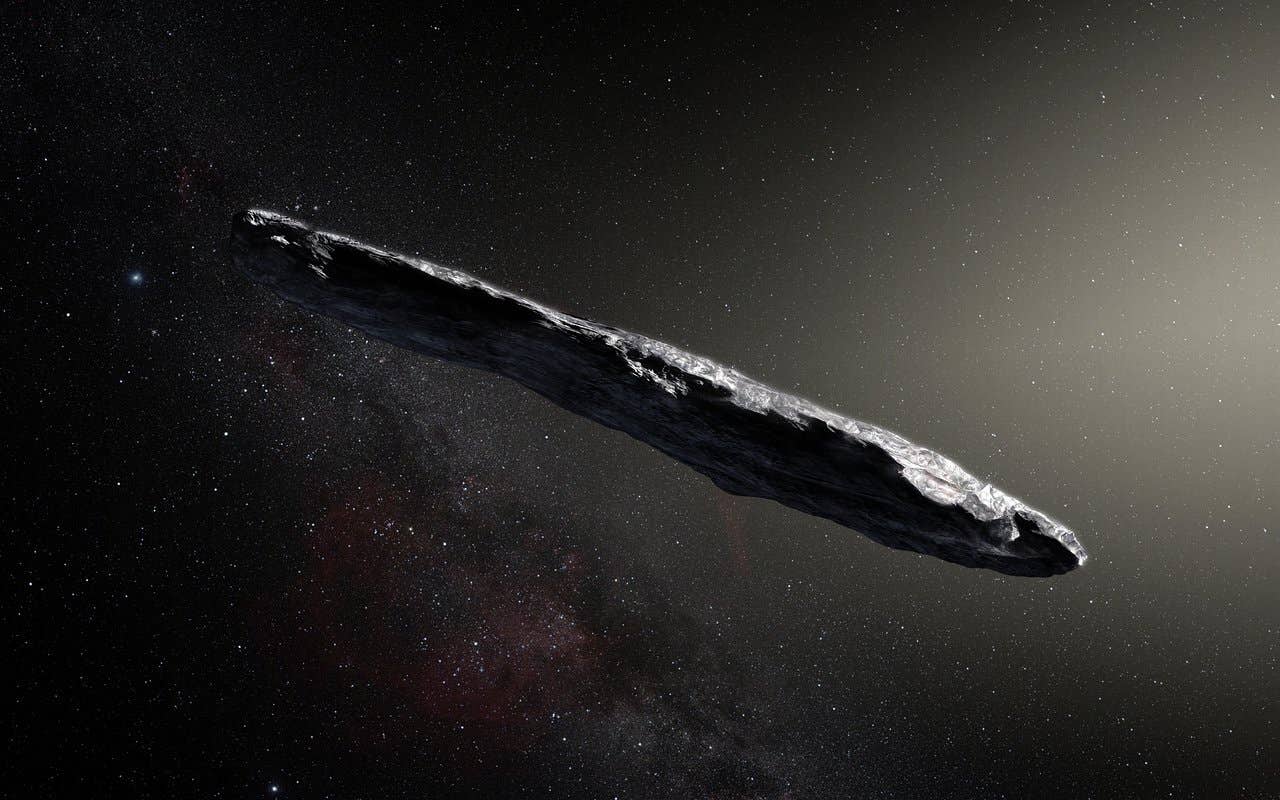
Cosmic rays may erode icy interstellar objects far faster than expected, suggesting ‘Oumuamua could once have been much larger. (CREDIT: Credit: European Southern Observatory/M. Kornmesser/ NASA)
- Cosmic rays and collisions with interstellar gas may erode icy interstellar objects much faster than some earlier estimates suggested, limiting how long small frozen bodies can survive between stars.
- The model found that a nitrogen-ice version of ‘Oumuamua traveling through interstellar space for about 500 million years may have needed an initial radius of at least roughly 0.5 kilometer, substantially larger than the object eventually observed.
- Because erosion depends on an object’s composition, speed and the cosmic-ray environment it crosses, future interstellar visitors could potentially help astronomers place limits on where in the Milky Way they originated.
Interstellar space may look empty, but an icy object drifting between the stars faces a relentless bombardment that can slowly erase it.
Cosmic rays and collisions with thin interstellar gas could strip material from frozen bodies much faster than previously estimated, according to theoretical work examining how objects such as ‘Oumuamua survive journeys lasting hundreds of millions of years.
The research, “Erosion of Icy Interstellar Objects by Cosmic Rays and Implications for ‘Oumuamua,” written by Vo Hong Minh Phan and his team from Aachen University in Germany, investigates whether frozen objects composed of nitrogen, carbon monoxide, carbon dioxide or methane can remain intact during long voyages through the Milky Way.
When the work was written, only two confirmed interstellar objects had been detected, ‘Oumuamua and comet 2I/Borisov. That tiny sample left scientists with major questions about how numerous such objects are, where they originate and how much they change before reaching another planetary system.
Cosmic rays can carve away ice
The researchers focused on Galactic cosmic rays, high-energy particles traveling through the Milky Way.
When energetic cosmic rays strike an icy object, they can deposit energy along tracks inside the material. That energy briefly heats the surrounding ice enough to evaporate molecules, some of which can escape into interstellar space.
The team modeled cosmic-ray particles with energies up to 10 gigaelectronvolts and estimated their effect using measured cosmic-ray conditions in the local interstellar medium.
Their calculation produced substantially faster erosion than an earlier estimate for nitrogen ice. Previous work had suggested cosmic rays might remove roughly 6 to 60 meters of nitrogen ice per billion years, depending on assumptions about cosmic-ray density.
The new analysis argues that impulsive heating along cosmic-ray tracks could reduce survival times by one to two orders of magnitude compared with that estimate.
How severe the destruction becomes depends strongly on what the object is made of. Nitrogen, carbon monoxide, carbon dioxide and methane have different molecular binding energies and densities, meaning each responds differently to the same incoming energy.
Interstellar gas adds another threat
Cosmic rays are not the only source of erosion.
An interstellar object also collides continuously with atoms in the thin gas between stars. Each impact carries little energy, but billions of years of collisions can matter.
The effect rises rapidly with speed. In the researchers' model, heating from gas collisions scales with the cube of an object's velocity.
That creates an unusual trade-off.
A fast-moving object spends less time traveling between its birthplace and the solar system, reducing its exposure to cosmic rays. Yet its higher velocity makes collisions with interstellar gas considerably more destructive.
A slower object experiences gentler gas impacts but remains exposed to cosmic rays for much longer.
The balance means survival depends not simply on distance traveled but on the combination of speed, composition, surrounding gas density and cosmic-ray intensity.
Cosmic-ray exposure adds another major uncertainty because conditions are not uniform throughout the Milky Way. Some regions may contain cosmic-ray densities several times greater than those measured near the Sun.
‘Oumuamua may once have been much larger
The findings have particularly interesting consequences for one proposed explanation of ‘Oumuamua.
Earlier research suggested that the strange interstellar visitor could have been a fragment of nitrogen ice knocked from the surface of a Pluto-like world in another planetary system. That scenario placed its ejection roughly 400 million to 500 million years before it reached us, potentially from a young stellar system associated with the Perseus arm.
If ‘Oumuamua really spent around half a billion years traveling as nitrogen ice, the new erosion calculation implies it could not have started at approximately the size eventually observed.
The researchers estimated an initial radius between roughly 0.5 and 2.5 kilometers, depending largely on the cosmic-ray environment along its route.
Under their representative assumptions, a nitrogen object with an initial radius of 0.5 kilometer moving at about 10 kilometers per second would have a destruction time near 580 million years.
Its internal ice would change even sooner.
The researchers estimated a structural modification time near 170 million years, meaning cosmic-ray heating could process essentially the entire object before erosion destroyed it.
That result suggests the material astronomers eventually encounter may no longer preserve its original microscopic ice structure even if much of the object survives.
An object's survival could point toward its birthplace
The same equations can be turned around.
If astronomers can estimate an interstellar object's original size, composition and velocity, its survival can place an upper limit on how far it could have traveled.
For slow objects, cosmic rays dominate the constraint because the journey lasts longer. At sufficiently high velocities, gas collisions become increasingly important.
The study therefore suggests that knowledge of cosmic-ray conditions across the Galaxy could eventually become an unexpected tool for tracing interstellar visitors.
For a nitrogen-ice object with a radius of 0.5 kilometer traveling near 10 kilometers per second, the allowed birth distance changed substantially when the modeled cosmic-ray intensity increased.
That sensitivity is also one of the study's largest uncertainties. The distribution of cosmic rays across the Galactic disk is not known precisely enough to reconstruct an object's journey with confidence.
Future discoveries could test the idea
The analysis is theoretical, and the proposed nitrogen composition of ‘Oumuamua remains a hypothesis rather than an established fact. Its initial dimensions, birthplace and travel time are also uncertain.
The erosion model itself makes simplifying assumptions about cosmic-ray energy deposition, molecular escape and object geometry. Non-spherical shapes can expose more surface area relative to their volume and therefore change predicted survival times.
Still, the work introduces an important selection effect into estimates of the interstellar population.
The objects that reach the solar system may not represent everything that gets ejected from distant planetary systems. Small, volatile-rich bodies could disappear during transit, leaving observers preferentially with larger, younger, tougher or more nearby survivors.
That means the apparent population of interstellar objects could carry the fingerprints not only of how other planetary systems create and eject them, but also of what the Milky Way destroys along the way.
Dig deeper into interstellar objects and ‘Oumuamua
These resources explore the possible composition, origins, abundance and future exploration of objects traveling between planetary systems.
The Interstellar Interlopers: Reviews the physical properties, origins and estimated population of ‘Oumuamua, 2I/Borisov and the broader class of extrasolar planetesimals moving through the Galaxy. (Annual Review of Astronomy and Astrophysics, 2023)
Project Lyra: A mission to 1I/’Oumuamua without Solar Oberth Manoeuvre: Investigates a spacecraft trajectory capable of pursuing ‘Oumuamua using near-term propulsion and a Jupiter Oberth maneuver rather than an extreme solar flyby. (Acta Astronautica, 2022)
Comet Interceptor: Describes ESA's mission designed to wait in space for a pristine comet, with an interstellar object also listed as a possible destination if a suitable target becomes reachable. (European Space Agency, 2026)
Research findings are available online in the journal arXiv.
The original story "A hidden cosmic filter may decide which interstellar objects reach our solar system" is published in The Brighter Side of News.
Related Stories
- Interstellar comet 3I/ATLAS may come from a solar system much older than our own
- 12 billion years old interstellar comet 3I/ATLAS may be older than the solar system
- Jupiter-sized interstellar visitor may have reshaped our solar system
Like these kind of feel good stories? Get The Brighter Side of News' newsletter.
Joseph Shavit
Writer, Editor-At-Large and Publisher
Joseph Shavit, based in Los Angeles, is a seasoned science journalist, editor and co-founder of The Brighter Side of News, where he transforms complex discoveries into clear, engaging stories for general readers. With vast experience at major media companies like The Los Angeles Times, Times Mirror and Tribune Publishing, he writes with both authority and curiosity. His writing focuses on space science, planetary science, quantum mechanics, geology. Known for linking breakthroughs to real-world markets, he highlights how research transitions into products and industries that shape daily life.