A new wave equation for light challenges how physics explains the arrow of time
A theory of accelerating waves connects light in matter with relativity and a possible microscopic explanation for time’s direction.

 Edited By: Joshua Shavit

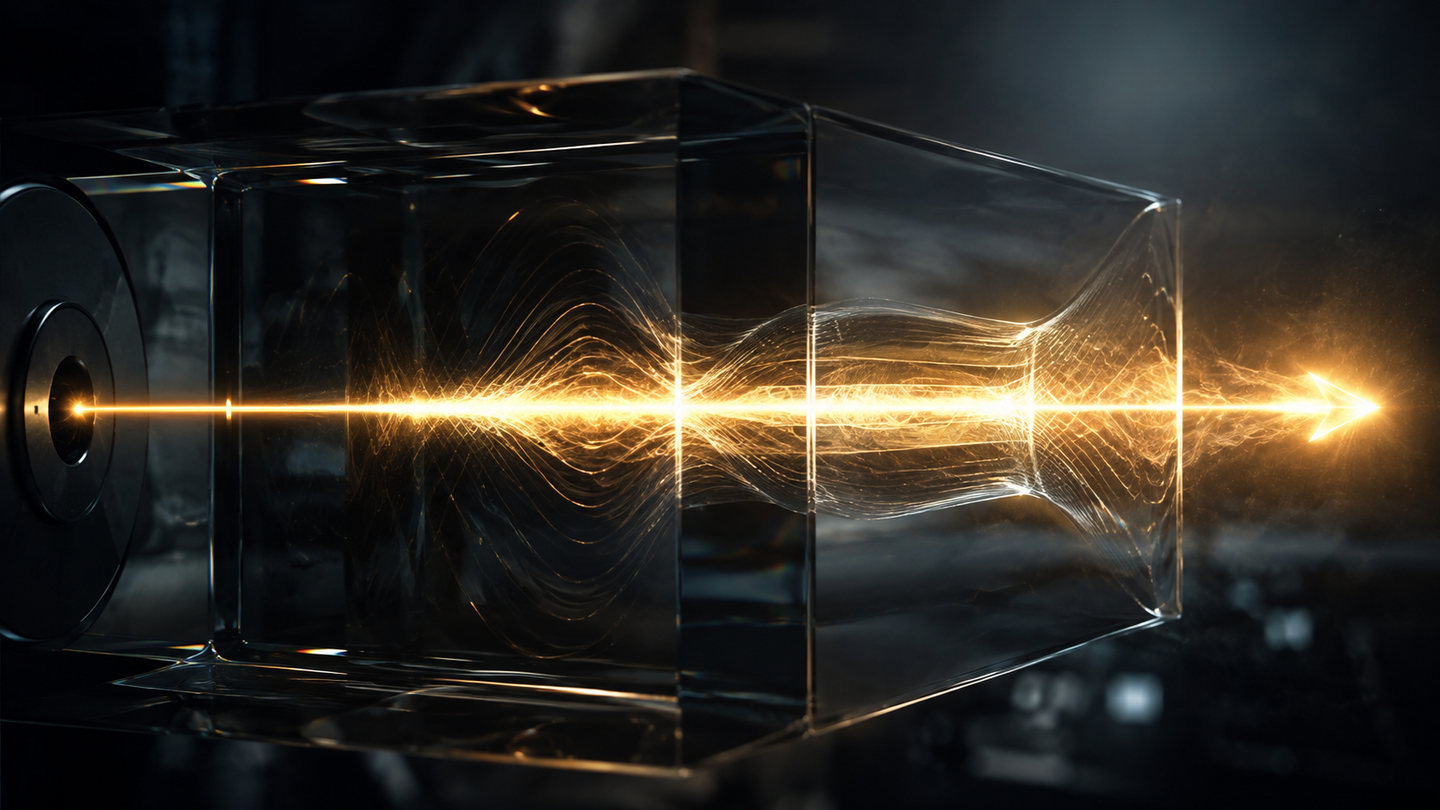
A new accelerating wave equation links changing light speeds to relativity, momentum conservation and the arrow of time. (CREDIT: Wikimedia / AI-Generated / CC BY-SA 4.0)
- A new wave equation suggests accelerating waves can move only toward positive time, offering a possible microscopic explanation for why time has a preferred direction.
- The framework treats changing wave speeds as relativistic effects and argues that light’s momentum remains unchanged from the wave’s own reference frame when it enters a material.
- The theory could be tested with time-varying photonic materials, although the proposed optical experiments face problems including energy losses and material damage.
Light does something deceptively simple when it enters matter: it slows down. Yet that familiar effect may conceal a deeper problem about how waves move through changing environments, how momentum is conserved and why time appears to move only forward.
A theoretical analysis from researchers at the University of Eastern Finland and Tampere University proposes a new way to describe waves whose speed changes over time. The work develops what the authors call an accelerating wave equation, designed to handle a feature the standard wave equation leaves out.
That missing feature is acceleration. When a wave moves between media or through material whose properties change with time, its speed can change. The new approach treats that motion continuously.
Assistant Professor Matias Koivurova said the idea grew from reconsidering a basic derivation of the standard wave equation. “Basically, I found a very neat way to derive the standard wave equation in 1+1 dimensions. The only assumption I needed was that the speed of the wave is constant. Then I thought to myself: what if it’s not always constant? This turned out to be a really good question,” he said.
A wave equation with a preferred direction
Allowing wave speed to vary produced an extra term linked to acceleration. Solving the resulting equation led to behavior that Koivurova initially found difficult to interpret.
“It dawned on me that it behaves in ways that are reminiscent of relativistic effects,” he said.
Working with the Theoretical Optics and Photonics group at Tampere University, led by Associate Professor Marco Ornigotti, the team connected the solution to ideas from relativity. The wave can be assigned an intrinsic or “proper” time, analogous to the time experienced in a moving frame.
“We found that we can ascribe a ‘proper time’ to the wave,” Ornigotti said.
The model also produced an unusual asymmetry. For a longitudinally accelerating wave, the equation allows solutions that move toward positive time. A true reversal along the time axis would require conditions that conflict with the acceleration involved in the reversal process.
That result differs from the traditional thermodynamic arrow of time, which links the direction of time to increasing entropy. The authors argue that entropy describes a macroscopic tendency but does not explain why microscopic time itself should have a fixed direction.
“Usually, the direction of time comes from thermodynamics,” Koivurova said.
The researchers describe their result as a possible microscopic arrow of time within wave mechanics. They stress that optical experiments described as “time reflection” or “time reversal” do not reverse time itself. Those experiments manipulate a wave while laboratory time continues moving forward.
Relativity enters an old momentum dispute
The same framework also touches the Abraham-Minkowski controversy, a long-running argument over what happens to the momentum of light when it enters a dielectric material.
One view, associated with Hermann Minkowski, treats the momentum as increasing inside the medium. Another, associated with Max Abraham, treats it as decreasing.
The accelerating-wave framework approaches the question through the wave’s own reference frame. When a wave moves along what the authors describe as a geodesic, its energy remains conserved. Its wavenumber also remains constant in the moving frame, which means its momentum does not change there.
“What we have shown is that from the point of view of the wave, nothing happens to its momentum,” Koivurova said.
The team argues that the apparent change in wavelength and momentum seen by an outside observer is a relativistic effect. In this interpretation, the disagreement does not require splitting momentum into separate material and optical parts.
For ordinary light entering a material, the formalism reproduces the standard optical description while providing a continuous solution across the boundary. The researchers argue that some familiar optics problems could therefore be reframed without mathematically separate regions.
Time-varying materials push the model further
The analysis becomes more unusual in time-varying media, where material properties change as a function of time. Such systems have been studied in electromagnetism, plasma science and quantum physics for decades, but newer nonlinear materials have renewed interest in them.
One example is a disordered photonic time crystal, a medium whose dielectric properties change abruptly and randomly over time. Earlier numerical work showed that a pulse in such a system can slow exponentially while its energy rises exponentially.
The new equation provides an analytical description of that behavior. In the model, the pulse slows, gains energy and becomes shorter as it propagates. The authors interpret the changing energy through an effective curved spacetime experienced by the wave.
“Our formalism shows that the observed change in the energy of the pulse is due to a curved space-time the pulse experiences,” Ornigotti said.
That does not mean energy disappears from or appears in the full system. The researchers note that a time-varying medium must be pumped to create the changing conditions, so the apparent violation is local while global energy remains conserved.
The work is entirely theoretical. Still, the authors point to possible laboratory tests using radio-frequency transmission lines or nonlinear epsilon-near-zero materials, whose refractive index can change rapidly under ultrashort optical pulses.
Those optical experiments face practical limits. Losses can be substantial, the material may need to remain optically thin, and intense ultrashort pulses can damage the medium.
Practical implications of the research
The accelerating wave equation gives physicists a single framework for describing waves whose speed changes with time, including mechanical and electromagnetic waves. It may also simplify problems that currently require separate boundary conditions on either side of a material interface.
Its strongest near-term test could come from time-varying photonic systems. The authors suggest disordered photonic time crystals could serve as laboratory analogues for studying wave behavior associated mathematically with curved spacetime.
The framework also offers a new way to examine the Abraham-Minkowski momentum debate and the microscopic direction of time. Both claims remain theoretical, and the researchers identify experimental tests as an important next step.
Research findings are available online in the journal Optica.
The original story "A new wave equation for light challenges how physics explains the arrow of time" is published in The Brighter Side of News.
Related Stories
- A beam of light can cross the entire universe in no time at all
- Inside the strange physics of why time stops at the speed of light
- Scientists observe ‘negative time’ for the first time in a quantum experiment
Like these kind of feel good stories? Get The Brighter Side of News' newsletter.
Joseph Shavit
Writer, Editor-At-Large and Publisher
Joseph Shavit, based in Los Angeles, is a seasoned science journalist, editor and co-founder of The Brighter Side of News, where he transforms complex discoveries into clear, engaging stories for general readers. With vast experience at major media companies like The Los Angeles Times, Times Mirror and Tribune Publishing, he writes with both authority and curiosity. His writing focuses on space science, planetary science, quantum mechanics, geology. Known for linking breakthroughs to real-world markets, he highlights how research transitions into products and industries that shape daily life.