Almost 500 years after its last eruption, Italy’s supervolcano is growing restless
Decades of unrest have damaged the crust beneath Campi Flegrei, changing how scientists interpret its next volcanic crisis.

 Edited By: Joshua Shavit

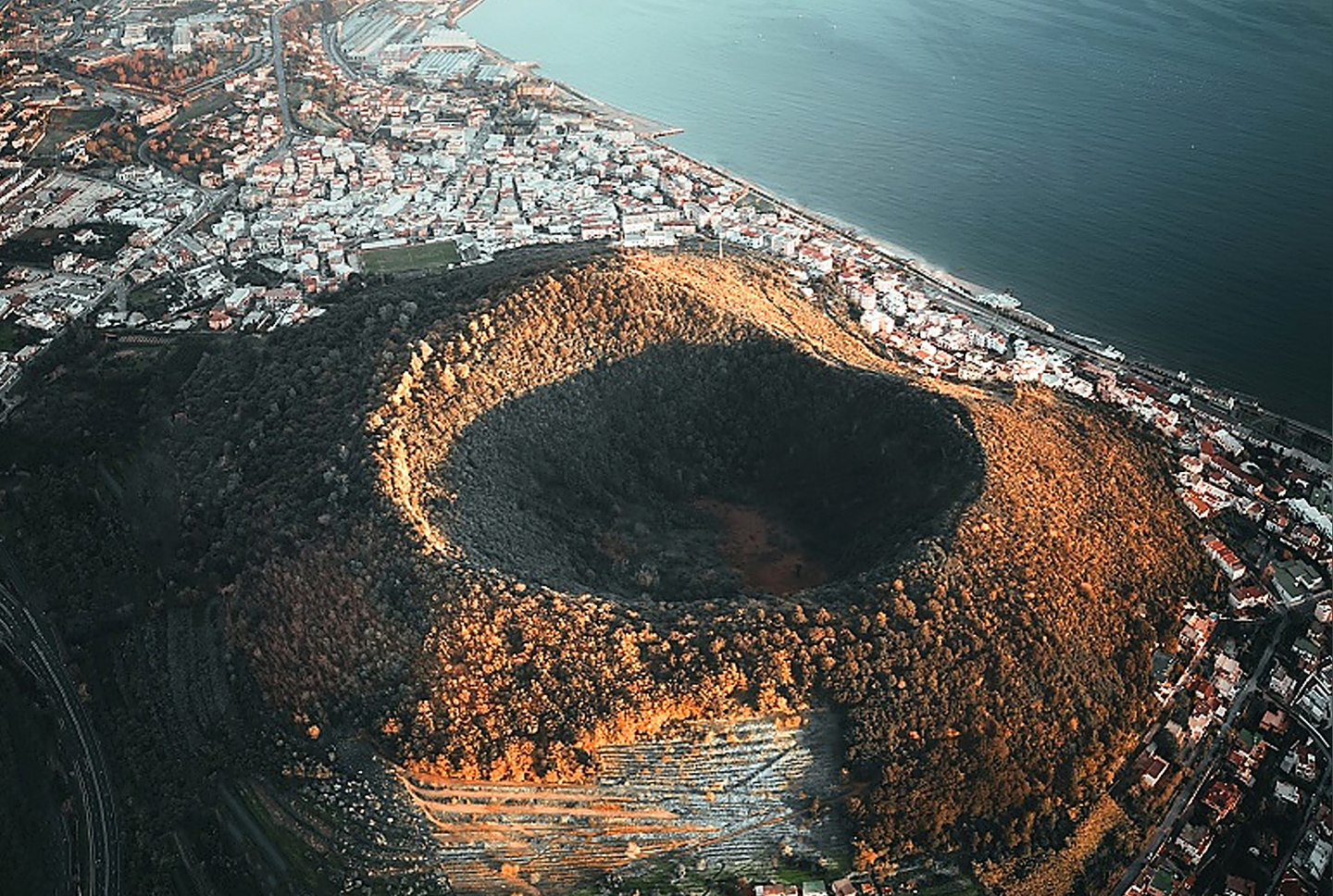
Campi Flegrei’s crust is weakening as uplift and earthquakes continue, but current monitoring does not point to an imminent eruption. (CREDIT: Shutterstock)
- Decades of uplift and earthquakes appear to have progressively weakened parts of the shallow crust beneath Italy’s Campi Flegrei caldera.
- A fracture model suggests the crust entered an inelastic stage in which additional deformation increasingly produces breaking and fault movement rather than simple bending.
- Campi Flegrei remains at yellow alert, but Italy’s volcano observatory reported that monitoring showed no signs of significant short-term escalation.
For decades, Campi Flegrei has been doing something that makes volcanologists uneasy: rising, shaking and releasing gas without erupting.
The sprawling caldera west of Naples last erupted in 1538, when Monte Nuovo formed near Pozzuoli. A 2023 analysis argued that repeated episodes of uplift since the 1950s have progressively damaged the shallow crust, leaving part of the volcanic system weaker and potentially easier to fracture than during earlier unrest.
Researchers from University College London and Italy’s National Institute of Geophysics and Volcanology, or INGV, developed a model that tracks earthquakes against ground uplift to estimate how the crust stores and releases stress.
Their conclusion was serious but conditional. The researchers found evidence that deformation had entered an “inelastic” stage, meaning growing strain was increasingly being accommodated by fractures and fault movement rather than by rock simply bending. The paper explicitly noted that bulk failure is not guaranteed and outlined several possible outcomes.
Decades of uplift have changed the crust
Campi Flegrei is a roughly 13-kilometer-wide caldera that includes part of metropolitan Naples and extends beneath the Gulf of Pozzuoli. Its modern unrest has unfolded in repeated episodes, with major uplift during 1950–52, 1969–72 and 1982–84, followed by renewed slow uplift beginning in the 2000s.
It is sometimes described as a “supervolcano,” although volcanologists more precisely classify it as a large active caldera. Its history includes enormous explosive events, notably the Campanian Ignimbrite tens of thousands of years ago, but the most recent eruption was far smaller than those ancient episodes.
The 2023 team focused on the cumulative effect of repeated deformation. Earthquake activity and inflation can leave lasting structural damage rather than resetting the volcano after each crisis.
Their calculations suggested that effective tensile strength in the zone undergoing rupture had fallen by roughly a factor of 2.5 to 3 compared with conditions before the 1980s. The change became especially important around 2020, when the relationship between earthquakes and uplift shifted into a pattern the researchers interpreted as inelastic deformation.
That transition means fractures are becoming a more important way for the crust to accommodate continuing pressure.
Gas, magma and several possible outcomes
The picture below Campi Flegrei is more complicated than a column of magma simply climbing toward the surface.
The 2023 researchers proposed that accumulating magmatic gas at roughly 3 kilometers depth could drive much of the slow deformation. Beneath the shallow system lies a deeper melt-rich region. If fractures become better connected, pressurized gases could escape more easily and potentially relieve some of the stress.
The study outlined several possibilities. Fluid pathways could reorganize and the uplift might stop. Cracks could repeatedly open and reseal, producing alternating uplift and subsidence. Continued pressure could also complete the rupture of part of the upper crust.
Even that last outcome would not automatically produce a magmatic eruption. New magma would still have to rise into the fractured region and find a route toward the surface.
The concern is that a weakened crust could make such a route easier to establish. The researchers warned that future magma movement might therefore produce weaker warning signals than earlier crises, because much of the necessary fracturing may already have occurred.
New studies reveal an evolving system
Research since 2023 has added evidence that the unrest involves both magma and pressurized fluids.
A 2024 study combining geodetic observations and petrological modeling found evidence that magma rising from at least 8 kilometers depth ultimately drives the present unrest. It reconstructed a shallower deformation source that widened and moved upward from about 5.9 to 3.9 kilometers.
Other work has found rapidly changing seismic behavior. A 2025 analysis identified increasingly frequent burst-like earthquake swarms between 2021 and 2024 alongside accelerating uplift and gas emissions. Another high-resolution study described a gas-rich reservoir below about 2 kilometers, overlain by deformed caprock, and identified earthquakes and possible phreatic explosions as important hazards.
Campi Flegrei then produced its strongest instrumentally recorded earthquake on July 31, 2026. INGV measured the event at Md 4.7, corresponding to Mw 4.4, at about 3 kilometers depth between Pozzuoli and Quarto. By the following morning, the associated swarm had produced 169 earthquakes with Md of at least zero.
What the volcano is doing now
The July earthquake did not begin a simple march toward eruption.
INGV’s latest weekly bulletin, issued Sept. 1, reported only 13 located earthquakes from Aug. 24 through Aug. 30, with a maximum magnitude of 1.8. Ground uplift in the area of greatest deformation has averaged about 10 ± 3 millimeters per month since early February 2026.
Geochemical measurements remain consistent with long-term heating and increased fluid flow through the hydrothermal system. Yet INGV stated that current observations contain no elements suggesting significant short-term changes in volcanic activity. Campi Flegrei remains at yellow alert, meaning monitoring parameters are above background but an eruption is not forecast as imminent.
That is the central lesson of the 2023 work and the observations that followed. Campi Flegrei appears to be structurally changing, and later research shows that its magma, gas, earthquakes and ground deformation are closely interconnected.
But weakened rock is not a timer.
What scientists have learned is that the next crisis may not behave like the last one. That makes continued monitoring more important precisely because the caldera has spent decades rewriting the conditions beneath its surface.
Dig deeper into Campi Flegrei unrest and eruption hazards
These recent studies examine magma movement, seismic swarms, pressurized fluids and structural changes shaping scientists’ understanding of Campi Flegrei.
Magma chamber failure and dyke injection threshold for magma-driven unrest at Campi Flegrei caldera: Researchers reconstructed magma-chamber pressure and dyke formation at Campi Flegrei, identifying pressure thresholds that could help distinguish persistent unrest from conditions capable of triggering magma injection toward the surface. (Nature Communications, 2025)
3D structure and dynamics of Campi Flegrei enhance multi-hazard assessment: High-resolution seismic imaging revealed a gas-rich reservoir below about 2 kilometers, deformed caprock above it and deeper fault activity, strengthening the case for considering earthquakes and phreatic explosions alongside magmatic hazards. (Nature Communications, 2025)
The unprecedented Md = 4.4, 2024, Campi Flegrei earthquake highlights the fluids contribution to the ongoing unrest: Analysis of the major May 2024 earthquake found evidence that pressurized fluids contribute substantially to seismic activity during the ongoing uplift, helping explain how the hydrothermal system interacts with stressed rock. (Communications Earth & Environment, 2025)
Burst-like swarms in the Campi Flegrei caldera accelerating unrest from 2021 to 2024: Researchers documented increasingly frequent, tightly spaced earthquake swarms near the main hydrothermal field during a period of accelerating uplift, seismicity and gas emissions. (Nature Communications, 2025)
Tracking the 2007–2023 magma-driven unrest at Campi Flegrei caldera (Italy): Geodetic observations and petrological modeling traced magma rising from at least 8 kilometers depth and found that a shallower deformation source widened and moved upward from about 5.9 to 3.9 kilometers, supporting magma ascent as the ultimate driver of the current unrest. (Communications Earth & Environment, 2024)
Research findings are available online in the journal Nature Communications Earth & Environment.
The original story "Almost 500 years after its last eruption, Italy’s supervolcano is growing restless" is published in The Brighter Side of News.
Related Stories
- Ancient English supervolcano blasted ash across northern Europe 454 million years ago
- Ancient Toba eruption reveals a supervolcano can stay dangerous for thousands of years
- The hidden mantle flow shaping Yellowstone’s supervolcano
Like these kind of feel good stories? Get The Brighter Side of News' newsletter.
Joseph Shavit
Writer, Editor-At-Large and Publisher
Joseph Shavit, based in Los Angeles, is a seasoned science journalist, editor and co-founder of The Brighter Side of News, where he transforms complex discoveries into clear, engaging stories for general readers. With vast experience at major media companies like The Los Angeles Times, Times Mirror and Tribune Publishing, he writes with both authority and curiosity. His writing focuses on space science, planetary science, quantum mechanics, geology. Known for linking breakthroughs to real-world markets, he highlights how research transitions into products and industries that shape daily life.