Ancient Toba eruption reveals a supervolcano can stay dangerous for thousands of years
Solidified magma kept moving beneath Toba long after its super-eruption, revealing a volcanic danger that can persist for millennia.

 Edited By: Joshua Shavit

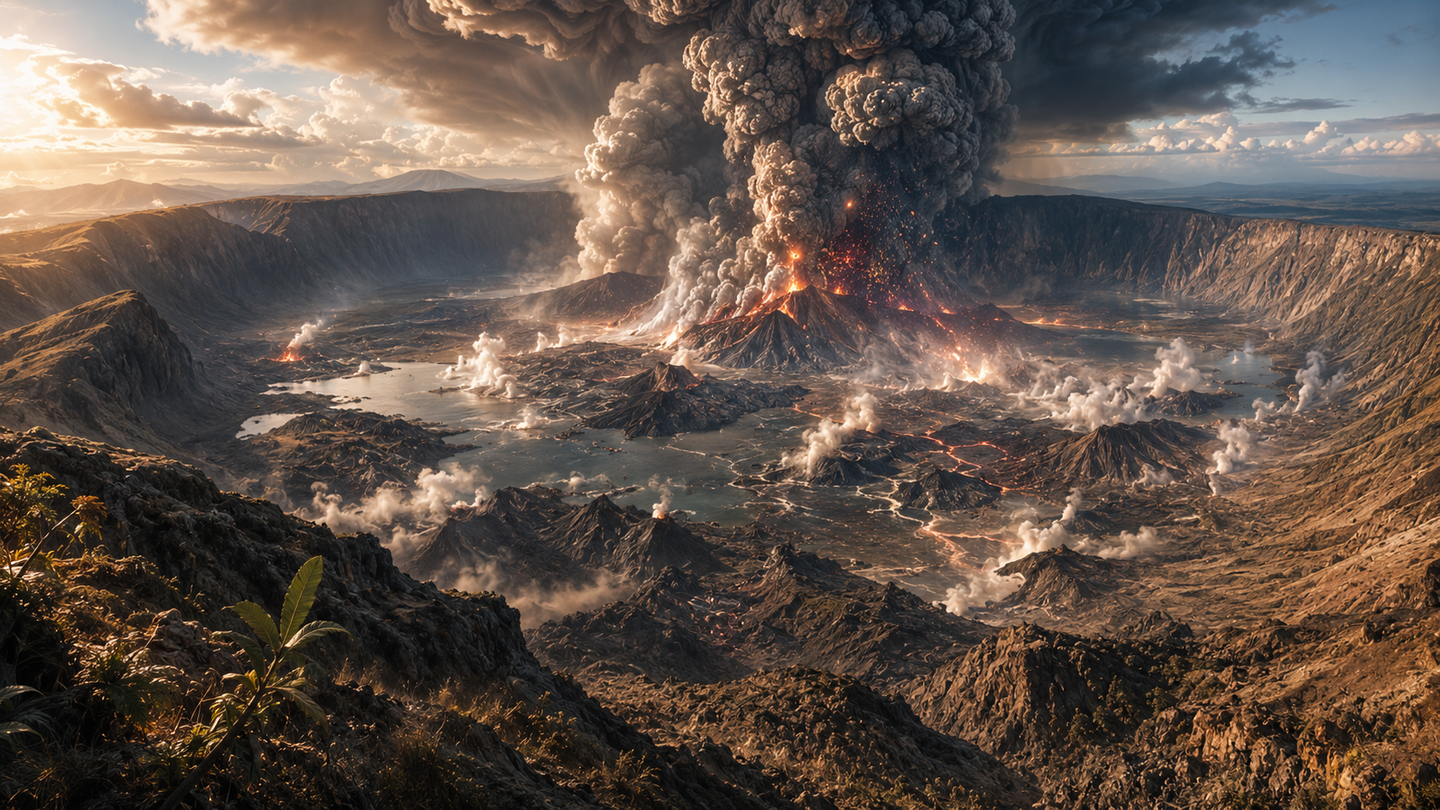
The Toba supervolcano remained active for thousands of years after its giant eruption, challenging how volcanic hazards are assessed. (CREDIT: Shutterstock)
- Indonesia’s Toba supervolcano remained active for thousands of years after its massive eruption about 74,000 years ago.
- Some later eruptions pushed mostly solidified volcanic material to the surface, showing that liquid magma is not always required for renewed activity.
- The findings suggest scientists may need to look beyond underground pools of molten rock when assessing long-term hazards at large volcanoes.
Toba’s 74,000-year-old super-eruption did not mark the end of its danger. Magma beneath the Indonesian caldera remained capable of driving eruptions for thousands of years, even after parts of the system had cooled into solid rock.
An international team involving Curtin University, Oregon State University, Heidelberg University and the Geological Agency of Indonesia examined how the giant volcanic system behaved after the Youngest Toba Tuff eruption. That event expelled at least 2,800 cubic kilometers of rhyolite magma.
The work focused on resurgence, when a collapsed caldera begins adjusting after a major eruption. At Toba, that recovery included uplift and renewed volcanic activity long after the main eruption ended.
“Gaining an understanding of those lengthy dormant periods will determine what we look for in young active supervolcanoes to help us predict future eruptions,” said Associate Professor Martin Danišík of Curtin University’s John de Laeter Centre.
A volcanic system that did not simply switch off
Large calderas such as Toba, Yellowstone in the United States and Campi Flegrei in Italy can remain restless after their biggest eruptions. Gas emissions, earthquakes, structural changes and smaller eruptions can continue as the system readjusts.
At Toba, the team investigated three post-eruption lava domes using two natural clocks preserved in volcanic minerals. Argon in feldspar and helium in zircon become trapped at different temperatures, allowing researchers to reconstruct how the rocks cooled.
The Youngest Toba Tuff samples gave matching argon and zircon-helium ages near 74,000 years. That agreement fits the rapid cooling expected after a catastrophic eruption.
The younger lava domes told a different story. Zircon-helium ages placed eruptions at about 70,000, 67,100 and 61,800 years ago. Their feldspar argon ages remained close to the age of the main eruption.
Bayesian analysis placed the delays between the main eruption and later dome eruptions at about 4,600 to 13,600 years. Thermal models allowed maximum pre-eruptive storage periods of about 4,500 and 7,400 years for the two Samosir domes, and 12,700 years for the Pardepur dome.
Cold rock could still reach the surface
The modelling indicated that the dome material spent long periods at roughly 300 to 425 degrees Celsius, with broader possible limits between about 280 and 500 degrees.
At those temperatures, much of the material would have been below the solidus, the point at which rock becomes sufficiently molten to behave as magma. The material sampled by the later domes was therefore largely solid and would normally be considered non-eruptible.
The researchers argue that the enormous Toba reservoir was thermally uneven. A warmer interior could exist alongside a colder outer “halo,” where crystal-rich material had cooled enough to retain argon.
Rather than being reheated into fully molten magma, solidified remnants may have been pushed upward as the caldera floor rose and new magma moved through the system.
“We showed that magma continued to ooze out within the caldera, or deep depression created by the eruption of magma, for 5000 to 13,000 years after the super-eruption, and then the carapace of solidified left-over magma was pushed upward like a giant turtle shell,” Danišík said.
The team compares the process with a plunger in a syringe. Deeper magma could have forced chilled conduit plugs and other solidified material through fractures reopened during resurgence.
Small eruptions carried a long thermal memory
The post-Toba domes were tiny compared with the super-eruption. The Samosir domes together represented less than 1 cubic kilometer of material, about 0.04 percent of the 2,800 cubic kilometers expelled during the Youngest Toba Tuff event.
Their small size made them unusually useful records of the reservoir’s colder margins. Large eruptions can mix crystals from warmer and colder parts of a magma system, masking their separate histories.
The Toba domes appear to have sampled that cold zone more directly. The researchers caution that labeling entire magma reservoirs as either “cold stored” or “warm stored” can therefore be misleading.
Different parts of the same reservoir may follow very different thermal paths. What scientists conclude can depend heavily on which rocks an eruption brings to the surface.
The timing of the domes also helps define when Toba’s resurgence began. Two Samosir domes erupted several thousand years after the super-eruption, during a period when uplift was reshaping the caldera floor. Geological evidence indicates that uplift continued for at least 36,000 to 42,000 years.
Practical implications of the research
The findings challenge a common approach to volcanic hazard assessment that places heavy emphasis on detecting liquid magma beneath a volcano.
“The findings challenged existing knowledge and studying of eruptions, which normally involves looking for liquid magma under a volcano to assess future hazard. We must now consider that eruptions can occur even if no liquid magma is found underneath a volcano – the concept of what is ‘eruptible’ needs to be re-evaluated,” Danišík said.
That does not mean every solidified volcanic reservoir is ready to erupt. The Toba work instead shows that long-lived caldera systems can remain mechanically active while different parts of their magma reservoirs exist at very different temperatures.
For monitoring active supervolcanoes, that widens the range of signals scientists may need to consider. Structural uplift, fault movement and the behavior of solidified remnants may matter alongside searches for molten rock.
“While a super-eruption can be regionally and globally impactful and recovery may take decades or even centuries, our results show the hazard is not over with the super-eruption and the threat of further hazards exists for many thousands of years after,” Danišík said.
Understanding when eruptible material accumulates, how it moves and whether it is molten or solid before reaching the surface could sharpen interpretations of unrest at large calderas. Toba shows that a supervolcano’s aftermath can last far longer than the eruption that created it.
Most recent supervolcano eruptions
No known supervolcanic eruption has occurred during recorded history. The most recent major events date back tens of thousands to hundreds of thousands of years:
- Taupō Volcano (New Zealand) – About 25,500 years ago, Taupō unleashed the enormous Oruanui eruption, generally regarded as the world’s most recent supereruption. Smaller eruptions followed, including a major explosive event roughly 1,800 years ago.
- Toba Supervolcano (Indonesia) – Roughly 74,000 years ago, Toba produced one of Earth’s largest eruptions of the past 2 million years. The blast triggered severe climatic disruption, although its impact on early human populations remains debated.
- Yellowstone Caldera (USA) – Yellowstone’s most recent supereruption occurred about 631,000 years ago, forming much of the caldera visible today. Later volcanic eruptions have occurred, but none approached supereruption scale.
- Campi Flegrei (Italy) – One of its largest known eruptions, the Campanian Ignimbrite eruption, occurred about 39,000 years ago. The restless caldera remains active, experiencing earthquakes and episodes of ground uplift.
Supereruptions are exceptionally rare but can have consequences extending far beyond the eruption site, including widespread ashfall and global climate disruption. Today, scientists closely monitor several active caldera systems for signs of changing volcanic activity.
Dig deeper into supervolcano resurgence, magma storage and volcanic hazards
These resources explore how large calderas recover after major eruptions, how magma is stored beneath them, and how scientists interpret unrest and future eruption potential.
Petrological Constraints on the Thermal History of Magma Storage in the Crust
This review examines the debate over “cold” versus “warm” magma storage and concludes that silicic magma systems can contain zones with very different thermal and physical states, helping explain why magma mobility cannot be judged from a single reservoir model. (Annual Review of Earth and Planetary Sciences, 2026)
Reappraisal of Holocene Caldera Resurgence at Campi Flegrei (Southern Italy): A Long-Lived Magma-Driven Resurgent Dome System
Researchers reconstructed about 10,500 years of deformation at Campi Flegrei and linked long-term uplift to repeated shallow magma emplacement, offering a modern comparison for understanding resurgence after caldera-forming eruptions. (Journal of Geophysical Research: Solid Earth, 2026)
Scenario-based forecast of the evolution of 75 years of unrest at Campi Flegrei caldera (Italy)
This analysis examines decades of earthquakes, gas emissions and ground deformation at one of the world’s most closely monitored restless calderas, showing how multiple observations can be combined to evaluate possible paths of future volcanic unrest. (Communications Earth & Environment, 2026)
The progression of basaltic–rhyolitic melt storage at Yellowstone Caldera
Magnetotelluric imaging revealed separate regions of rhyolitic melt beneath Yellowstone with generally low melt fractions rather than one enormous eruptible reservoir, illustrating why detecting underground melt does not by itself establish that a major eruption is approaching. (Nature, 2025)
A sharp volatile-rich cap to the Yellowstone magmatic system
Controlled-source seismic imaging identified the top of Yellowstone’s upper-crustal magma system about 3.8 kilometers beneath the northeastern caldera and found evidence for magma and volatile-rich fluids there, adding new detail to how hazardous caldera reservoirs are structured. (Nature, 2025)
Research findings are available online in the journal Nature—Earth and Environmental Sciences.
The original story "Ancient Toba eruption reveals a supervolcano can stay dangerous for thousands of years" is published in The Brighter Side of News.
Related Stories
- The hidden mantle flow shaping Yellowstone’s supervolcano
- Yellowstone lake mud reveals 15,000 years of fire, forest and geyser change
- Global supervolcano threat rises as scientists sound the alarm
Like these kind of feel good stories? Get The Brighter Side of News' newsletter.
Joseph Shavit
Writer, Editor-At-Large and Publisher
Joseph Shavit, based in Los Angeles, is a seasoned science journalist, editor and co-founder of The Brighter Side of News, where he transforms complex discoveries into clear, engaging stories for general readers. With vast experience at major media companies like The Los Angeles Times, Times Mirror and Tribune Publishing, he writes with both authority and curiosity. His writing focuses on space science, planetary science, quantum mechanics, geology. Known for linking breakthroughs to real-world markets, he highlights how research transitions into products and industries that shape daily life.