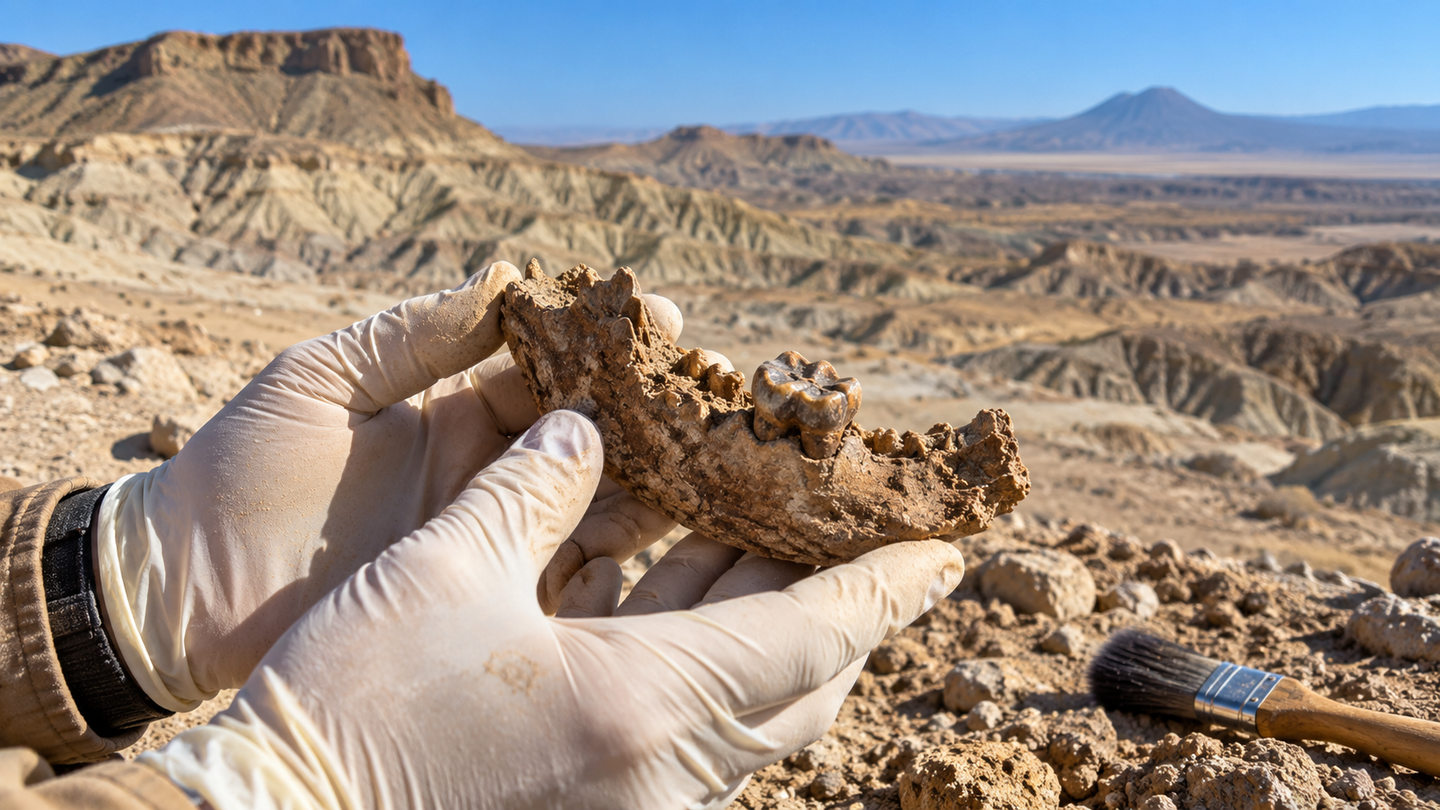
Atomic images reveal why one common mineral is superior at producing ice
Nanoscale imaging shows ice can form across flat microcline surfaces without relying only on cracks or step edges.

 Edited By: Joseph Shavit

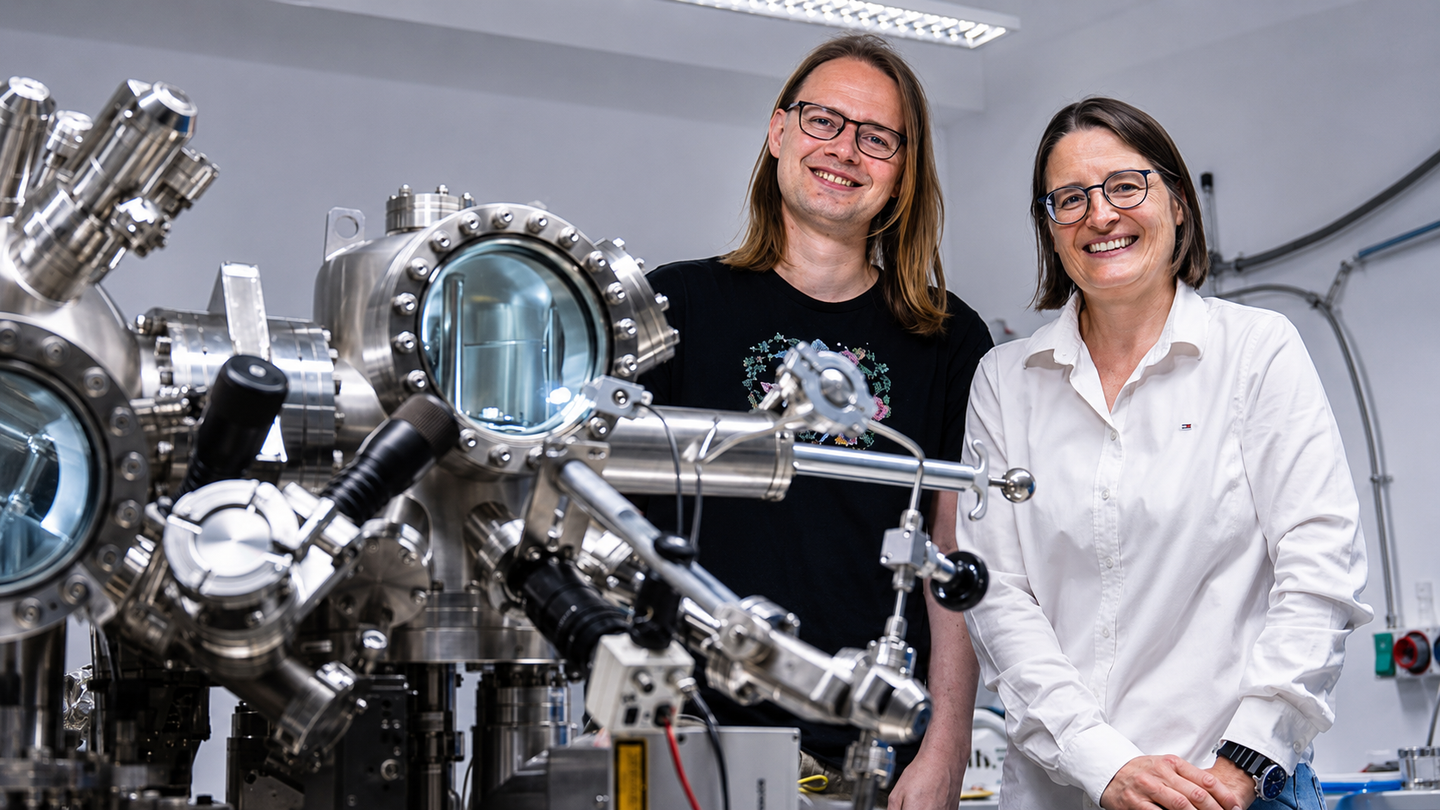
Nanoscale imaging shows ice can form across flat microcline surfaces without relying only on cracks or step edges. (CREDIT: Bielefeld University/Magnus Krenz)
- Microcline can trigger ice formation across ordinary flat mineral terraces, rather than relying mainly on cracks, pores or other rare surface defects.
- Its unusually strong ice-nucleating ability appears tied to an ordered pattern of aluminol groups that helps stabilize hydrogen bonds with water.
- Closely related sanidine behaves differently, showing how tiny changes in atomic organization can strongly alter where and how ice begins to form.
A mineral surface does not always need a crack, pore or other obvious defect to help ice form. Experiments on microcline, a potassium-rich feldspar common in atmospheric dust, suggest its ordinary flat surface carries an atomic arrangement that can help water organize into ice.
The work, published in Nature Communications by researchers at Bielefeld University, the University of Vienna and the University of Helsinki, addresses a long-standing puzzle. Microcline is unusually effective at triggering ice formation, even compared with feldspars that are chemically very similar.
Pure water can remain liquid down to about minus 38 degrees Celsius. In the atmosphere, mineral dust can provide surfaces that allow ice to form at higher temperatures, influencing cloud freezing, precipitation and the amount of sunlight clouds reflect.
Ice forms on ordinary terraces
The team examined microcline’s thermodynamically most stable surface, the (001) cleavage plane. Using dynamic atomic force microscopy under ultrahigh vacuum, the researchers cooled freshly cleaved samples to 145 kelvins and exposed them to water vapor.
Ice clusters began appearing after about three to four minutes when water pressure reached a minimum near 4.6 × 10^-8 millibar. Some formed at surface steps, but many appeared directly on broad, atomically flat terraces.
The crucial test came when the researchers repeatedly removed the ice and allowed it to form again. They ran 16 nucleation and desorption cycles at six locations. For five consecutive cycles, an analysis of 88 nucleation positions found that terrace locations were close to randomly distributed.
If rare defects controlled most of the activity, ice should have returned to the same spots. Instead, large portions of the stable microcline surface appeared able to support nucleation.
A nearly identical mineral acts differently
The team compared microcline with sanidine, another potassium-rich feldspar with almost the same overall composition. Sanidine required more water vapor before ice appeared.
Nucleation became visible above about 7 × 10^-8 millibar, compared with about 4.6 × 10^-8 millibar for microcline. Below 9 × 10^-8 millibar, ice on sanidine formed almost exclusively along step edges.
An analysis of 75 nucleation positions from six consecutive experiments found ice was five times more likely to appear at an edge than a random distribution would predict. Only at higher water pressures did clusters begin forming on sanidine’s flat terraces.
The contrast was difficult to explain through large-scale crystal geometry. Surface unit-cell dimensions differ by less than 1 percent, while their angles differ by less than 3 percent. That pointed toward an atomic-scale difference.
An ordered chemical pattern may guide water
Microcline and sanidine differ in how aluminum atoms are arranged inside their crystal frameworks. Microcline has an ordered aluminum-silicon structure, while sanidine is more disordered.
On microcline’s (001) surface, each unit cell contains two aluminol groups in equivalent, regularly arranged positions. Sanidine has an average of only one randomly positioned aluminol group per unit cell, giving microcline roughly twice the surface aluminol density.
Those groups can form strong hydrogen bonds with water. Molecular dynamics simulations suggested that this ordered pattern could help stabilize the earliest ice structures.
At 145 kelvins, the researchers modeled nanoscale hexagonal ice crystals on both minerals. A larger fraction of water molecules remained ice-like on microcline, and the simulated ice network formed several ice-like hydrogen bonds with hydroxyl oxygen atoms on its surface. Comparable clusters on sanidine formed very few.
“We wanted to understand why microcline is so exceptionally good at forming ice, even though it differs only slightly in chemical composition from other feldspars,” Florian Schneider of Bielefeld University said. “Our results reveal for the first time at the molecular level what makes this mineral so special.”
Ice uses an unexpected crystal face
The orientation of the ice offered another clue. Microcline did not provide its best match with the commonly considered low-index faces of hexagonal ice.
Instead, the team identified a lattice match of better than 5 percent between microcline and the (10.4) plane of hexagonal ice. That is a higher-index, less commonly emphasized crystal face, and the observed crystals aligned in that orientation.
“Interestingly, the (001) surface of microcline does not match with the common surfaces of hexagonal ice,” Tobias Dickbreder of the University of Vienna said.
The result suggests that unusual ice faces may matter more for nucleation than often assumed.
The laboratory is not a cloud
The experiments do not directly recreate atmospheric conditions. Atomic force microscopy examines only a tiny surface area, so the team needed relatively high saturation ratios, about 2 to 5, to observe nucleation within minutes.
The method also cannot easily image the interiors of cracks and pores at the same resolution. Small atomic defects could still contribute to some nucleation events.
Even so, the lack of repeated freezing at the same terrace locations argues against rare, fixed active sites being the main explanation under the conditions studied. Earlier work has shown that pores and cracks can strongly promote ice formation in feldspars. These experiments add another part to that picture by showing that microcline’s stable terrace is already unusually favorable.
Why a flat mineral surface matters
Mineral dust is one route by which ice begins forming in clouds. Understanding which surfaces are most effective could improve how atmospheric models represent dust-driven cloud freezing.
Microcline appears to gain an advantage from a subtle feature: a dense, ordered pattern of aluminol groups that can interact with water and stabilize an ice-like network. Sanidine, despite being nearly identical in composition and surface dimensions, lacks the same ordered pattern and relies more strongly on step edges at lower water pressures.
“Our work closes a key knowledge gap,” Angelika Kühnle of Bielefeld University said. “For the first time, we can explain at the molecular scale why microcline promotes ice formation so efficiently.”
The next challenge is connecting those nanoscale observations with real atmospheric particles, where humidity, pressure, surface damage, pore geometry and mineral mixtures are more complicated.
Dig deeper into feldspar, mineral dust and atmospheric ice nucleation
These resources explore how mineral surfaces, pores, chemistry and molecular-scale water interactions help control ice formation in clouds.
Atmospheric ice nucleation: This review examines the physics of atmospheric ice formation, including mineral particles, water structure, nanopores and the challenges of translating molecular processes into cloud and climate models. (Nature Reviews Physics, 2023)
A first-principles machine-learning force field for heterogeneous ice nucleation on microcline feldspar: This work develops an atomically detailed model for water interacting with microcline and shows that the mineral can influence water structure several angstroms away from its surface. (Faraday Discussions, 2024)
The impact of (bio-)organic substances on the ice nucleation activity of the K-feldspar microcline in aqueous solutions: This study tests how organic and biological compounds alter microcline’s ability to nucleate ice, showing how surface chemistry can change the mineral’s freezing behavior. (Atmospheric Chemistry and Physics, 2022)
Effect of chemically induced fracturing on the ice nucleation activity of alkali feldspar: This research examines how chemically created fractures influence ice nucleation in alkali feldspar, helping clarify how surface damage and newly exposed structures affect freezing efficiency. (Atmospheric Chemistry and Physics, 2021)
Pores Dominate Ice Nucleation on Feldspars: Direct microscopy experiments found that most observed nucleation sites were associated with pores, providing an important comparison with evidence that microcline’s flat terraces can also support ice formation. (The Journal of Physical Chemistry C, 2019)
Research findings are available online in the journal Nature Communications.
The original story "Atomic images reveal why one common mineral is superior at producing ice" is published in The Brighter Side of News.
Related Stories
- China's Chang’e-7 targets the Moon’s South Pole in search of usable water ice
- New form of ice can freeze at room temperature, study finds
- AI maps ice levels beneath the world’s glaciers - could raise global sea levels by over a foot
Like these kind of feel good stories? Get The Brighter Side of News' newsletter.
Rebecca Shavit
Writer
Based in Los Angeles, Rebecca Shavit is a dedicated science and technology journalist who writes for The Brighter Side of News, an online publication committed to highlighting positive and transformative stories from around the world. Having published articles on MSN, AOL News, and Yahoo News, Rebecca's reporting spans a wide range of topics, from cutting-edge medical breakthroughs to historical discoveries and innovations. With a keen ability to translate complex concepts into engaging and accessible stories, she makes science and innovation relatable to a broad audience.