
Laser-induced plasma filament transmits a 30 MHz radio signal without a solid antenna
A laser-created plasma antenna boosted a nearby 30 MHz signal in a lab test; broadband, receiving and space uses remain unproven.
 NC State University Writer: Matt Shipman

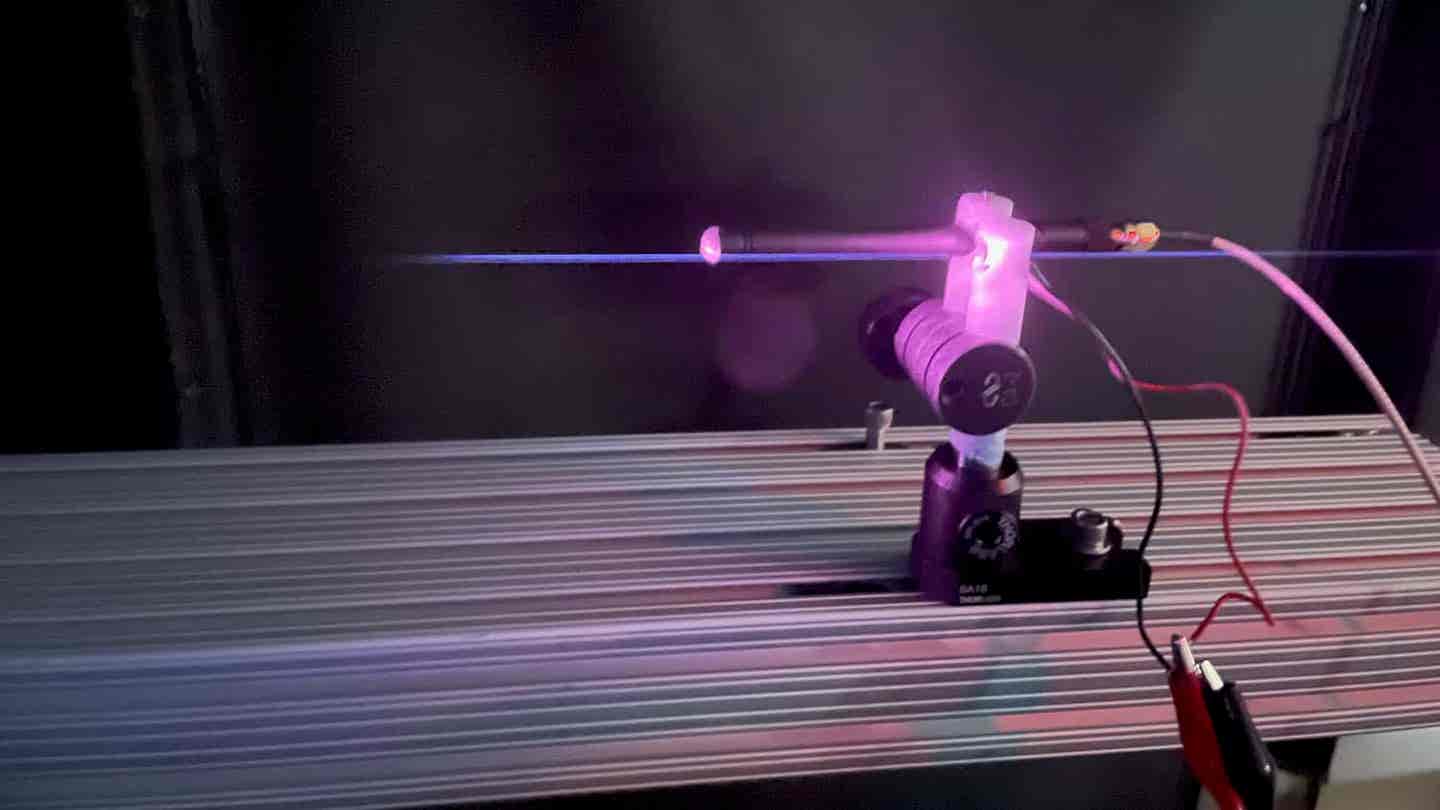
A contactless feed enabled a laser-generated plasma filament to contribute to radio transmission in a short-range laboratory demonstration. (CREDIT: Prya Darshni)
A thin channel of ionized air helped transmit a radio signal without a solid antenna extending along its length. When researchers switched on the laser that created the channel, a nearby receiver registered about 2.5 times the signal measured with the feed alone. The experiment joins efforts to rethink antenna design.
Prya Darshni, a doctoral student at North Carolina State University, and colleagues describe the demonstration in the IEEE Journal of Microwaves. Their antenna used a laser-induced plasma filament, a narrow region containing free electrons and ions. Unlike work that uses lasers to synchronize radio telescopes, this experiment made the plasma itself part of the transmitting structure.
The test operated at 30 megahertz, near the boundary between the high-frequency and very-high-frequency radio bands. It demonstrates a specific laboratory capability, rather than a replacement for conventional antennas. Its appeal lies in the possibility of eventually changing a radiating element with light instead of mechanical hardware.
Making a conducting channel from air
Plasma forms when enough energy separates electrons from atoms or molecules. Here, an intense laser pulse created a filament approximately 20 centimeters long and 0.1 millimeters wide. Related research on air waveguides also uses ultrashort laser pulses to alter air, although guiding light and transmitting radio signals are different tasks.
The laser delivered pulses lasting about 100 femtoseconds, each carrying roughly 5 millijoules, at 1,000 pulses per second. A femtosecond is one quadrillionth of a second. These brief pulses concentrate energy intensely enough to ionize the air rather than merely illuminate it.
Dividing pulse energy by duration gives a peak-power estimate of about 50 billion watts. That does not mean the laser continuously delivered that power: the stated pulse energy and repetition rate correspond to about 5 watts of average optical output. Electrical consumption of the complete laser system is a separate quantity.
The resulting charged channel provided the basis for interaction with radio-frequency signals. The engineering challenge was then to supply those signals without disturbing the filament through direct metallic contact. Creating plasma alone would not establish that it could function as the intended antenna.
Feeding the antenna without touching it
A conventional antenna connects to a transmitter through an electrical feed. The researchers instead placed a capacitive structure around the laser’s path. Its electric field could interact with the plasma without a solid contact, providing a different approach to wireless hardware.
The feed used small copper cylinders surrounding the filament. A radio-frequency generator supplied a 30 MHz signal at 4 volts peak-to-peak, meaning the difference between its highest and lowest voltage. This voltage does not by itself specify transmitted power, which also depends on the electrical load and coupling.
Capacitive coupling transfers energy through an electric field. The team used it to excite the filament, with surface-wave propagation forming part of the proposed explanation for how the plasma carries and radiates the signal. The metal feed remained essential, so the system was not entirely metal-free.
This distinction separates the source of the radio signal from the laser’s role. The generator provided the radio-frequency drive; the laser created the plasma structure that interacted with it. Changing the medium carrying electromagnetic energy is a broader theme in waveguide research, but this experiment tested a particular antenna arrangement.
What the receiver actually measured
The researchers compared the same feed with and without the plasma filament. Blocking the laser supplied the baseline, which included a signal from the feed itself. Allowing the laser through then tested the added contribution of the plasma to the transmission system.
With the filament present, the received waveform reached approximately 0.5 millivolts, about 0.3 millivolts above the feed-only measurement. The reported increase was approximately 150%, equivalent to 2.5 times the baseline signal. These voltage measurements should not be read as a directly established 150% increase in radiated power or efficiency.
Both antennas had matching linear polarization, meaning their electric-field orientations aligned. They sat approximately 5 centimeters apart in an unobstructed near-field configuration. At 30 MHz, the free-space wavelength is roughly 10 meters, making that separation very small compared with the wavelength.
The near field contains local electromagnetic interactions that differ from the far-field radiation used in long-distance communication. Consequently, this comparison supports the reported proof of concept without establishing a useful communication range. Future antenna characterization must distinguish nearby coupling from performance over greater distances, a crucial issue for radio observations and communications alike.
Changing geometry with a laser
Antenna dimensions influence the frequencies at which a structure operates effectively. Mechanical adjustment can become difficult when equipment must unfold or change configuration remotely. That motivates research into reconfigurable antennas and provides the central attraction of the plasma approach.
Laser parameters influence filament characteristics, including length. The researchers therefore envision adjusting the radiating element without extending or retracting a metal rod. However, a demonstration at 30 MHz does not establish operation across every frequency, or even a measured broadband tuning range.
Steering the laser could also change the filament’s orientation. This offers a potential way to reconfigure the antenna, but filament direction and the complete radio radiation pattern are not interchangeable. Researchers still need to measure how changes in geometry affect gain, polarization and directionality.
“The plasma beam antenna looks like a lightsaber and is tunable, meaning we should be able to transmit across a broad range of frequencies,” Darshni said. That expectation points toward future experiments, much as laser-created channels require testing under the conditions of their intended application.
The next tests go beyond a nearby signal
Satellite and aircraft applications interest the team because antenna size and deployment can constrain system design. Yet replacing a solid radiating element would still leave the laser, optics, feed and power supply. Any advantage for space instruments requires evaluating that complete package.
The current experiment used ordinary atmospheric conditions. Low-pressure tests must establish how reliably filaments form and behave in thinner air before orbital operation becomes credible. The presence of some atmospheric particles at altitude does not demonstrate an antenna capable of working there.
Receiving with the plasma filament also remains a proposed capability. The experiment’s conventional receiver detected the transmission, but the team did not demonstrate the filament acting as a receiver. Those are separate milestones in developing radio technology.
Modeling presents another challenge because the filament is extremely thin compared with the radio wavelength. A calculation must represent both the narrow plasma structure and electromagnetic behavior across much larger distances. Better models could guide improvements to the feed and help explain which plasma properties control performance, while measurements remain necessary to establish how much radio energy the system actually radiates.
The immediate result is a measured contribution from a capacitively fed plasma filament at one frequency and short separation. The next advance must quantify radiation, efficiency and controllability, then show whether those properties persist beyond the laboratory arrangement.
Dig deeper into laser-created plasma channels
These studies explain filament formation and related ways lasers reshape electromagnetic propagation.
- Femtosecond laser-induced plasma filaments for beam-driven plasma wakefield acceleration: Characterizes plasma filaments in low-pressure nitrogen, illustrating why pressure-specific measurements matter for proposed applications. (Physical Review E, February 2025)
- Two-dimensional high resolution electron properties of femtosecond laser-induced plasma filament in atmospheric pressure argon: Measures electron properties within a filament, providing context for the plasma characteristics that influence electromagnetic behavior. (Scientific Reports, February 2024)
- Optical Guiding in 50-Meter-Scale Air Waveguides: Uses laser filaments to shape air into an optical guide, a related application distinct from radio transmission. (Physical Review X, January 2023)
- Laser-guided lightning: Reports field observations of laser-guided lightning, showing another application of laser-modified atmospheric paths. (Nature Photonics, January 2023)
- Femtosecond filamentation in transparent media: Reviews the nonlinear optical processes underlying filament formation in air and other transparent materials. (Physics Reports, March 2007)
Research findings are available online in the journal IEEE Journal of Microwaves.
The original story "Laser-induced plasma filament transmits a 30 MHz radio signal without a solid antenna" is published in The Brighter Side of News.
Related Stories
- Scientists twist laser light into patterns that can repair themselves
- Laser light reveals the hidden quantum properties of crystals
- Lasers reveal a rugby-ball-shaped nucleus inside fermium-255
Like these kind of feel good stories? Get The Brighter Side of News' newsletter.
Shy Cohen
Writer