Ancient argon may hide clues to the rocky interiors of Uranus and Neptune
Argon from the early solar system could mask the gas made by radioactive decay inside Uranus and Neptune. A second isotope could help future probes tell the sources apart.
 SWRI Writer: Jesus Chavez

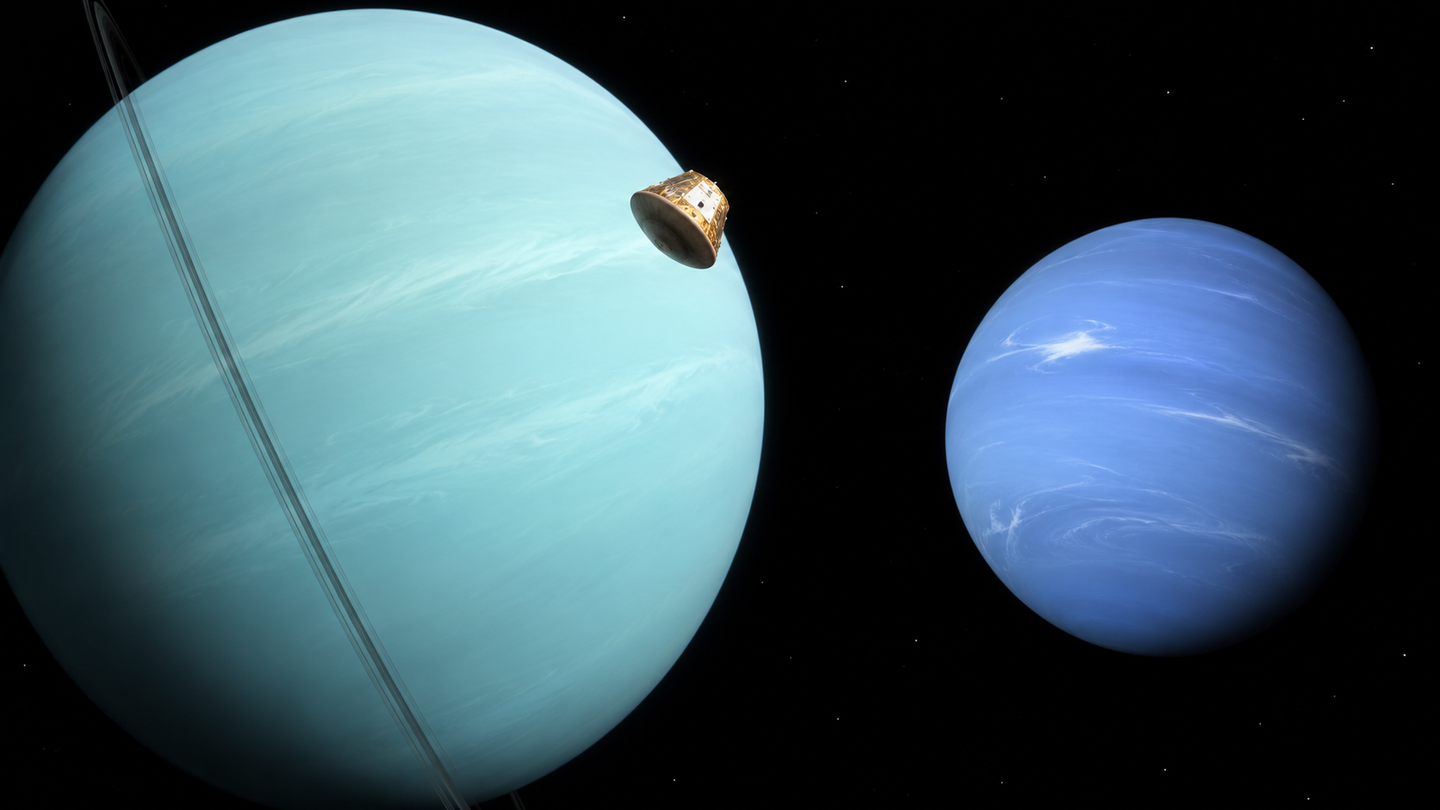
An artist’s rendering shows a proposed atmospheric probe approaching Uranus, with Neptune at right. A future probe could measure argon isotopes to help distinguish gas inherited during planet formation from gas produced by radioactive decay in buried rock. (CREDIT: The Brighter Side of News)
- A new model tests whether atmospheric argon-40 could reveal how much rock Uranus and Neptune contain.
- Argon inherited from the early solar system could overwhelm the contribution from radioactive decay inside the planets.
- Measuring two argon isotopes together could help a future probe distinguish between clues to planetary formation and clues to the interior.
A trace gas could help explain how Uranus and Neptune formed. It could also give a misleading answer about what lies deep inside them. The same isotope, argon-40, can come from the material that built the planets or from the slow decay of radioactive potassium in their rocky interiors.
Researchers led by Olivier Mousis at Southwest Research Institute modeled how much each source might contribute. Their study in The Planetary Science Journal finds that under some formation conditions, inherited argon-40 could drown out the signal from rock. The analysis predicts what a future probe could find. The researchers did not directly sample either atmosphere.
The result adds a new question to the debate over the planets’ chemical origins. A probe that detects abundant argon-40 would first need to determine how much arrived with the planets’ building blocks.
That distinction matters because the familiar label “ice giants” leaves their proportions of rock and ice open. Researchers can study features such as Uranus’ auroras remotely. A measurement of rare gases inside the atmosphere could give them a different view of each planet’s history.
Why argon-40 could reveal hidden rock
Potassium-40 occurs naturally in rocky material. Over billions of years, some of it decays into argon-40. If that argon moves out of the rocky interior and into the hydrogen and helium envelope, a probe could sample it. More rock could produce more argon-40, provided the rocks started with comparable potassium concentrations and released comparable shares of the gas.
Neither condition is guaranteed. The team estimated production using plausible potassium contents and explored how much of the resulting argon might reach the envelope. The efficiency of that transfer is poorly known. Layers of different composition could impede mixing, so even a planet that produced a great deal of argon-40 might deliver only a small share to an instrument near the clouds.
The signal also depends on how much gas receives it. The same amount of argon released into a larger envelope would be more diluted. The model therefore considers the amount of rock relative to the mass of the envelope when estimating what an instrument might see.
Atmospheric measurements therefore need models that connect a local sample with the rest of the planet. Recent work on carbon monoxide in the two atmospheres illustrates this challenge. More generally, studies of planetary atmospheres can use chemistry to test formation histories, even when the connection depends on how material moves within a planet.
How the early solar system could supply argon
The other source goes back to the protosolar nebula, the disk of gas and dust from which the planets formed. The researchers simulated how the disk cooled and how gas and solids moved. That let them follow argon as it condensed into solid form or became trapped inside cages of water ice. The process depends on temperature and on how the surrounding disk changes with time.
Near a frost line, a substance can move between vapor and solid as it crosses a temperature boundary. Particles carrying argon can drift inward and release it as they warm. Some vapor can then move outward and freeze again. Over time, the process can enrich solids near the boundary. Similar questions about planetary building blocks arise in studies of icy bodies that formed far from their stars.
The model finds that the amount of argon delivered in solids depends strongly on where and when those solids were assembled. Combining the simulations with estimates of atmospheric carbon produced a wide range of possible enrichments.
Under the modeled conditions, the inherited argon could range from roughly the protosolar abundance to about 610 times that level for Uranus and 1,220 times for Neptune. Those upper values depend on the assumed properties of the disk and on how argon and carbon entered the solids.
The wide ranges show how differently two sets of building blocks can record the same disk. They also refer to where the material acquired its chemistry. A planet could gather solids that had traveled from a different part of the disk, an important distinction when interpreting a frost line.
How argon-36 could clarify atmospheric argon-40
Argon-36 provides a way to test how much argon the planets inherited. It is the most abundant isotope in primordial argon and is not produced by potassium-40 decay. If a probe measured a large excess of argon-36 relative to the starting material of the solar system, that would indicate a substantial inherited supply. It would also make it more likely that inherited argon-40 masks the contribution from rock.
If argon-36 shows little enrichment, the story changes. Argon from radioactive decay could make up a substantial share of atmospheric argon-40, perhaps even the dominant share. Under those conditions, the measurement could still help constrain the rocky component. Researchers would also need a better estimate of the original isotope ratio, which the paper identifies as an important uncertainty.
The point is to interpret the gases together. In a separate comparison of the planets’ carbon and oxygen, researchers used chemistry to explore whether the two worlds assembled from different materials. An isotope measurement would add an independent line of evidence. Studies of volatile compounds in smaller bodies also show why several chemical clues can be more informative than one.
What a future probe could measure
Voyager 2 flew past Uranus in 1986 and Neptune in 1989. Those encounters gave scientists their only close spacecraft views of either planet. More recently, observations of Uranus’ atmosphere have mapped parts of its upper layers. A descent probe could take the next step by collecting gas directly and using a mass spectrometer to distinguish the isotopes.
The proposed Uranus Orbiter and Probe concept offers one way to make such measurements. The authors also point to nitrogen and carbon isotope ratios as complementary clues. Some compounds condense or react in the clouds, so a reading from one altitude may not capture the abundance deeper down. That problem also appears when scientists use light to infer the composition of atmospheres around distant worlds.
A precedent comes from Jupiter. The Galileo probe measured several noble gases during its descent, but its instrument did not detect argon-40. The authors suggest that a more sensitive instrument at Jupiter could also help pin down the original isotope ratio, making readings at the ice giants easier to interpret.
One probe would tell researchers about one planet. Comparable measurements at both would let them ask whether the same process left similar signatures in Uranus and Neptune. A large inherited signal would point toward the cold conditions that shaped their raw materials. A smaller one would leave more room for the signal from rock buried deep inside.
Dig deeper into the ice giants
Contrasting C/O ratios in Uranus and Neptune from disequilibrium chemistry
The authors use atmospheric chemistry to test whether Uranus and Neptune acquired different proportions of carbon and oxygen. (Astronomy & Astrophysics, September 2026)
Icy or rocky? Convective or stable?
Interior models examine how different mixtures of rock and ice can fit the available observations. (Astronomy & Astrophysics, December 2025)
Mining Old Data From NASA’s Voyager 2 Solves Several Uranus Mysteries
A fresh analysis shows how a solar wind event affected what Voyager 2 saw at Uranus. (NASA Jet Propulsion Laboratory, November 2024)
Origins, Worlds, and Life decadal survey briefing
The briefing summarizes priorities for planetary science, including a Uranus orbiter and atmospheric probe. (National Academies, April 2022)
Noble gas abundance and isotope ratios in the atmosphere of Jupiter
The Galileo team reports what an entry probe learned by sampling noble gases directly. (Journal of Geophysical Research: Planets, June 2000)
Research findings are available online in the journal The Planetary Science Journal.
The original story "Ancient argon may hide clues to the rocky interiors of Uranus and Neptune" is published in The Brighter Side of News.
Related Stories
- Neptune and Uranus appear to have significantly different chemical origins
- Scientists discover new state of matter inside Uranus and Neptune
- Rethinking the “Ice Giants”: Uranus and Neptune may be rockier than we thought
Like these kind of feel good stories? Get The Brighter Side of News' newsletter.
Joseph Shavit
Writer, Editor-At-Large and Publisher
Joseph Shavit, based in Los Angeles, is a seasoned science journalist, editor and co-founder of The Brighter Side of News, where he transforms complex discoveries into clear, engaging stories for general readers. With vast experience at major media companies like The Los Angeles Times, Times Mirror and Tribune Publishing, he writes with both authority and curiosity. His writing focuses on space science, planetary science, quantum mechanics, geology. Known for linking breakthroughs to real-world markets, he highlights how research transitions into products and industries that shape daily life.