Scientists twist laser light into patterns that can repair themselves
Researchers rotated overlapping patterns of polarized light to create new structures. Some recovered after opaque disks blocked parts of the beam.

 Edited By: Joseph Shavit

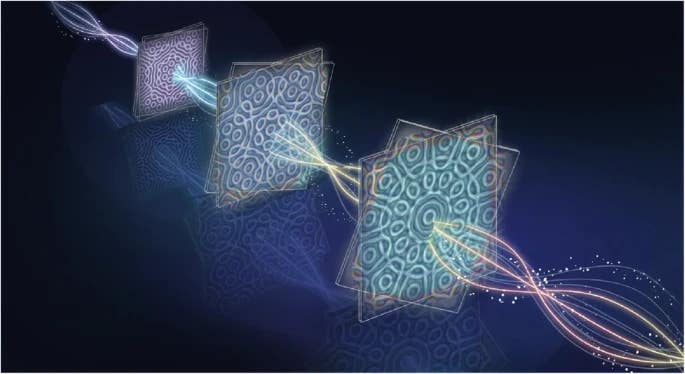
Conceptual architecture of freespace twistronics and optical supertopologies. (CREDIT: ZHE)
- Researchers digitally rotated and overlapped two patterns of polarized light to create new optical structures in free space.
- Selected patterns remained stable over 40 centimeters in the lab. Some recovered after opaque disks blocked parts of the beam.
- The method gives researchers a way to test how structured light might carry information or control particles.
Place two grids over each other and turn one slightly. The lines begin to form a larger pattern that appears in neither grid alone. Researchers in Singapore have now used that principle to combine two patterns made from laser light. Some of the resulting structures could rebuild parts of themselves after an obstacle blocked them.
Yijie Shen led the team at Nanyang Technological University. The study, published in Light: Science & Applications, calls the resulting patterns optical supertopologies. They are arrangements of polarization, the direction and motion of light’s electric field, that can travel through free space.
The idea borrows from twistronics, which studies what happens when thin crystalline layers are rotated relative to one another. In certain materials, the overlap changes how electrons behave. Experiments on twisted materials show how sensitive those effects can be to the angle between layers.
The new work brings that control to light itself. The researchers encoded two lattices and their relative rotation in a digital hologram. Changing the hologram let them explore a new pattern using the same apparatus. That flexibility adds to the ways researchers can design twisted light for experiments.
How optical supertopologies form
The researchers used a spatial light modulator, a device that changes how a light wave emerges across a grid of pixels. A computer-generated hologram tells the device how to shape the beam. The team used it to superpose two lattices with different orientations around a common propagation axis. The rotation was across the beam, like turning a pattern printed on a sheet while keeping its center fixed.
Each lattice contained repeated changes in polarization. At one point, the electric field might oscillate along a line. At another, it might trace an ellipse. A skyrmion is a texture in which those polarization states wrap around the full range of possible orientations in a particular way. Researchers can describe that wrapping with a number. The number gives optical information a label that can survive some changes in the pattern’s shape.
A camera ordinarily records how much light arrives at each point. That image misses the direction in which the field oscillates and whether it rotates as it does so. The team reconstructed the polarization across the beam to identify the textures it had created.
Where the two lattices overlap, their waves interfere. The combined polarization pattern can have a larger repeating unit than either starting lattice. This is a moiré superlattice. The same broad principle explains why a small change in the angle between crystal layers can produce a much larger pattern, even though the physics inside those materials differs.
Different angles produce different patterns
At a relative angle of 13.2 degrees, the team obtained repeated units it calls skyrmionium bags. Each unit contains several smaller skyrmions inside a larger polarization texture. The term “bag” describes how the patterns sit within one another. All of them are features of the same light field, which the team reconstructed from polarization measurements.
A turn to 27.8 degrees produced a different arrangement with several nested rings at its center. Other combinations produced clusters. At some angles, the overlap yields a pattern with rotational symmetry and no regularly repeating unit. Such quasicrystal patterns broaden the design options beyond familiar repeating grids.
The starting geometry matters too. The researchers combined lattices with sixfold or fourfold symmetry in different tests. A given rotation therefore does not specify a pattern on its own. The result also depends on what is being rotated and how the two lattices are aligned.
The twist angle is only one control. Shifting the point around which a lattice rotates changes which parts of the original patterns line up. The study also explored changing the axes along which the lattices travel, which can make the texture evolve with distance.
As in other work on optical vortices, manipulating the beam requires controlling features that an ordinary intensity image cannot fully show. A polarization measurement can reveal the organization hidden in that image.
A partially blocked beam can rebuild its pattern
Ordinary focused beams spread as they travel. The team arranged the waves in its lattices so selected patterns could propagate with little change across the measured distance. For two bag patterns and two cluster patterns, the researchers tracked the polarization textures from the start of the test to 40 centimeters. The measured skyrmion numbers remained close to the predicted values. In a practical optical system, the size of the aperture limits how long that behavior can last.
To test recovery, the team used one opaque disk to block one unit and then used two disks to block two units. Farther downstream, the affected polarization patterns gradually returned, and their measured skyrmion numbers moved back toward their original values. Measuring that number helped distinguish recovery of the texture from a simple return of brightness. Other work on topological labels likewise separates what a beam looks like from the information its polarization carries.
The light that passes around the obstruction continues to interfere as it travels. That interference can reconstruct missing features, including their polarization. The size and position of the blockage affect how well and how quickly the pattern returns. Experiments on laser manipulation illustrate a broader point: the field in a particular part of a beam depends on how the light was shaped before it arrived there.
From a lab pattern to a working application
One possible use is to encode information in several features of the same beam. A receiver could look for a particular arrangement or a skyrmion number, depending on what the transmitter encodes. Before the approach can support optical communications, researchers would need to test how accurately receivers can distinguish those signals under turbulence and across realistic distances.
Another possibility is to project the patterns onto matter. Laser light can already act as optical tweezers, holding small objects with forces created by the light field. The new patterns could offer additional ways to arrange particles or atoms. Whether they can do so depends on how the target responds to the light and on the forces the setup can produce.
A communications test would need to check more than whether a pattern reappears. It would need to show how much signal reaches the receiver, how often one pattern is mistaken for another and how those errors change when multiple channels are used.
The researchers also want to explore whether related patterns can be made with sound, elastic waves or electron waves. Each would require a different way to build and overlap the starting lattices. The optical experiment gives them a specific behavior to look for: a larger pattern that changes when the relative orientation changes and can recover after part of it is lost.
Dig deeper into structured light and twistronics
Topological protection of optical skyrmions through complex media
The researchers investigate how optical skyrmions respond to changes as they pass through complex media. (Light: Science & Applications, November 2024)
Optical skyrmions and other topological quasiparticles of light
A review explains how topological textures are defined and measured in light. (Nature Photonics, December 2023)
Self-healing of structured light: a review
This review surveys the ways shaped beams can recover after an obstruction. (Journal of Optics, September 2022)
Unconventional superconductivity in magic-angle graphene superlattices
The researchers show how rotating two graphene layers changes their electronic behavior. (Nature, March 2018)
Diffraction-free beams
An early experiment demonstrates a beam that can retain a narrow central region over an extended distance. (Physical Review Letters, April 1987)
Research findings are available online in the journal Light: Science & Applications.
The original story "Scientists twist laser light into patterns that can repair themselves" is published in The Brighter Side of News.
Related Stories
- Light-powered neural network could transform future quantum communications
- Physicists use 3D light pulses to unlock new electron quantum states
- Scientists reshape light to control magnetic memory and a material's magnetic properties
Like these kind of feel good stories? Get The Brighter Side of News' newsletter.
Shy Cohen
Writer