
A robot swarm could explore Mars by air, on foot and underground
Flying scouts, walking machines and rovers could explore Mars together. Würzburg engineers are developing the navigation and camera systems to help them do it.
 University of Würzburg Writer: Robert Emmerich

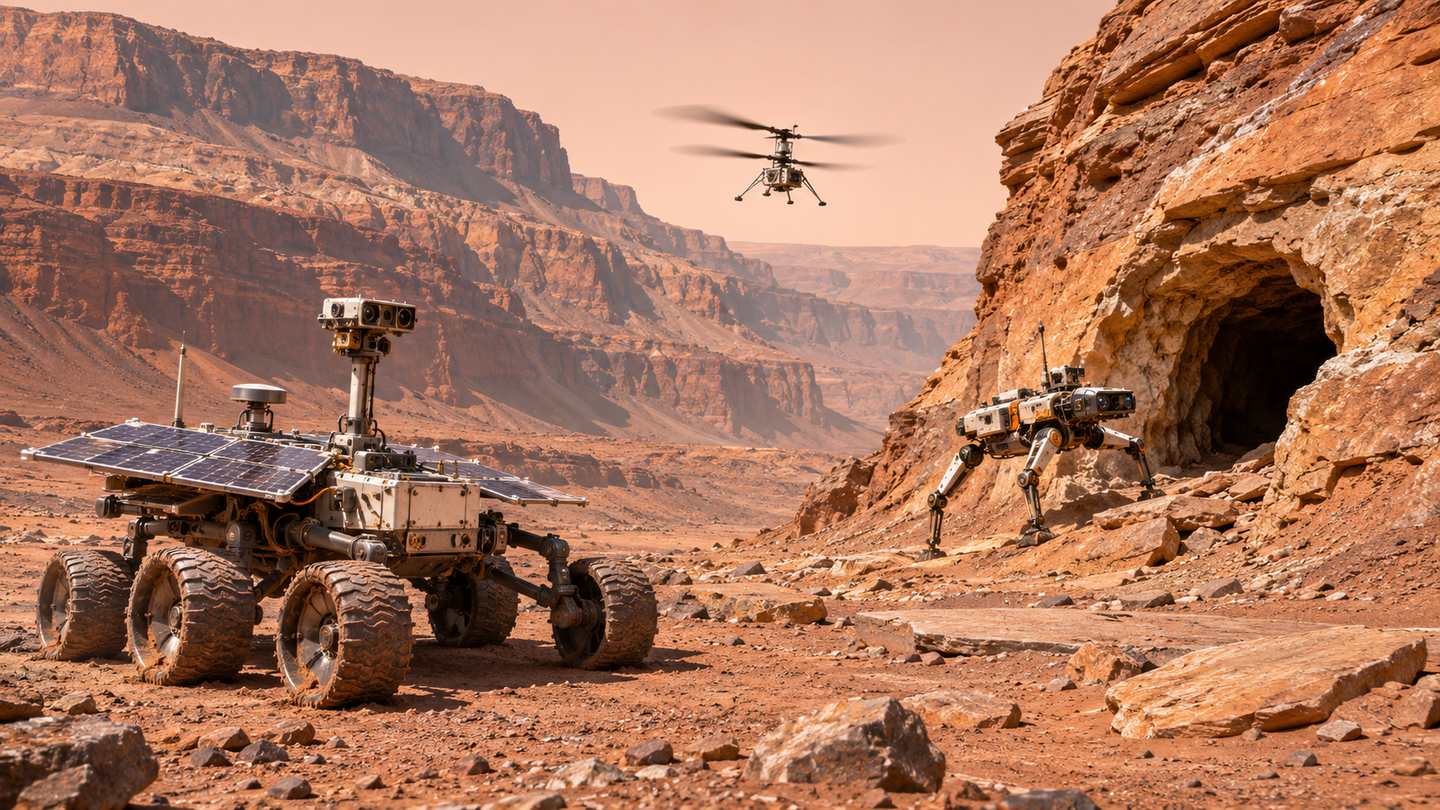
An artist’s rendering shows a wheeled rover crossing the floor of Valles Marineris, a walking robot approaching a cave and a scout flying overhead. Germany’s VaMEx project is developing technology that could help robots like these explore Mars together. (CREDIT: The Brighter Side of News)
- Germany’s VaMEx initiative is developing teams of flying, walking and wheeled robots for a possible expedition to Valles Marineris.
- Würzburg researchers are adapting a sky camera and developing navigation that combines celestial observations with radio beacons.
- The team plans to test its technology on Earth, including a Mars simulation in Portugal scheduled for April 2027.
A wheeled rover can cover stretches of open ground on Mars, but a steep slope or a dark opening can stop it short. A flying scout could look for another route. A walking robot could examine terrain that wheels struggle to cross. Engineers in Germany are working on a way to make those machines cooperate as they explore the same landscape.
The project is called Valles Marineris Explorer, or VaMEx. The German Aerospace Center has tested elements of the concept on Earth. In its fourth development phase, two teams at the University of Würzburg will work on ways for the robots to find their position and share observations.
The robot swarm is a proposed Mars mission concept. The new work is a three-year technology project that began in October 2026. Würzburg says the German Space Agency at DLR is providing about €1.4 million for the university’s contribution. The effort builds on a program that began in 2012 and on the broader development of walking robots for planetary exploration.
The planned destination is Valles Marineris, a canyon system about 4,000 kilometers long. The mission concept includes exploring possible caves and collecting images and other data. Research with a cave rover on Earth illustrates why those spaces need different tools from the open surface.
A robot swarm for terrain that keeps changing
A rover, a walking machine and an aircraft each see a different part of a canyon. A scout overhead can survey a slope before a ground robot tries to cross it. A rover can spend longer investigating an accessible site. A walking machine could step across rocks or gaps that are awkward for a wheeled vehicle. The project aims to coordinate those jobs so the robots can use one another’s observations.
Flight on Mars has a precedent in NASA’s Ingenuity, which flew alongside the Perseverance rover. VaMEx adds the challenge of coordinating several kinds of machines in rough terrain. A route that appears open from above may still be too steep for a rover. A robot swarm would need a way to share that information while each machine works within its own limits.
Working as a group also changes what happens when a route becomes impassable. One machine could investigate a detour while another continues to survey its own area. How much of that coordination can happen automatically is one of the engineering questions behind the concept.
The canyon is also of scientific interest. Orbital measurements have pointed to water or water-bearing material in part of the canyon system. That makes it a place to investigate past or present habitability. Work on Mars-like conditions can help guide those questions. The proposed exploration would look for evidence on the ground, including in sheltered places where conditions may differ from the exposed surface.
SkyCAM would watch for brief events
Hakan Kayal’s team is adapting SkyCAM for the Janus rover. The camera system looks for short-lived events such as meteors, clouds or flashes. An automatic trigger could capture an event that begins and ends while the rover is busy with other tasks. Surface cameras offer a different view from spacecraft overhead, much as instruments on the Curiosity rover can examine material in ways an orbiter cannot.
Würzburg plans to prepare SkyCAM for AMADEE-27, a Mars simulation organized by the Austrian Space Forum. The university lists April 5 to 18, 2027, for the exercise in Monsaraz, Portugal. The team hopes to set up two or three stations and synchronize them so each records the same event at the same time.
A single camera can show the direction in which an object appears to move. Views from separate positions can also help estimate how far away it is and how fast it is traveling. Würzburg wants to test whether those measurements can help with navigation. For a team that includes a flying scout, combining observations across stations could provide more information than a single view from the ground.
Navigation without a satellite network
On Earth, GPS gives a vehicle a position derived from signals sent by satellites. Mars lacks an equivalent navigation constellation. Guido Dietl’s team is developing a system that would use the Sun and stars as references and combine those observations with signals from radio beacons. Each source can help answer a different part of the navigation problem.
The beacons would use ultra-wideband radio. The engineers want to measure distances and the direction from which a beacon’s signal arrives. Combining several measurements could help a robot estimate where it is and which way it is moving. That would support autonomous navigation when the team cannot depend on step-by-step instructions from Earth.
The Sun and stars provide references for orientation, while known beacon locations can help tie a robot’s measurements to a local map. That distinction matters when two vehicles see the same feature from different sides. Their observations become more useful when they can place it in the same coordinate system.
Canyon walls and cave entrances make that combination especially relevant. A robot can lose sight of the sky underground, and rock can block or reflect radio signals. A field test could show where a robot still gets reliable measurements and where it needs more support. Other work on underground exploration faces the same practical question of what a machine can do once it leaves open ground.
Earth trials come before a Mars expedition
The two Würzburg teams will initially help define how sensors, software and vehicles fit together. They will then integrate their systems into the swarm and test them under field conditions. Those trials can reveal whether the machines agree on positions and observations, a prerequisite for combining separate journeys into a usable map.
A previous VaMEx phase brought robots together at an off-road site in Langenaltheim, Germany. Tests like that expose the machines to uneven ground and obstacles that are hard to reproduce in a lab. Portugal offers another opportunity to evaluate how people and robots share work during a simulated mission. Longer term, the experience may also inform research on planetary caves elsewhere in the solar system.
A successful Earth trial would show which tools work together under those test conditions. Engineers would still need to account for Mars itself, including thin air for flying machines and dusty surfaces that can complicate camera observations.
Finding a scientifically interesting site is only part of an expedition. The team also needs to know where an image came from, whether another machine can reach the same spot and how to get observations back when a robot moves beyond sight. Those capabilities would help researchers decide where to send instruments and how to interpret signs of habitability in a landscape as large as Valles Marineris.
Dig deeper into robotic Mars exploration
NASA’s Perseverance Rover Completes First AI-Planned Drive on Mars
JPL explains how engineers tested AI-assisted route planning and checked commands before a rover drive. (NASA Jet Propulsion Laboratory, January 2026)
RM-Scout rover joins the VaMEx-3 test campaign in Langenaltheim
DLR describes an earlier field campaign involving the rover and other vehicles in the swarm. (German Aerospace Center, August 2025)
After Three Years on Mars, NASA’s Ingenuity Helicopter Mission Ends
NASA reviews the helicopter’s flights and the experience gained operating an aircraft on Mars. (NASA, January 2024)
ExoMars discovers hidden water in Mars’ Grand Canyon
ESA explains how orbital measurements revealed evidence of water near the surface in part of Valles Marineris. (European Space Agency, December 2021)
Recurring Martian Streaks: Flowing Sand, Not Water?
NASA describes evidence that seasonal dark streaks may be caused by moving grains. (NASA, November 2017)
The original story "A robot swarm could explore Mars by air, on foot and underground" is published in The Brighter Side of News.
Related Stories
- Scientists find that Earth microbes can thrive in Mars-like conditions
- Mars orbiter finds hidden volcanic activity near Alba Mons
- Japan’s historic MMX mission begins a daring journey to collect the first samples from Mars’ moon Phobos
Like these kind of feel good stories? Get The Brighter Side of News' newsletter.
Joseph Shavit
Writer, Editor-At-Large and Publisher
Joseph Shavit, based in Los Angeles, is a seasoned science journalist, editor and co-founder of The Brighter Side of News, where he transforms complex discoveries into clear, engaging stories for general readers. With vast experience at major media companies like The Los Angeles Times, Times Mirror and Tribune Publishing, he writes with both authority and curiosity. His writing focuses on space science, planetary science, quantum mechanics, geology. Known for linking breakthroughs to real-world markets, he highlights how research transitions into products and industries that shape daily life.