Interstellar comet 3I/ATLAS contains planet-building materials from worlds beyond Neptune
Webb observations reveal unusual dusty ice around interstellar comet 3I/ATLAS, hinting that planetary systems may share similar forms of icy building blocks.
 SWRI Writer: Deb Schmid

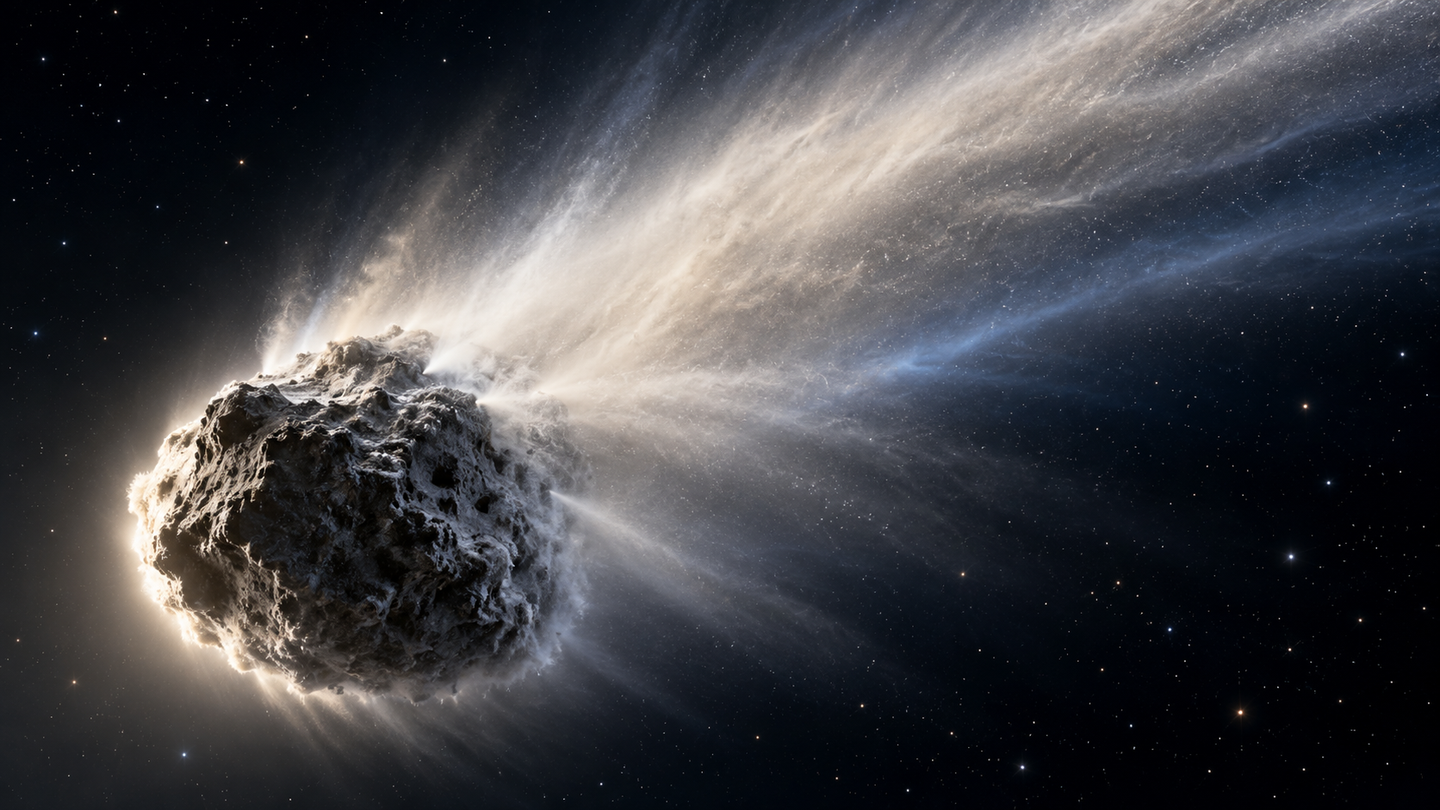
Webb spectra suggest 3I/ATLAS carries dusty ice grains resembling material in distant solar system worlds. (CREDIT: The Brighter Side of News)
- Webb observations suggest that interstellar comet 3I/ATLAS releases tiny grains of water ice mixed with substantial amounts of dust.
- Models explain a strong infrared ice signature alongside unusually weak or missing bands at shorter wavelengths.
- Similarities with distant solar system bodies hint at shared planet-building materials, but do not establish identical origins or compositions.
Dusty ice streaming from a comet born around another star carries a surprisingly familiar signature. Observations of interstellar comet 3I/ATLAS suggest that its tiny icy particles resemble material associated with distant worlds in our own solar system. The resemblance offers a way to investigate whether different planetary systems assemble their icy building blocks in similar forms.
A Southwest Research Institute–led team analyzed the comet using NASA’s James Webb Space Telescope. The study, published in The Astrophysical Journal Letters, points to clusters of water ice and dust with characteristic sizes around a micron or smaller. A micron is one millionth of a meter, far below what the unaided eye can resolve.
These particles differ from the relatively clean ice inferred in several previously studied comets. Yet their infrared signatures resemble those of some icy bodies beyond Neptune. The results suggest a shared range of grain properties across planetary systems, rather than identical ingredients or a proven common formation history.
A visitor carrying material from another star
3I/ATLAS is the third identified interstellar object, following 1I/‘Oumuamua and 2I/Borisov. Astronomers interpret such visitors as small bodies that formed around other stars and later escaped their original systems. Their passage through the solar system provides rare opportunities to examine material from other planet-forming environments.
Unlike ‘Oumuamua, which lacked a detectable surrounding cloud of gas and dust, 3I/ATLAS displays cometary activity. As sunlight warms the comet, escaping gas carries particles into its coma, the cloud around its solid nucleus. Those released grains make the comet’s ice accessible to spectroscopic investigation.
“As 3I/ATLAS warms up, gas escaping from its interior carries ice and dust grains into the surrounding cloud, or coma,” said lead author Silvia Protopapa of Southwest Research Institute. “Those grains hold clues to the conditions where the comet was born.” Reading those clues requires separating the material’s inherited properties from changes caused by solar heating.
Martin Cordiner of NASA’s Goddard Space Flight Center and the Catholic University of America led the Webb observing program. The team designed it to respond to an active interstellar comet and follow its evolution. Its aim was to characterize released ice, dust and gas as evidence about planetesimals, the small bodies involved in building planets.
A missing pair of ice signatures
Webb’s Near-Infrared Spectrograph observed 3I/ATLAS on August 6 and December 22, 2025, and April 1, 2026. The dates bracketed its closest approach to the Sun on October 29, 2025. That sequence let astronomers compare material released before and after the comet passed through its warmest part of the encounter.
The instrument’s prism separates incoming light into wavelengths, producing a spectrum. Different materials absorb light at characteristic wavelengths, leaving recognizable dips called absorption bands. Their shapes and strengths can reveal both composition and the physical arrangement of the material.
Water ice commonly produces a strong infrared absorption near 3 microns, accompanied by weaker bands near 1.5 and 2.0 microns. The comet showed the strong 3-micron feature, but the two shorter-wavelength bands were unusually weak or absent. That combination differed from the signatures in several well-studied ice-rich cometary clouds.
The researchers concentrated their detailed grain modeling on the August and April observations. Gas and organic emission, along with contributions from warm dust, complicated the December spectrum. Treating those observations differently helped prevent overlapping signals from being mistaken for properties of the ice itself.
How dust changes the appearance of ice
To investigate the unusual pattern, the team modeled how light scatters from particles with different sizes and compositions. The preferred solutions contained very small aggregates, meaning clusters that combine water ice with dust. The models reproduced the strong 3-micron absorption while suppressing the weaker bands.
In these small, dust-rich particles, light travels a shorter effective distance through the ice. That weakens the 1.5- and 2.0-micron signatures without eliminating the stronger 3-micron feature. The result shows why missing weaker bands do not necessarily mean that water ice is absent.
“The grains of 3I/ATLAS are about the same size as those in our own comets,” Protopapa said. “What seems to set them apart is how much dust is mixed into the ice.” In that interpretation, the comet extends the known range toward grains containing more dust within the ice-bearing particles.
The researchers did not photograph individual grains or recover physical samples. Their conclusions come from matching spectra to models, and the preferred mixtures are not unique descriptions of every particle. Uncertainty in laboratory measurements of ice’s optical properties also affects the inferred grain characteristics.
A changing cloud leaves questions unanswered
By April 2026, the observations favored an additional population of somewhat larger, ice-rich aggregates. These particles still had characteristic sizes around a micron. The change emerged from the overall spectrum, rather than from a single small feature alone.
The August and April observations sampled the comet at about 3.3 and 5.7 times Earth’s distance from the Sun, respectively. One possibility is that different temperatures changed which grains survived long enough to appear in the coma. Another is that erosion near the Sun exposed deeper material inside the nucleus. The available observations cannot distinguish those explanations.
The April spectrum also contained a subtle feature consistent with crystalline ice, whose molecules have an ordered structure. However, the data do not demonstrate that initially disordered ice transformed into crystalline ice during the encounter. Changes in grain size and dust mixing could explain the observations even if crystalline ice was present throughout.
Those uncertainties matter when interpreting the particles as records of another planetary system. Grains may change after leaving the nucleus, and some could be fragments of larger aggregates. Their modeled sizes therefore cannot be treated as direct measurements of the original grain population inside the comet.
Familiar features beyond Neptune
The team compared 3I/ATLAS with Webb spectra of trans-Neptunian objects, icy bodies orbiting beyond Neptune. Its broad 3-micron absorption resembled features in several groups of those distant worlds. Some of the closest comparisons involved objects with spectra associated with carbon dioxide ice and organic compounds.
The relevant resemblance concerns the broad absorption near 3 microns, rather than matching carbon dioxide signatures. It raises the possibility that dusty water-ice aggregates contribute to features previously attributed partly to other materials. It does not establish that all these bodies have the same composition.
The broader proposal is that icy planetesimals may preserve a range from relatively pure ice grains to ice mixed with substantial dust. Some aspects of that physical structure could originate in disks around young stars. Later heating, radiation and impacts can modify the evidence, particularly on exposed surfaces.
Future observations must test whether 3I/ATLAS represents a wider population or an unusual example. Webb studies of additional comets, alongside improved laboratory measurements of ice, can help separate grain structure from temperature and composition. More interstellar visitors would provide the crucial comparison: whether another star’s comet carries a similarly dusty version of familiar ice.
Dig deeper into interstellar comets and cosmic ice
These resources connect the latest observations with research on icy grains, distant worlds and material formed around other stars.
Isotopic evidence for a cold and distant origin of 3I/ATLAS
This separate study uses isotopic measurements to investigate the comet’s formation environment, offering a chemical comparison with the grain-structure analysis. (Nature, June 2026)
Water ice in the debris disk around HD 181327
Webb observations identify water ice in another star’s debris disk, providing a direct comparison for ice outside the solar system. (Nature, May 2025)
NASA’s Webb Reveals the Ancient Surfaces of Trans-Neptunian Objects
Researchers explain how infrared spectra distinguish groups of icy bodies beyond Neptune and help reconstruct the early solar system. (NASA, February 2025)
Research findings are available online in the journal Astrophysical Journal Letters.
The original story "Interstellar comet 3I/ATLAS contains planet-building materials from worlds beyond Neptune" is published in The Brighter Side of News.
Related Stories
- Nitrogen in 3I/ATLAS reveals an extremely cold birthplace beyond the solar system
- Interstellar comet 3I/ATLAS may come from a solar system much older than our own
- SETI checked 3I/ATLAS for alien signals — Here’s what they found
Like these kind of feel good stories? Get The Brighter Side of News' newsletter.
Joseph Shavit
Writer, Editor-At-Large and Publisher
Joseph Shavit, based in Los Angeles, is a seasoned science journalist, editor and co-founder of The Brighter Side of News, where he transforms complex discoveries into clear, engaging stories for general readers. With vast experience at major media companies like The Los Angeles Times, Times Mirror and Tribune Publishing, he writes with both authority and curiosity. His writing focuses on space science, planetary science, quantum mechanics, geology. Known for linking breakthroughs to real-world markets, he highlights how research transitions into products and industries that shape daily life.