Ancient fingerprints suggest children helped make clay figurines 15,000 years ago
Clay figurines from three Natufian settlements preserve fingerprints that suggest children helped make art before farming reached the region.
 Hebrew University Writer: Yarden Mills

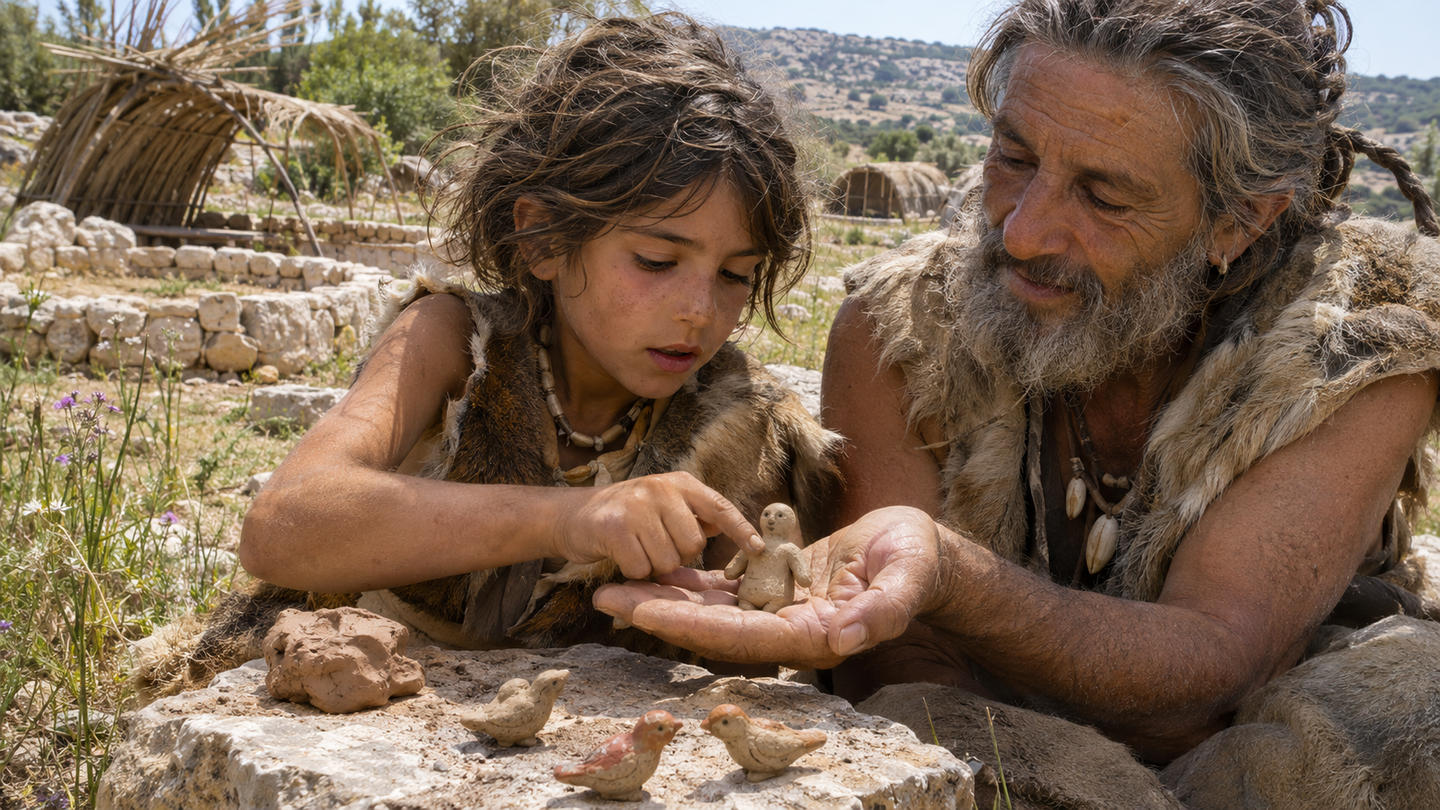
An artist’s reconstruction shows a child and an adult shaping a clay figurine at a Natufian settlement. Overlapping fingerprints on a figure found at Eynan-Mallaha suggest that a child and an older maker handled the same piece while the clay was still soft. (CREDIT: The Brighter Side of News)
- Researchers identified 15 recognizable figurines and 139 modeled clay fragments at three Natufian sites in present-day Israel.
- Prints on several pieces suggest children took part in shaping or coloring clay. A human figure carries overlapping marks from a child and an older person.
- The oldest pieces date to about 15,000 years ago, placing a regional tradition of clay figurines before the rise of farming villages.
Someone pressed a finger into the back of a small human figure while the clay was still soft. A child left another print over part of the first. The two marks survived at Eynan-Mallaha, a prehistoric settlement in what is now northern Israel. They offer a rare clue to who handled a piece of art made before farming took hold in the region.
A study in PLOS ONE places the figure in a wider tradition that reaches back about 15,000 years. Laurent Davin and colleagues from institutions including the Hebrew University of Jerusalem, the University of Haifa and the Israel Antiquities Authority examined clay from three sites. They identified 154 pieces that they interpret as figures or parts of figures.
The objects belonged to Natufian hunter-gatherers, who lived in the Levant from about 15,000 to 11,650 years ago. Some formed settled communities while continuing to hunt and gather food. A separate clay figurine showing a woman and a goose comes from near the end of that period.
The new study traces the practice farther back and adds evidence about its makers. As with research on prehistoric keepsakes, the way people shaped or handled an object can reveal parts of its history that its final form alone cannot show.
What the clay figurines reveal
The team examined objects from Eynan-Mallaha in the Upper Jordan Valley, Hayonim Terrace in the Galilee and el-Wad Terrace at Mount Carmel. Researchers checked that the finds came from Natufian layers and looked for marks that distinguished pieces shaped by people from natural lumps of clay. Those marks included pinches, grooves and impressions left by fingers or tools.
Only 15 of the objects retained enough of their form to identify what they represented. The other 139 were modeled cylindrical fragments. The authors interpret them as figurative pieces, although their original subjects often cannot be recovered. The assemblage therefore documents a tradition through complete and incomplete forms, much as a fragmentary hand stencil can preserve evidence of an artistic act with much of the original image gone.
Some cylinders preserve a rounded or pointed end, while others broke across the middle. Even without an identifiable subject, those shapes help the researchers compare how people worked the material across sites. The fragments broaden the evidence for the practice without establishing how many complete objects there once were.
Clay also gave makers choices different from those offered by stone or bone. They could add material, pinch it into a new shape or smooth a surface and work it again. That flexibility matters when considering how someone might practice a technique. The range of pieces adds to what archaeologists can learn about settled communities before the rise of early farming.
Fingerprints suggest children helped make the figures
The team found prints linked to pressing or pinching on two figurines and five cylinders. To estimate who left them, the researchers measured the spacing of ridges and compared those measurements with prints from people of known ages. Narrower ridges can point to a child. Ridge spacing also varies among people, and clay can shrink as it dries or fires. The analysis therefore supports broad age groups rather than exact ages or identities.
The surviving prints also represent a small part of the collection. A maker could smooth away an impression or leave one on a surface that later broke. The prints offer evidence that children took part, while their scarcity makes it hard to estimate how often children worked with clay.
The overlapping marks on the human figure fit a child who had yet to reach puberty and a person from a category that includes young adults and adult women. The two prints show that different hands contacted the same piece while it could still take an impression. Passing it from an older maker to a child is one possible explanation. Like the marks left on ancient tools, the impressions give a glimpse of a sequence of actions.
The location of other prints links some children to shaping and, in at least one example, coloring. The team also drew on prints from ornaments and other worked clay at the sites.
Together, the evidence suggests people of different ages took part. It leaves open whether children learned by watching, by receiving help or by trying things on their own. Those possibilities matter when interpreting how cultural knowledge passed through a community.
Birds dominate the figures that can be identified
Eleven of the 15 recognizable pieces portray birds. The others include two human forms, a gazelle and another mammal. Some birds have simple outlines. Others carry marks that may represent wings, tails or feathers. The authors identify possible waterfowl and birds of prey. A human-animal figure from a different Natufian site likewise shows the attention some makers paid to animal form.
Some figures show a head lowered and turned to the left. The team compares that posture with movements seen in courting ducks. If the interpretation is right, a maker may have depicted something the bird did as well as what it looked like. The pieces give researchers a way to ask whether prehistoric art carried observations about behavior or seasons.
Color was another choice. Several objects carried red residues, and the researchers identified evidence consistent with an engobe, a thin coating of colored clay. Microscopic analysis detected iron-rich clay in the red areas of one early piece that dates to about 15,000 years ago. The team describes it as the earliest known example of that coloring technique. Other red residues in the collection still need chemical identification.
A regional tradition before farming villages
The significance lies in the combination of age and repetition. Three sites yielded pieces shaped and decorated in comparable ways. Together they provide evidence of an established practice in Southwest Asia. Older clay figures are known from Europe, so the finding concerns when this tradition appeared in the Levant. It also adds to evidence that people could develop complex symbolic practices under different ways of living.
Settling in one place may have created more opportunities to work with clay and share techniques. The objects cannot establish why the practice began or what the figures meant to their makers. They do show that clay could be shaped, colored and used to represent people and animals well before farming communities developed in the region.
The marks at Eynan-Mallaha preserve a smaller and more immediate detail. At least two people handled the same figure while it was being made, and one appears to have been a child. That gives archaeologists a way to see young people’s participation in a craft whose tools and finished pieces rarely identify who used them.
Dig deeper into Natufian clay and prehistoric craft
Modeling identities among the first-sedentary communities
A related study examines clay ornaments and evidence for who handled them in early settled communities. (PLOS ONE, March 2026)
A 12,000-year-old clay figurine of a woman and a goose marks symbolic innovations in Southwest Asia
Researchers describe a figure that combines human and animal forms at another Natufian site. (Proceedings of the National Academy of Sciences, November 2025)
Children at play: The role of novices in the production of Europe’s earliest Upper Paleolithic ceramics
The study uses marks on clay to examine how inexperienced makers took part in a much older European tradition. (PLOS ONE, October 2024)
Bone aerophones from Eynan-Mallaha
Researchers examine small bone instruments and test how their sounds compare with bird calls. (Scientific Reports, June 2023)
Fermented beverage and food storage in 13,000-year-old stone mortars at Raqefet Cave
The authors use residues and experiments to investigate food preparation at a Natufian site. (Journal of Archaeological Science: Reports, October 2018)
Research findings are available online in the journal PLOS One.
The original story "Ancient fingerprints suggest children helped make clay figurines 15,000 years ago" is published in The Brighter Side of News.
Related Stories
- Scientists solve a 137-year-old mystery hidden in Van Gogh’s ‘The Starry Night’
- X-rays, AI and 3D printing bring lost Van Gogh artwork to life
- 67,800 year-old cave wall hand stencil offers clues to Australia’s first settlement
Like these kind of feel good stories? Get The Brighter Side of News' newsletter.
Joshua Shavit
Writer and Editor
Joshua Shavit is a NorCal-based science and technology writer with a passion for exploring the breakthroughs shaping the future. As a co-founder of The Brighter Side of News, he focuses on positive and transformative advancements in technology, physics, engineering, robotics, and astronomy. Having published articles on AOL.com, MSN, Yahoo News, and Ground News, Joshua's work highlights the innovators behind the ideas, bringing readers closer to the people driving progress.