Scientists and the general public define science very differently
Scientists and the public agreed that science takes curiosity and detective work. They differed on how much it depends on creativity, judgment and established methods.
 Santa Fe Institute Writer: Edson De la O Barquero

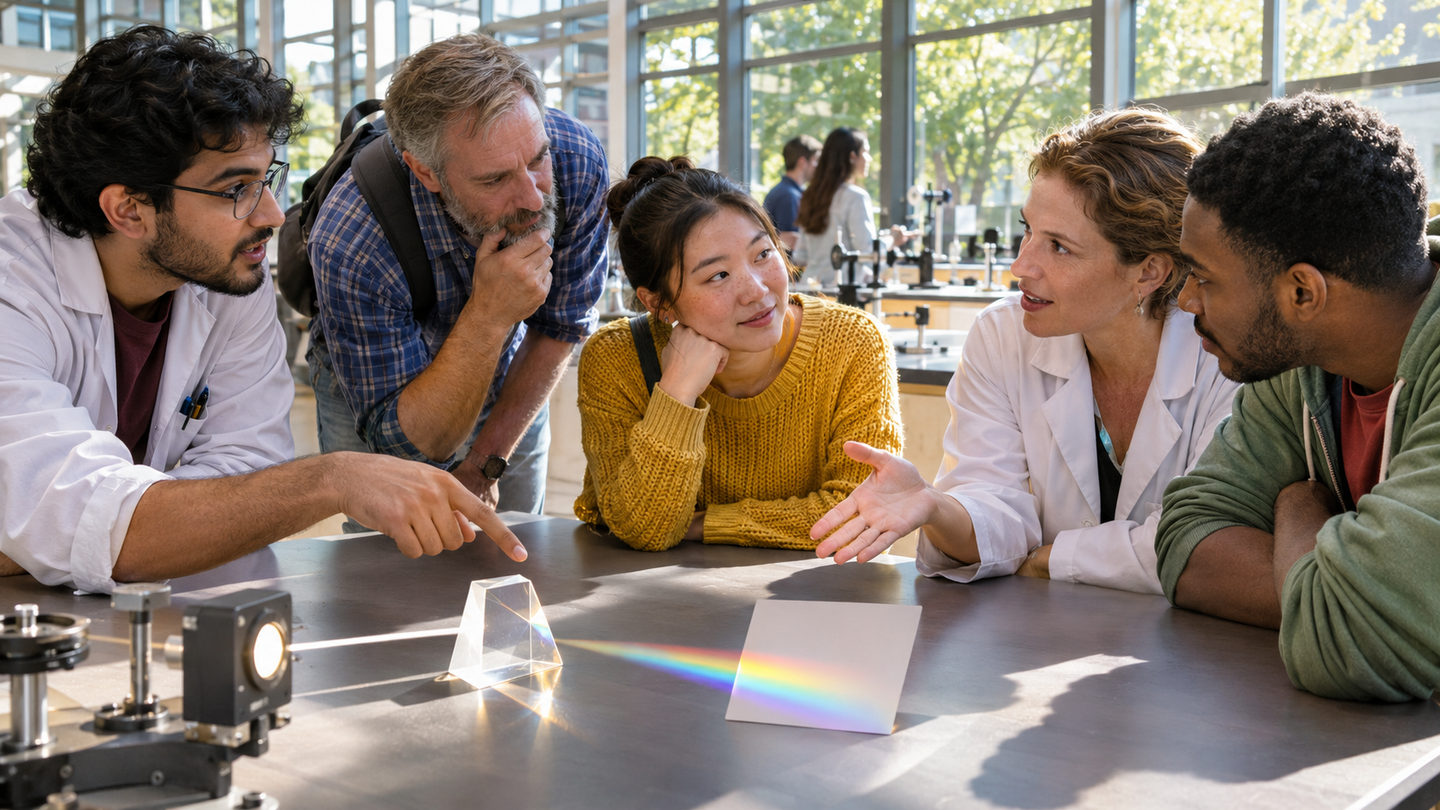
In this illustration, scientists and visitors discuss a prism demonstration at a public science event. In a recent survey, both groups saw curiosity as central to science, but differed on the roles of creativity and established methods. (CREDIT: The Brighter Side of News)
- Researchers asked scientists and members of the public to rate 18 descriptions of science.
- Both groups strongly endorsed curiosity and detective work, while scientists varied more in how they saw the role of truth, methods and creativity.
- The survey suggests why researchers and the public may bring different expectations to the same finding.
Ask two scientists what makes their work scientific, and one might describe a search for truth while the other talks about building models that simplify reality. They might agree on how to run an experiment and still give very different accounts of what the experiment is for. A survey found that scientists’ descriptions of science varied more than those of the members of the public who took part.
Marina Dubova conducted the research at the Santa Fe Institute with Qiawen E. Liu of Princeton University. Dubova is now at the University of California, Berkeley. Their study, published in Royal Society Open Science, compared ratings of 18 descriptions drawn from the history, philosophy and public discussion of science.
The strongest agreement came on familiar ideas. Nearly everyone in both groups saw science as curiosity-driven exploration and detective work. Those descriptions emphasize looking for clues and following them wherever they lead. Real disputes, such as how to interpret archaeological evidence, show how investigators can share that aim while differing in what they make of the clues.
The groups separated most clearly over how directly science reveals the world and how much the process depends on researchers’ choices. Those questions now arise in discussions of automated research, where decisions about what a system should do reflect assumptions about how discovery works.
How the survey asked what science is
About 190 participants used a seven-point scale, from strong disagreement to strong agreement. The descriptions ranged from science as a mirror of nature to science as a craft or a way of building knowledge piece by piece. The authors also sought written explanations. Those explanations helped distinguish respondents who selected the same score for different reasons, a distinction that matters when evaluating how people interpret scientific evidence.
The team measured agreement by comparing each person’s pattern of ratings across all 18 descriptions. On average, the public respondents’ patterns were more similar to one another than the scientists’ patterns were. In the comparisons the researchers could test item by item, the groups differed on 14 of 15 descriptions. Three descriptions drew agreement so widely in both groups that the statistical test could not be applied.
The two groups still shared a recognizable pattern. About 96% of scientists and 99% of public respondents endorsed curiosity-driven exploration. Detective work drew support from about 92% of scientists and 99% of the public. These items show that the overall gap can coexist with strong agreement on specific descriptions.
The researchers recruited most scientists through the Santa Fe Institute, which brings together people from different fields. The public group came from a U.S. online participant pool. Both were convenience samples, so the results describe the people who took part.
A larger survey could show whether the same pattern holds across institutions and countries, especially among researchers who work outside interdisciplinary settings. How people respond to the survey may depend partly on the kind of research practice they have encountered.
Truth, judgment and the role of creativity
Public respondents tended to favor descriptions in which science uncovers objective facts through established procedures. Scientists were more divided. Some also emphasized the search for truth, while others focused on assumptions, simplifications and uncertainty. Those are familiar issues in fields such as dark matter research, where investigators use observations to distinguish between models of something they cannot see directly.
Scientists also gave more weight to improvisation. An investigator may use standard methods for part of a project and then change course when an instrument behaves unexpectedly or a result raises a better question. Creativity in this context can mean finding another way to check a measurement. It can also mean choosing which question to ask before there is any measurement at all.
Seeing science as a way to construct knowledge can also mean several things. A map leaves out most details of a landscape and still helps people find their way. Likewise, scientists decide which details a model needs to capture. They can then test how well it works for a particular purpose.
The wording of the survey left room for people to answer different questions. A respondent might endorse the search for truth as an ideal while doubting how often it succeeds in practice. Two respondents could agree that science builds knowledge over time while disagreeing about whether it proceeds steadily. Debates over age verification illustrate how revisiting records can change the strength of an existing claim.
Views differed within and across fields
Among the disciplines represented, biologists and physicists tended to give ratings more like the public group’s average. Psychology, cognitive science and the social sciences showed less alignment. Some disciplines had only a handful of participants, so the comparisons are better read as clues for follow-up than as a ranking of fields.
“What was surprising to me was that there was quite a bit of disagreement between scientists, including scientists who are in the same subfield,” Dubova says. Education may influence which examples of science the public recognizes most readily.
The survey did not measure whether exposure to physics or biology in school explains the pattern. The same field can also contain very different jobs, from building an instrument to testing a model against observational data.
Differences in day-to-day work may help explain why people trained in the same discipline choose different descriptions. A scientist who spends months refining an instrument may emphasize craft. Another working with existing data may emphasize testing competing explanations. Following new evidence can require both habits within the same project.
What the gap could mean for trust and AI
If people expect a method that leads directly to firm answers, conflicting results or revised conclusions can be frustrating. Researchers who expect uncertainty may see a revision as a normal response to more evidence. The survey raised that possibility without testing how participants react to revisions in real time. That would require following people’s responses as claims and evidence change.
The study also suggests a distinction for science communication. A change in a conclusion can reflect a stronger measurement, a different method or a new interpretation of the same result. Explaining which of those happened gives readers a way to judge the change.
The rise of AI research tools makes these differing expectations concrete. A tool can help review papers or analyze data. Choosing what it should prioritize still requires a judgment about what counts as progress. A system rewarded for following a standard procedure may favor different work from one rewarded for exploring unusual explanations.
That concern also applies to AI-generated papers. Writing a report and deciding which claims deserve a closer look are different tasks. The next step for survey research is to see whether a scientist’s description of the work predicts which questions, methods and results that person actually values.
Dig deeper into how people understand science
Trust in scientists and their role in society across 68 countries
A multinational survey examines confidence in scientists and views on their role in public life. (Nature Human Behaviour, January 2025)
Public trust in scientists and views on their role in policymaking
Pew surveyed U.S. adults on confidence in scientists and their role in public decisions. (Pew Research Center, November 2024)
The effects of communicating uncertainty on public trust in facts and numbers
Experiments test how communicating uncertainty influences trust in estimates and their sources. (Proceedings of the National Academy of Sciences, April 2020)
Many Analysts, One Data Set
Multiple teams analyze the same data and question, revealing how analytical choices affect results. (Advances in Methods and Practices in Psychological Science, September 2018)
Communicating Science Effectively
A research agenda examines how the goals, audience and context of science communication shape its effectiveness. (National Academies, December 2016)
Research findings are available online in the journal Royal Society Open Science.
The original story "Scientists and the general public define science very differently" is published in The Brighter Side of News.
Related Stories
- AI is flooding peer review, and editors say it’s making science harder to judge
- Penn engineers use AI to solve some of science's most difficult math problems
- New space-time flow analysis is transforming science and medicine
Like these kind of feel good stories? Get The Brighter Side of News' newsletter.
Joshua Shavit
Writer and Editor
Joshua Shavit is a NorCal-based science and technology writer with a passion for exploring the breakthroughs shaping the future. As a co-founder of The Brighter Side of News, he focuses on positive and transformative advancements in technology, physics, engineering, robotics, and astronomy. Having published articles on AOL.com, MSN, Yahoo News, and Ground News, Joshua's work highlights the innovators behind the ideas, bringing readers closer to the people driving progress.