Freshwater fish can make human bones appear centuries older
Six medieval Danish burials yielded dates that appeared to predate their monasteries. The likely explanation was old carbon in freshwater fish.
 University of Southern Denmark Writer: Birgitte Svennevig

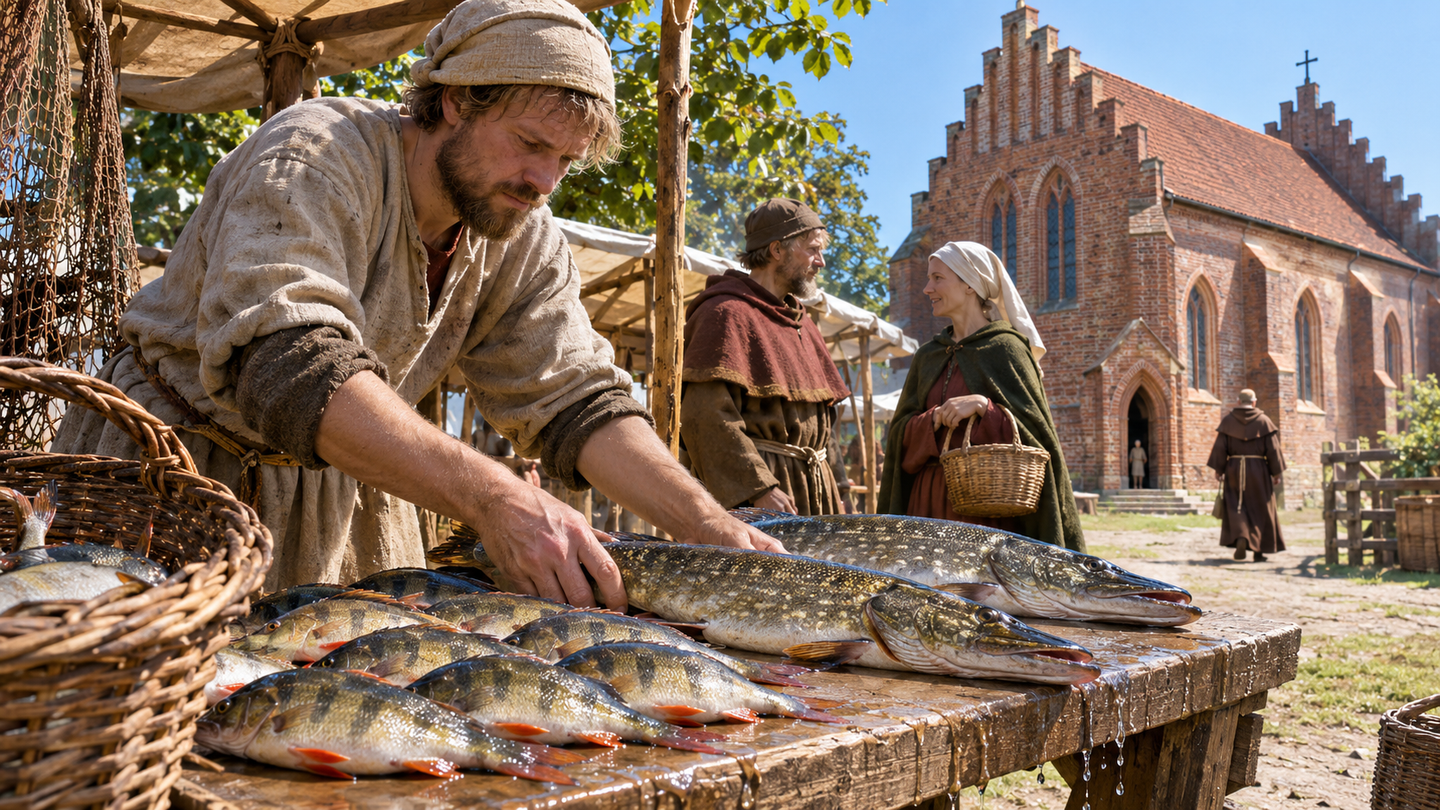
In this reconstruction, a fishmonger displays freshwater perch and pike near a medieval Danish friary. Carbon from freshwater fish can make human bones appear centuries older in radiocarbon dating. (CREDIT: The Brighter Side of News)
- Six of 27 medieval Danish burials yielded radiocarbon dates that appeared to predate their monasteries.
- Freshwater fish can carry carbon depleted in carbon-14, which becomes incorporated into the bones of people who eat them.
- The offset varies by waterway and diet. Archaeologists can use chemical and historical clues to judge when a date needs closer scrutiny.
A burial at a Franciscan friary in Svendborg, Denmark, came with a puzzle. Radiocarbon dating placed the person’s death between AD 1100 and 1155. Historical records put the friary’s founding in 1236. Even the latest year in the laboratory range came 81 years before the institution where the person was buried.
Researchers at the University of Southern Denmark and the University of Groningen found similar problems in other medieval graves. Six of the 27 people they studied yielded dates that appeared too early for their burial settings. The team’s report in npj Heritage Science traces the discrepancy to a likely source in the diet: freshwater fish.
The method still measures the carbon in the bones. The difficulty is knowing what amount of radioactive carbon the person started with. When food includes carbon from a different reservoir, a date calibrated as though all the food came from land can be shifted back in time. That distinction matters whenever human remains anchor a reconstruction of a community’s history.
The Danish burials offered a check that many sites lack. Historians knew when the monasteries were established, giving researchers a way to compare the lab results with evidence outside the bones. Other work on burial chronology similarly depends on how dates fit the context in which remains were found.
How freshwater fish shift radiocarbon dating
Carbon-14 is a radioactive form of carbon. Plants absorb it from the atmosphere, and animals take it in through food. After death, the supply stops and the carbon-14 already in the body decays. Measuring how much remains lets a lab estimate when an organism lived, provided the starting amount can be estimated from the right reference.
A river or lake can draw carbon from sources other than the atmosphere. Water can dissolve ancient carbonate from rock or pick up old carbon released from sediments. Much of the carbon-14 in that material has already decayed. Aquatic organisms take up that carbon, and it moves through the food web into fish. Research on carbon isotopes shows how aquatic and terrestrial food sources can leave different chemical signatures.
People who eat those fish can incorporate some of that carbon into bone collagen, the main protein in bone. Starting with less carbon-14 makes the collagen resemble material that has had more time to decay. Researchers call this the freshwater reservoir effect. Like other chemical traces of ancient diets, the signal reflects an interaction between the body and its food supply.
The size of the effect depends on the water chemistry and what the fish ate. It also depends on how much of the person’s collagen carbon came from aquatic food. Two people buried at the same site could therefore have different offsets, even if both ate fish. A measurement from one river cannot establish the correction for a meal caught in another.
What six Danish burials revealed
Kaare Lund Rasmussen, Johannes van der Plicht and Jesper Lie Boldsen examined collagen from well-preserved thigh or shin bones. They compared the calibrated dates with the dates associated with the monasteries and checked stable carbon and nitrogen isotopes from the same samples. The stable isotopes served as clues to food sources, a separate role from that of radioactive carbon-14.
The samples had elevated nitrogen isotope values, while the carbon isotope readings suggested a relatively small marine contribution. The researchers interpreted the combination as evidence for substantial freshwater protein. A nitrogen reading alone cannot specify the fish species, the waterway or the size of the dating offset. Other studies use food residues to reconstruct diet from a different source of evidence.
In Viborg, even the latest end of one calibrated date range was AD 976, more than 200 years before the monastery was built. Three burials at the Cistercian monastery at Øm also appeared too early. The six discrepancies represent about 22% of this selected sample.
The study used monastic burials to demonstrate the problem, so that share does not estimate its prevalence across Denmark. Research on dated bones illustrates how much chronological interpretation can depend on choosing samples that fit the question.
Why a standard correction would miss the mark
Seawater can also yield apparent ages older than those from land. For the North Sea, the researchers cite an offset of around 400 years for an organism whose carbon comes entirely from the marine food chain. A person with a mixed diet would require an estimate of the marine share. Regional differences also matter.
Freshwater offsets can range from negligible to around 1,000 years or more in some settings. A fish can therefore register an apparent age centuries older than a land animal that was alive at the same time. Applying the fish’s full offset to human bone would treat all the relevant carbon as aquatic. Chemical studies of tooth enamel similarly depend on understanding how different sources contribute to the signal.
At sites along the Danube, bone arrowheads made from land animals were found embedded in human remains. The objects and people must have been close in age, yet some human bones dated several centuries older. The physical relationship helped expose the offset. A piece of independent evidence can be just as revealing as a second laboratory measurement, as research on ancient remains also illustrates.
The case of England’s Richard III offers a check from written history. An early radiocarbon range placed his death between 1412 and 1460. Historical records put it in 1485, when he died in battle. Researchers found that accounting for fish in his diet could explain the difference. In the Dutch town of Dorestad, researchers found a much larger offset of about 250 years.
How archaeologists can check a suspect date
Stable isotope measurements can flag samples that deserve a closer look. From there, researchers can compare human bones with associated remains from land animals, use archaeological layers or historical records, and model the contribution from different foods where local evidence allows. Each check addresses a different source of uncertainty. The dates used to reconstruct ancient sites become stronger when those checks agree.
Medieval fasting rules made fish a regular alternative to meat. That makes a freshwater contribution plausible in monastic settings, though a burial location alone cannot tell researchers what a person ate. Investigations of past diets often combine chemical evidence with what is known about local food practices.
The researchers’ warning applies wherever people or animals relied on rivers and lakes for food. Svendborg makes the stakes easy to see: the founding record revealed a problem that would have been harder to spot at a site without a written history. Where that check is missing, knowing how carbon entered the food web can help keep an apparent age from becoming a mistaken timeline.
Dig deeper into radiocarbon dating and freshwater diets
Radiocarbon Dating and Chronological Modelling
These guidelines explain how to select samples, calibrate measurements and use archaeological context when building chronologies. (Historic England, September 2022)
Life of the famous Renaissance astronomer: Tycho Brahe and his wife ate lots of fish
Chemical analyses shed light on how much freshwater fish the astronomer and his wife ate. (University of Southern Denmark, September 2020)
IntCal20 calibration papers
The collection explains the curves researchers use to translate radiocarbon measurements into calendar dates. (Radiocarbon, August 2020)
Multi-isotope analysis demonstrates significant lifestyle changes in King Richard III
Researchers use isotope measurements from teeth and bones to reconstruct changes in the English king’s diet and life. (Journal of Archaeological Science, October 2014)
The freshwater reservoir effect in radiocarbon dating
Bente Philippsen examines why freshwater offsets vary and how they can affect archaeological dates. (Heritage Science, August 2013)
Research findings are available online in the journal npj Heritage Science.
The original story "Freshwater fish can make human bones appear centuries older" is published in The Brighter Side of News.
Related Stories
- Scientists discover the world's first fully marine amphibian living 237 million years ago
- TikTok video leads scientists to a new species of transparent fish in India
- First-ever 'grumpy' fish species discovered in the Red Sea
Like these kind of feel good stories? Get The Brighter Side of News' newsletter.
Joshua Shavit
Writer and Editor
Joshua Shavit is a NorCal-based science and technology writer with a passion for exploring the breakthroughs shaping the future. As a co-founder of The Brighter Side of News, he focuses on positive and transformative advancements in technology, physics, engineering, robotics, and astronomy. Having published articles on AOL.com, MSN, Yahoo News, and Ground News, Joshua's work highlights the innovators behind the ideas, bringing readers closer to the people driving progress.