Ancient underwater canyons helped preserve some of Earth’s earliest complex life
South Australian rock layers record giant underwater canyons that filled as seas rose, helping preserve traces of early complex life.
 Writer: Candy Gibson (Adelaide University)

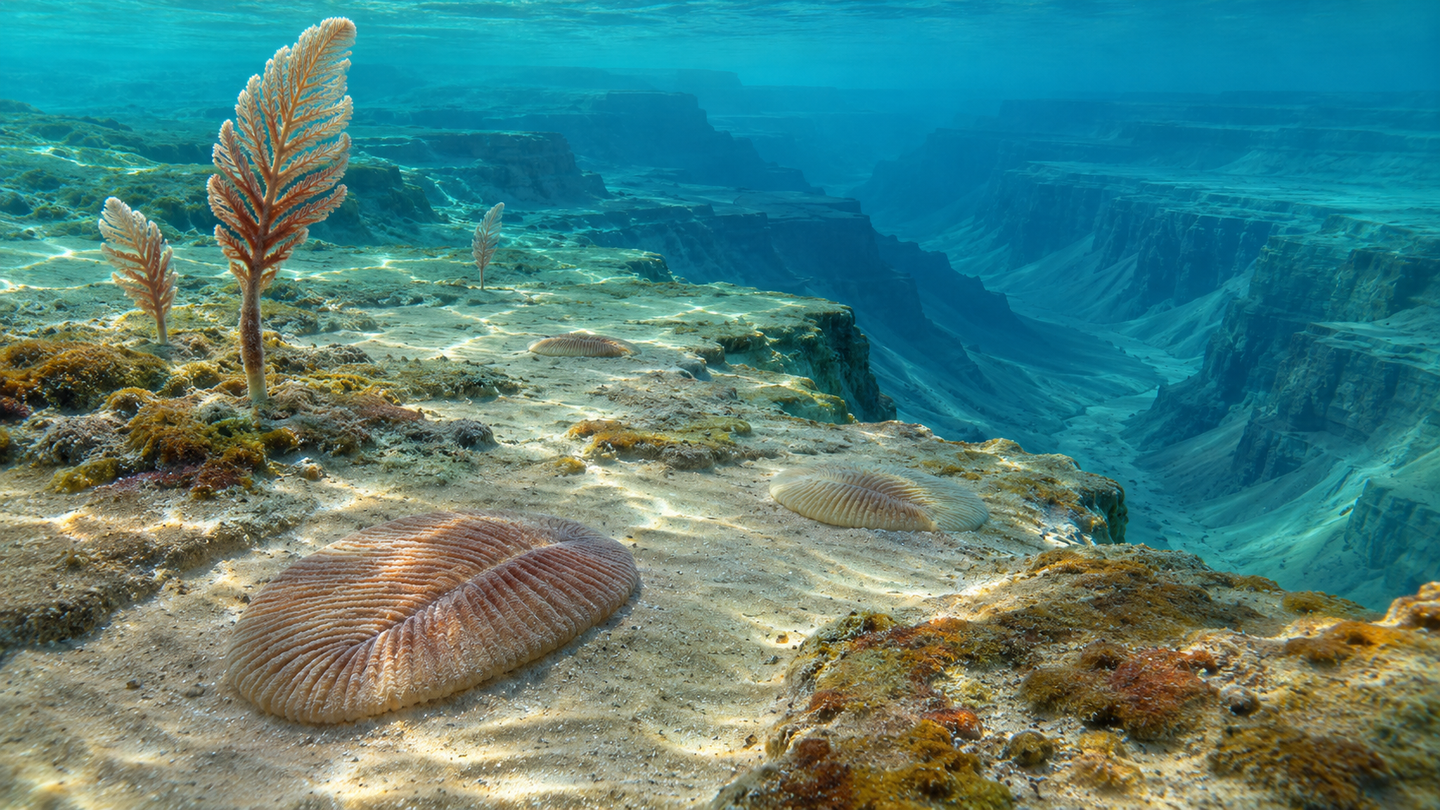
An artist’s reconstruction shows ribbed Dickinsonia and frond-like organisms on a sunlit seafloor beside an ancient submarine canyon. Research in South Australia’s Flinders Ranges suggests that rising seas and sediment buildup helped preserve soft-bodied Ediacaran life. (CREDIT: The Brighter Side of News)
- Rock layers in South Australia’s Flinders Ranges record ancient canyons up to 280 meters deep and more than six kilometers wide.
- Geologists found evidence that underwater currents carved much of the terrain and that rising seas later helped fill the canyons with sediment.
- That shift helped set the stage for the preservation of soft-bodied Ediacaran organisms more than half a billion years ago.
South Australia’s Flinders Ranges hold impressions of soft-bodied organisms that lived before the Cambrian explosion. The rocks beneath those fossils tell a different part of the story. Before sediment preserved the organisms, erosion cut canyons hundreds of meters deep into the ancient continental shelf.
Geologist Karol Faehnrich of Adelaide University and colleagues traced the buried landscape across the Flinders Ranges, including at Nilpena Ediacara National Park. Their findings, reported in Earth and Planetary Science Letters, suggest that falling seas helped initiate the erosion and that rising seas later helped fill the canyons.
The reconstruction gives geologists a better idea of what happened before one of the richest records of early complex life formed. The fossils show which organisms left traces behind. The layers around them show how the seafloor changed before those traces became part of the rock record.
A buried landscape beneath the fossils
The team followed a boundary at the base of the Ediacara Member, a fossil-bearing part of the Rawnsley Quartzite. Geologists call this kind of boundary an unconformity. It marks a gap in the record where erosion removed material before younger sediment accumulated over it. Tracing the boundary from one outcrop to the next allowed the team to reconstruct the shape of what had been cut away.
The boundary describes valleys oriented toward the southeast. They generally broaden and deepen in that direction, reaching up to 280 meters deep and more than six kilometers wide. The dimensions show that the erosion affected a wide stretch of the shelf. The deposits inside the valleys helped the researchers work out what kind of flows passed through them.
Near the canyon floors, some deposits contain angular fragments ripped from older layers. Above them are deposits left by sediment-laden flows, alternating with finer siltstone that accumulated in deeper water. The sequence records periods when strong currents moved debris and quieter intervals when finer material could settle. The researchers compared that combination of shape and sediment with what geologists see in modern underwater canyons.
Why the team favors underwater erosion
One explanation would place rivers across the shelf when sea level was lower. Rivers can cut valleys that later flood, so the team considered whether the canyons might have started above water. Explaining their scale through river erosion alone, however, would require a very large fall in sea level or substantial uplift of the land. The deposits also record sediment moving downslope underwater.
The team favors an explanation in which underwater flows cut into the shelf and extended the canyons. Lower sea levels may have helped start that process. Some stretches could have undergone erosion above water before they flooded, and the authors allow for local geological processes to have influenced how the basin changed.
The geometry helps define the scale of the event, while the deposits help establish how it happened. Canyon depth alone cannot measure how far the sea fell. An underwater current can cut downward into the shelf, so the relief in the buried landscape reflects erosion as well as the conditions that allowed it to occur.
Rising seas helped fill the canyons
After the erosion came a shift toward deposition. The researchers infer that seawater advanced across the shelf and sediment gradually filled the canyons. In the lower part of the fill, the layers record deeper water and sediment moving downslope. Higher up, the deposits record shallower conditions, ending with material that waves reworked across the basin.
Flooding and the later appearance of shallower conditions describe different parts of the sequence. Rising water could spread across the shelf while sediment built up inside the flooded canyons. As the fill accumulated, the seafloor rose within the water column. The canyon walls and floors that once directed sediment flows gradually disappeared beneath younger deposits.
That sequence helps explain how sharply different environments came to be stacked in the same rock succession. It also places the deposition of fossil-bearing beds in a regional context. The impressions at Nilpena record life on particular surfaces, while the layers underneath record the longer history of the basin that held them.
A window for preserving soft bodies
Many Ediacaran organisms left delicate impressions. Unlike a shell or bone, soft tissue generally decays without leaving an obvious fossil. A sediment surface can retain its shape if burial and the conditions around it preserve enough detail. At Nilpena, some beds preserve numerous organisms and traces of activity across what was once a seafloor.
The canyon study addresses the circumstances under which those fossil-bearing layers accumulated. It links flooding and sedimentation to the development of a setting capable of preserving unusual detail. That link helps explain why the rocks of the Flinders Ranges offer such a rich view of the period before animal diversity expanded in the Cambrian.
It also matters when comparing fossil sites. Two deposits may preserve different numbers or kinds of organisms partly because their sediments recorded life differently. A bed that captured delicate impressions can reveal organisms that would leave little recognizable trace elsewhere. Reconstructing the setting helps paleontologists weigh how much a difference between sites reflects the original communities and how much reflects what survived.
Practical implications
Geologists can use the mapped boundary to compare fossil-bearing beds across the Flinders Ranges. Following it from one locality to another helps establish which deposits formed in canyon fills and which accumulated after the shelf became more uniform. Those comparisons could show whether the best-preserved fossils tend to occur in particular parts of that sequence.
The Australian reconstruction also gives researchers a case to compare with Ediacaran fossil sites on other continents. If similar environmental changes preceded exceptional preservation elsewhere, they may help explain why the record is especially rich in some places. The Flinders Ranges show how much of that history can lie in the rocks beneath the fossils themselves.
Dig deeper into Ediacaran fossils
These resources explore the Nilpena fossil site, the organisms preserved there, and what they reveal about early animal life.
Ediacara Fossil Site – Nilpena: Describes the site’s discovery and why its soft-bodied fossils are significant. (Australian Department of Climate Change, Energy, the Environment and Water, 2026 update)
And now for something completely random: Spatial distribution of Dickinsonia on the Ediacaran seafloor: Examines how specimens of Dickinsonia are distributed on fossil beds at Nilpena. (Global and Planetary Change, 2024)
Discovery of the oldest bilaterian from the Ediacaran of South Australia: Describes Ikaria wariootia and its proposed connection to traces in the Ediacara Member. (Proceedings of the National Academy of Sciences, 2020)
Ancient steroids establish the Ediacaran fossil Dickinsonia as one of the earliest animals: Uses preserved molecular evidence to investigate where Dickinsonia belongs in the tree of life. (Science, 2018)
The advent of animals: The view from the Ediacaran: Reviews what Ediacaran fossils reveal about the early history of animals. (Proceedings of the National Academy of Sciences, 2015)
Research findings are available online in the journal Earth and Planetary Science Letters.
The original story "Ancient underwater canyons helped preserve some of Earth’s earliest complex life" is published in The Brighter Side of News.
Related Stories
- Hidden bacteria beneath the Arctic ice could boost ocean life
- Fungi’s ancient origins: How they shaped life on Earth a billion years ago
- Paleobotanists discover the world's oldest forest dating back 385 million years
Like these kind of feel good stories? Get The Brighter Side of News' newsletter.
Joshua Shavit
Writer and Editor
Joshua Shavit is a NorCal-based science and technology writer with a passion for exploring the breakthroughs shaping the future. As a co-founder of The Brighter Side of News, he focuses on positive and transformative advancements in technology, physics, engineering, robotics, and astronomy. Having published articles on AOL.com, MSN, Yahoo News, and Ground News, Joshua's work highlights the innovators behind the ideas, bringing readers closer to the people driving progress.