Tiny glass chip combines starlight from two telescopes to view the universe in sharper detail
A tiny glass chip combined starlight from two telescopes, giving astronomers a flexible testbed for compact instruments and future planetary-system studies.

 Edited By: Joseph Shavit

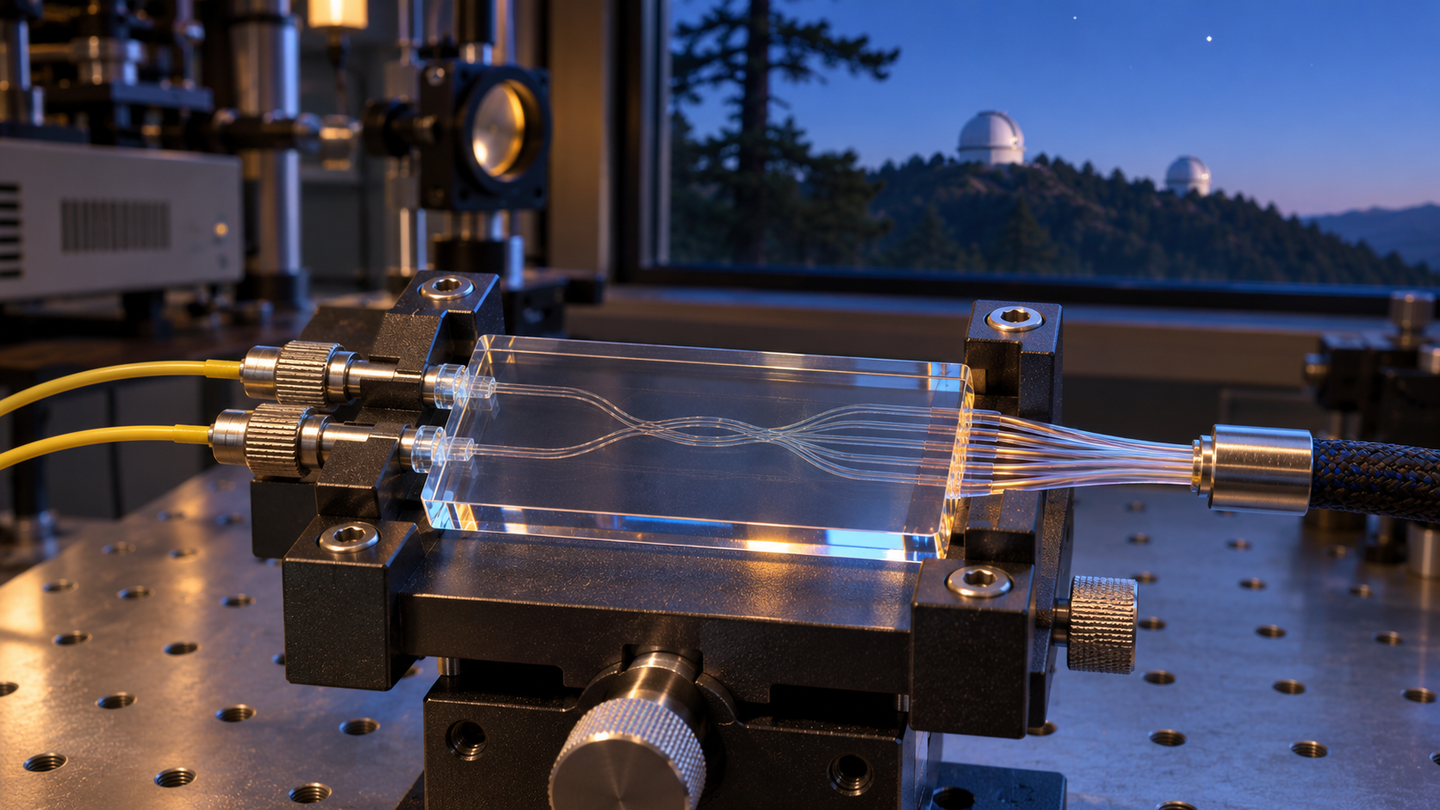
At California’s CHARA Array, the CHARIOT instrument used a chip just a few centimeters across to combine starlight from two telescopes and record interference patterns. (CREDIT: The Brighter Side of News)
- A glass photonic chip combined starlight from two CHARA telescopes during observations in California.
- CHARIOT measured bright-star interference signals with better than 1% precision and detected fainter targets than its predecessor.
- The swappable technology could support future planetary-system studies, but greater sensitivity and further calibration are needed.
Starlight collected by two separate telescopes has met inside a glass chip just a couple of centimeters across. The device combined the beams precisely enough to record interference signals from real stars. Its successful operation moves a compact optical technology from laboratory development into astronomical observing.
Developed at Heriot-Watt University, the chip forms the heart of CHARIOT, an experimental instrument at California’s CHARA Array. The international team reported its first observations in Monthly Notices of the Royal Astronomical Society. The work demonstrates a new component for linking telescopes, rather than a newly discovered planet or a complete replacement for an observatory’s optical equipment.
Making separate telescopes work together
CHARA consists of six telescopes at Mount Wilson Observatory and belongs to Georgia State University. Astronomers can combine their light through interferometry, a technique that extracts fine detail from overlapping light waves. CHARIOT currently combines two telescope beams, providing a test platform within the larger array.
When the beams meet, their waves reinforce or cancel one another, producing an interference pattern called fringes. Those patterns carry information about a star’s apparent size and surrounding emission. Obtaining useful measurements requires careful control of the distances the beams travel and the properties of the incoming light.
Combining telescopes improves their ability to distinguish features separated by very small angles on the sky. It does not mean the glass chip collects light like a giant mirror. The telescope array supplies the incoming light, while the new component helps preserve and combine the information carried by its waves.
Traditionally, that task involves complex arrangements of mirrors and lenses. “We have shown that much of that work can instead be carried out by a glass chip only a couple of centimetres in size,” said Robert Thomson, a Heriot-Watt professor. His group’s research program began more than 15 years ago.
Tiny channels guide incoming starlight
Thomson and researcher Aurélien Benoît developed the chip using ultrafast-laser inscription, which writes light-guiding channels inside glass. These channels, called waveguides, route the incoming beams through a solid component. The team used Infrasil quartz glass with low contamination from hydroxyl groups, helping it transmit near-infrared light in astronomy’s K band.
The design splits some light from each telescope into separate monitoring channels. It combines the remaining light to create two interference outputs, which a camera records. Monitoring the individual beams helps researchers account for changes in brightness while interpreting the interference signal.
The surrounding instrument still includes mirrors, moving stages, optical fibers and a detector. However, integrating the combining function inside a small glass block can reduce its footprint and sensitivity to environmental disturbances. The project also involved the University of Cologne, the University of Potsdam and the Leibniz Institute for Astrophysics Potsdam, where lead author Aline Dinkelaker works.
Three observing campaigns tested the hardware
CHARIOT recorded its first stellar fringes in May 2024, followed by observing campaigns in October 2024 and July 2025. The team developed it by rebuilding and upgrading the older JouFLU instrument. Changes included a new camera, revised imaging optics and the glass beam combiner.
Early observations exposed practical problems, including camera vibrations, lost light and malfunctioning hardware. The researchers adjusted the instrument between campaigns rather than treating every early signal as a reliable astronomical measurement. By July 2025, the reported observing nights proceeded without the technical problems that had hindered earlier runs.
An improved chip assembly also increased the light transmitted through the component by roughly a factor of ten compared with the earlier assembly. The improvement came from optimizing how fibers were attached to the chip, rather than simply changing its internal design. That distinction highlights how connections and alignment can determine whether a promising optical device performs well on a telescope.
Precision improves, but faint signals remain difficult
For bright targets with K-band magnitudes around 2 or lower, CHARIOT measured raw squared visibility with better than 1% precision. Squared visibility measures the strength of the interference pattern and helps astronomers characterize a source. This precision describes uncertainty in that measurement, not the sharpness of a conventional photograph.
The instrument also detected fringes from HD 210824, a star with a K-band magnitude of 5.212, under poor to moderate atmospheric conditions. Higher magnitudes indicate fainter objects, so this extended fringe detection beyond JouFLU’s reported limit of about 4.5. Precision for that faint target was approximately 4.6%, rather than the sub-1% achieved on bright stars.
Important qualifications remain, including possible bias when the signal is weak relative to noise. The researchers also need an updated measurement of the system’s effective wavelength bandwidth to improve calibration. Although CHARA now has adaptive optics to counter atmospheric distortions, further gains will require attention to light collection, detector behavior and data processing.
Light loss remains another engineering constraint: the chip with its attached fibers transmits about 40% of the incoming light. The glass component alone loses less, showing that the surrounding connections matter substantially. Improving those connections and reducing unnecessary fiber length could make more of each telescope’s collected starlight available for measurement.
Dust and stellar companions are science targets
One goal is measuring faint, hot dust close to other stars. Such dust can reveal conditions in planetary systems while complicating efforts to see small planets nearby. Its emission can be difficult to distinguish from the much brighter stellar light.
Interferometry can help because extended dust emission changes the visibility expected from the star alone. The paper describes a case in which dust contributes around 1% of the starlight, producing an approximately 2% deficit in squared visibility. Detecting that small difference requires measurement precision better than 1%, explaining the emphasis on stable, repeatable observations.
Another intended application is resolving close stellar companions that other surveys cannot separate directly. Measuring their separation can help researchers determine the masses of binary systems. These are proposed science uses for the developing instrument; the reported work primarily establishes its design, calibration and initial observing performance.
Swappable chips offer a route to future upgrades
CHARIOT’s fiber connectors allow a beam combiner to be replaced within a few hours, including necessary optical adjustments. That makes the instrument a practical testbed for comparing new photonic components under real observing conditions. Benoît said its advantage lies in integrating complex optical functions into a small, stable glass chip.
Planned improvements include shortening output fibers to reduce light loss and using another instrument to track atmospheric changes during measurements. Longer-term ideas include combining four telescope beams and cooling the beam combiner to reduce background noise. Those developments could support nulling interferometry, which suppresses stellar light through destructive interference to investigate fainter nearby emission.
Directly studying planets around other stars remains a longer-term ambition, rather than a result of these observations. For now, the next engineering question is specific: Can the team preserve its bright-star precision while gathering reliable measurements from substantially fainter targets? CHARIOT provides a working platform on which to test that improvement with real starlight.
Dig deeper into astronomical photonics
These studies trace the development of compact light-combining technology and the observatories that use it.
Fiber-connectorized ultrafast-laser-inscribed K-band integrated optics beam combiner for the CHARA telescope array
This earlier laboratory study describes the chip design and fiber connections underlying the new observing instrument. (Applied Optics, January 2024)
2023 Astrophotonics Roadmap: pathways to realizing multi-functional integrated astrophotonic instruments
The roadmap surveys compact astronomical technologies and the engineering barriers to integrating them into working instruments. (Journal of Physics: Photonics, October 2023)
MIRC-X: A Highly Sensitive Six-telescope Interferometric Imager at the CHARA Array
This instrument paper explains another CHARA beam combiner and the challenges of sensitive observations with multiple telescopes. (The Astronomical Journal, September 2020)
First on-sky demonstration of an integrated-photonic nulling interferometer: the GLINT instrument
The study demonstrates a related approach that uses a photonic chip to suppress bright starlight through interference. (Monthly Notices of the Royal Astronomical Society, November 2019)
First Results from the CHARA Array. II. A Description of the Instrument
This foundational paper describes the array’s hardware, control systems and methods for combining light from separated telescopes. (The Astrophysical Journal, July 2005)
Research findings are available online in the journal Monthly Notices of the Royal Astronomical Society.
The original story "Tiny glass chip combines starlight from two telescopes to view the universe in sharper detail" is published in The Brighter Side of News.
Related Stories
- NASA’s giant space ‘starshade’ could help ground telescopes photograph another Earth
- Rectangular space telescopes could reveal dozens of Earth-like planets nearby
- Radio telescopes reveal the final years of a rare exploding star
Like these kind of feel good stories? Get The Brighter Side of News' newsletter.
Joshua Shavit
Writer and Editor
Joshua Shavit is a NorCal-based science and technology writer with a passion for exploring the breakthroughs shaping the future. As a co-founder of The Brighter Side of News, he focuses on positive and transformative advancements in technology, physics, engineering, robotics, and astronomy. Having published articles on AOL.com, MSN, Yahoo News, and Ground News, Joshua's work highlights the innovators behind the ideas, bringing readers closer to the people driving progress.