Hydrogen chloride gas found above Martian fissures points to new volcanic activity
A Mars orbiter detected traces of hydrogen chloride near Alba Mons when the gas is usually scarce. Nearby fissures offer a possible route from below, but the source remains unconfirmed.

 Editor: Joshua Shavit

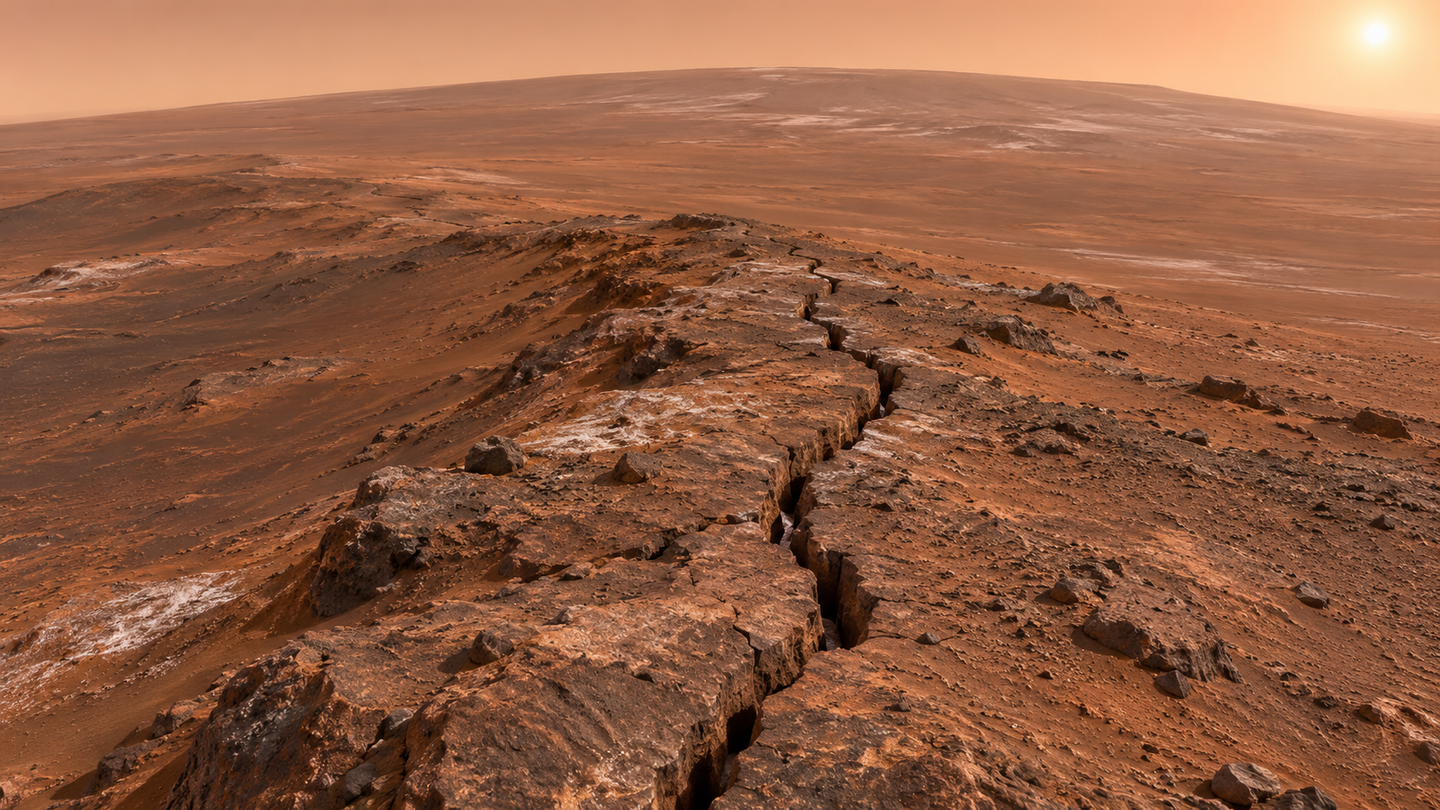
A narrow fissure cuts across a sunlit ridge in this illustration of the terrain near Alba Mons on Mars. The ExoMars Trace Gas Orbiter detected traces of hydrogen chloride in the region, a possible sign of volcanic activity underground. (CREDIT: The Brighter Side of News)
- The ExoMars Trace Gas Orbiter detected hydrogen chloride in the lower Martian atmosphere near Alba Mons during a season when the gas is usually scarce.
- The detections were localized and measured at parts-per-billion levels. Orbital images revealed narrow fissures in the same region that might provide a route for gas to reach the surface.
- The findings point to possible volcanic activity below ground, but researchers have yet to trace the gas to an individual fissure or confirm the presence of magma.
The gas appeared where researchers least expected it. Near Alba Mons, a broad volcano in Mars’ northern hemisphere, an orbiter detected hydrogen chloride low in the atmosphere while the planet was far from the Sun. The gas is familiar to scientists studying Mars, but its location and timing stood out. Both pointed to a source closer to the ground than the seasonal chemistry that usually explains its presence.
Alexander Trokhimovskiy of the Space Research Institute and an international team reported the findings in Science Advances. They combined measurements from the Atmospheric Chemistry Suite aboard the ExoMars Trace Gas Orbiter with detailed images of the terrain. The images showed narrow cracks in the area, giving researchers a possible explanation for how gas from below might reach the atmosphere.
Researchers have long found signs of ancient eruptions across the planet. Orbital surveys also continue to turn up landforms interpreted as large volcanoes. At Alba Mons, the gas gives researchers a way to ask whether an old volcanic region still has enough internal heat to drive activity beneath its surface.
Why hydrogen chloride on Mars stood out
Hydrogen chloride, or HCl, is a gas that can escape from volcanic systems on Earth. ExoMars first reported it in the Martian atmosphere in 2021. Those early detections were widespread and occurred during a warmer, dustier part of the Martian year. Researchers linked that pattern to reactions involving airborne particles and water.
The Alba Mons detections came during aphelion, when Mars is farthest from the Sun. At that time of year, researchers usually find little or no hydrogen chloride elsewhere. The new detections clustered around one region, and some observations there still came up empty. That patchy pattern made the signal harder to explain using the known seasonal cycle alone.
Chemical readings can vary as the Martian atmosphere responds to changing conditions. Scientists also have to account for Martian weather when interpreting what an orbiter sees. Around Alba Mons, the combination of season, location and altitude gave the team a reason to investigate whether the gas came from the surface or from below it.
How an orbiter finds a trace gas
The instrument looks at sunlight that has passed through Mars’ atmosphere. As the Sun appears to rise or set behind the planet’s edge, the light travels through different layers of air. Molecules absorb particular wavelengths along the way. By looking for gaps in the spectrum, scientists can identify a gas even when very little of it is present.
The concentration of hydrogen chloride on Mars near Alba Mons was on the order of a few molecules per billion molecules of air. The gas appeared in the lower atmosphere, with its abundance changing sharply over the first several kilometers above the surface. The result told researchers where to look more closely. The view from orbit covered a stretch of atmosphere, leaving the precise point of release unresolved.
Orbital instruments often reveal patterns that take further work to explain. Researchers have used them to map buried river deltas and assess possible signs of liquid water. At Alba Mons, the next step was to compare the atmospheric measurements with images sharp enough to reveal small features on the ground.
Fresh cracks offer a possible route
The team examined images from the ExoMars orbiter and NASA’s Mars Reconnaissance Orbiter. They identified fissures less than a meter wide in the area of the detections. Some cut across terrain shaped by earlier volcanic activity. Their appearance suggests relatively recent formation or modification, although the images alone cannot establish when individual cracks opened.
A fracture can provide a path through rock for gas released at depth. The researchers propose that some of the fissures may connect to an underground source associated with magma, the molten or partly molten rock beneath the surface. They also considered whether chlorine-bearing material could interact with buried ice on its way up, potentially affecting when hydrogen chloride reaches the air.
Elsewhere on Mars, surface fractures have helped scientists investigate how fluids once moved through rock. Studies of buried ice show how much of the planet’s geology can remain hidden from view. At Alba Mons, the fissures offer places to look for gas exchange, while their depth and connection to an underground source remain unknown.
Marsquakes add context from another region
NASA’s InSight lander recorded marsquakes that helped scientists study the planet’s interior. Several came from Cerberus Fossae, a system of fractures far from Alba Mons. Research on those quakes and nearby volcanic deposits has strengthened the case that parts of Mars remained geologically active long after most of its large volcanoes formed.
Scientists have also used seismic data to investigate whether the Martian mantle varies in temperature from one region to another. Studies of ancient magma systems show how molten rock once moved through the crust. The Alba Mons observations add atmospheric chemistry to those lines of inquiry. Because the strongest seismic evidence comes from a different region, it provides context for the new finding without locating its source.
The authors favor an explanation involving underground magma because the detections coincide with young-looking fractures and depart from the usual seasonal pattern. The study reports no detection of sulfur dioxide, a gas that could help make the case for eruptive activity. The evidence is consistent with gas escaping from below ground without a surface eruption.
Practical implications
Alba Mons gives planetary scientists a specific place to look for further evidence of present-day activity. Repeat observations could establish whether hydrogen chloride on Mars returns to the same area at the same point in the planet’s orbit. Better coverage near the surface could help separate a recurring local release from a brief event that atmospheric circulation carried into the region.
Planetary geologists could compare gas detections with detailed images of the fissures, while atmospheric scientists test how dust, ice and winds might shape the signal. Earlier work on water beneath Mars and evidence of ancient hot water helps frame another question. If heat, water and rock interact beneath Alba Mons today, what chemical traces would reach the surface?
For now, the orbiter has identified a place where the gas appears out of season and close to the ground. The cracks give researchers a feature they can revisit and compare with future measurements. Finding a repeatable link between the gas and specific terrain would bring them closer to determining whether Mars’ interior is still releasing volcanic gases.
Dig deeper into possible volcanism on Mars
These resources cover the Alba Mons observations, Martian atmospheric chemistry and evidence of geological activity elsewhere on the planet.
Geological intuition for Mars: An account from the mission team explains how unusual gas measurements led researchers to examine the terrain around Alba Mons. (European Space Agency, 2026)
Observed seasonal changes in Martian hydrogen chloride explained by heterogeneous chemistry: This study examines how reactions involving particles can explain the gas’s usual seasonal pattern. (Astronomy & Astrophysics, 2024)
Geophysical evidence for an active mantle plume underneath Elysium Planitia on Mars: Researchers assess whether a region of rising hot rock can explain volcanism, seismic activity and surface features in Elysium Planitia. (Nature Astronomy, 2022)
Tectonics of Cerberus Fossae unveiled by marsquakes: The team uses seismic data from InSight to investigate a system of fractures where several marsquakes originated. (Nature Astronomy, 2022)
Evidence for geologically recent explosive volcanism in Elysium Planitia, Mars: Researchers analyze a young deposit that may record an explosive eruption near Cerberus Fossae. (Icarus, 2021)
Research findings are available online in the journal Science Advances.
The original story "Hydrogen chloride gas found above Martian fissures points to new volcanic activity" is published in The Brighter Side of News.
Related Stories
- Perseverance found a 245-foot Martian rock wall formed by asteroid impacts nearly 4 billion years ago
- Martian microbes can survive being blasted into space by a large asteroid strike
- Hidden Martian deltas point to an ancient ocean covering half of Mars
Like these kind of feel good stories? Get The Brighter Side of News' newsletter.
Joseph Shavit
Writer, Editor-At-Large and Publisher
Joseph Shavit, based in Los Angeles, is a seasoned science journalist, editor and co-founder of The Brighter Side of News, where he transforms complex discoveries into clear, engaging stories for general readers. With vast experience at major media companies like The Los Angeles Times, Times Mirror and Tribune Publishing, he writes with both authority and curiosity. His writing focuses on space science, planetary science, quantum mechanics, geology. Known for linking breakthroughs to real-world markets, he highlights how research transitions into products and industries that shape daily life.