Cosmic ‘pearls’ emerge around the surviving star of an ancient supernova
Pa 30’s apparent streaks are chains of enormous gas knots, while its surviving star shows little sideways recoil from the explosion.
 ISTA Writer: Veronika Oleksyn

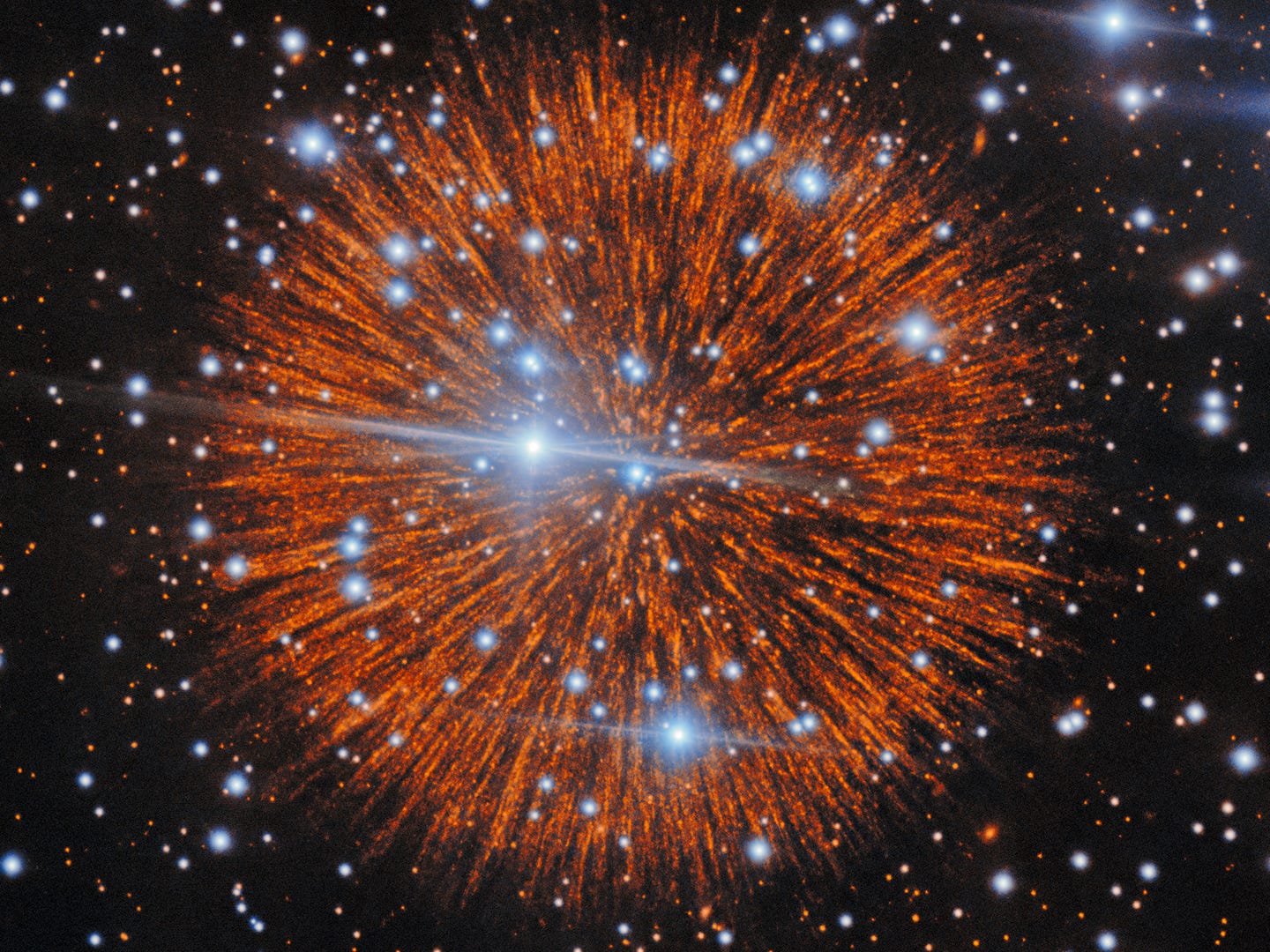
Gemini North images reveal chains of gas knots in Pa 30, a supernova remnant linked to 1181 with a surviving central star. (CREDIT: J. Miller & M. Rodriguez (International Gemini Observatory/NSF NOIRLab), T.A. Rector (University of Alaska Anchorage/NSF NOIRLab), D. de Martin & M. Zamani (NSF NOIRLab)
- Gemini North images reveal that Pa 30’s radial filaments contain chains of gas knots, each roughly 100 billion kilometers wide.
- The remnant offers a rare close view of a suspected Type Iax supernova, linked to an explosion recorded in 1181.
- Its surviving star lies near the nebula’s center, indicating a small sideways recoil, while the knots’ origin remains uncertain.
Streaks of gas left by an ancient stellar explosion have resolved into something more intricate: chains of enormous knots. New telescope images show that Pa 30’s apparent fireworks contain clumps with surprisingly similar sizes, arranged along filaments radiating from a surviving star.
The observational study, reported in The Astrophysical Journal, used Gemini North in Hawai‘i to examine this unusual supernova remnant. Tim Cunningham and Ilaria Caiazzo co-led the international team, working through the Center for Astrophysics | Harvard & Smithsonian and the Institute of Science and Technology Austria (ISTA). Cunningham is now an assistant professor at the University of Warwick in the United Kingdom.
Pa 30 is associated with a supernova recorded in 1181, nearly 850 years ago. At approximately 7,500 light-years from Earth, it allows astronomers to inspect an explosion’s aftermath in detail. The observations reveal about ten times more filamentary structure than earlier images showed.
An old explosion with a surviving star
Japanese, Chinese and Arabic historical sources recorded the stellar event in 1181. Its likely remnant remained unrecognized until a citizen scientist identified Pa 30 in archival infrared images in 2013. Follow-up observations eventually connected the nebula with the historical explosion.
The object stands apart because a hot star remains at its center. Astronomers describe it informally as a “zombie star,” reflecting its apparent survival after an incomplete explosion. The central object’s presence helps distinguish Pa 30 from remnants of explosions that completely destroy their progenitor.
Several lines of evidence support classifying the event as a Type Iax supernova, a comparatively faint thermonuclear explosion. These include the historical brightness, relatively modest ejecta speeds and surviving star. The absence of hydrogen and helium in the star and surrounding nebula also supports that interpretation.
Pa 30 remains the only known Milky Way remnant of its kind. Similar explosions have been observed in other galaxies, but distant events do not offer the same access to a surviving star and resolved ejecta. Its unusual status makes it a valuable test of models for incomplete stellar destruction.
Researchers have proposed that two white dwarfs merged to produce Pa 30. These dense stellar remnants no longer sustain the nuclear fusion that powered their earlier lives. The merger explanation remains a proposed origin, and Type Iax explosions may arise through more than one route.
Sulfur light exposes the hidden chains
The team observed Pa 30 with the Gemini Multi-Object Spectrograph across six nights between July 26 and August 5, 2025. Narrowband filters isolated light from singly ionized sulfur and doubly ionized oxygen. This approach highlighted gas structures that would be harder to distinguish in broader images.
The sulfur image revealed many more filaments than previous observations could detect. Instead of smooth, continuous streaks, individual filaments generally consist of cascades of knots. The oxygen image traced structures in the same locations, confirming that both emissions arise from the filament network.
Each knot has a characteristic diameter of approximately 10 quadrillion centimeters, or 100 billion kilometers. That is roughly ten times the diameter of Neptune’s orbit. The measurement describes the planetary region of the solar system, rather than its much more distant outer boundaries.
“The knots are quite strikingly uniform. We are excited to try to model them,” Caiazzo said. Their apparent similarity gives researchers another property that any successful explanation of Pa 30’s shape must reproduce.
The size estimate comes with an observational limit: the sulfur knots are only marginally resolved. Their apparent widths are slightly larger than the blurring caused by observing through Earth’s atmosphere. The oxygen image has poorer resolution and cannot independently establish the knots’ sizes.
A star that received little sideways recoil
The filaments also provided a way to locate the nebula’s geometric center. The researchers used an image-analysis method called a rolling Hough transform to identify filament directions. They then tested which central position best matched the outward-pointing pattern.
That position agreed closely with the surviving star’s location. The result matters because asymmetric explosions can give surviving objects a recoil, or “kick.” A star displaced far from its expanding nebula’s center would indicate a larger sideways component of that motion.
The analysis placed a three-sigma upper limit of 14 kilometers per second on the star’s kick across the sky. This constrains its recoil relative to the nebula, rather than describing every component of its motion through the galaxy. The result favors a small transverse kick.
Its motion toward or away from Earth is harder to establish. The central star’s powerful wind broadens emission lines, preventing a precise radial-velocity measurement. Assuming that all three-dimensional kick directions are equally likely, the team inferred a total-speed upper limit of 94 kilometers per second at three sigma.
That broader limit depends on the directional assumption. The observations therefore do not prove that the explosion was perfectly symmetric or that the star received no recoil. They provide a quantitative constraint that competing explosion models must address.
The mechanism behind the pearls remains open
Pa 30’s distinctive radial pattern has already prompted several explanations. One proposes that the central star’s fast wind strips material from slower ejecta clumps. However, the new study finds that this picture does not naturally explain the regular knot chains or previously measured expansion behavior.
Other models involve interactions between supernova ejecta and surrounding gas. Strong cooling or large density differences could help produce narrow filaments. Instabilities caused by shearing flows, potentially assisted by rapid cooling, might then break those structures into knots.
These remain possibilities rather than an established account. The researchers have not determined whether cooling alone would create orderly chains or more chaotic structures. Measuring knot spacing is also difficult because separate filaments overlap along the line of sight.
The images reveal another unresolved component: faint emission between the brightest filaments. It could come from genuinely diffuse gas or numerous filaments too faint to distinguish individually. Deeper oxygen observations and sharper imaging could help separate those possibilities.
A guide to finding other remnants
The team sees Pa 30 as a reference for searches elsewhere in the Milky Way and nearby galaxies. Its filament geometry, clumpy structure and surviving star provide a combination of features to investigate. Other remnants of similar explosions may remain unidentified.
Further observations with the Hubble Space Telescope could sharpen measurements of the knots and central position. For now, Gemini North has supplied a more demanding picture for theorists to explain. An explosion recorded centuries ago has left both a surviving star and an unexpectedly intricate gas network.
Dig deeper into Pa 30 and incomplete stellar explosions
These studies explore Pa 30’s identification, expansion and central star, alongside the broader Type Iax supernova class.
Expansion Properties of the Young Supernova Type Iax Remnant Pa 30 Revealed: Maps the remnant’s gas velocities and three-dimensional structure, providing context for its radial filaments. (The Astrophysical Journal Letters, 2024)
Discovery of an Exceptional Optical Nebulosity in the Suspected Galactic SN Iax Remnant Pa 30 Linked to the Historical Guest Star of 1181 CE: Reports the earlier sulfur images that revealed Pa 30’s extraordinary outward-pointing filaments. (The Astrophysical Journal Letters, 2023)
The Remnant and Origin of the Historical Supernova 1181 AD: Presents evidence linking Pa 30’s location, expansion age and inferred brightness to the historical event. (The Astrophysical Journal Letters, 2021)
A massive white-dwarf merger product before final collapse: Investigates the unusual central star and the proposed merger origin of the star-nebula system. (Nature, 2019)
Type Iax Supernovae: A New Class of Stellar Explosion: Establishes the observational properties of this supernova class and discusses explosions that may leave surviving white dwarfs. (The Astrophysical Journal, 2013)
Research findings are available online in The Astrophysical Journal.
The original story "Cosmic ‘pearls’ emerge around the surviving star of an ancient supernova" is published in The Brighter Side of News.
Related Stories
- Ancient supernova remnants found in Antarctic ice
- Rare x-ray flash reveals the first moments of a powerful supernova without a gamma-ray burst
- Scientists find evidence of a rare double supernova in the Jellyfish Nebula
Like these kind of feel good stories? Get The Brighter Side of News' newsletter.
Joseph Shavit
Writer, Editor-At-Large and Publisher
Joseph Shavit, based in Los Angeles, is a seasoned science journalist, editor and co-founder of The Brighter Side of News, where he transforms complex discoveries into clear, engaging stories for general readers. With vast experience at major media companies like The Los Angeles Times, Times Mirror and Tribune Publishing, he writes with both authority and curiosity. His writing focuses on space science, planetary science, quantum mechanics, geology. Known for linking breakthroughs to real-world markets, he highlights how research transitions into products and industries that shape daily life.