Birds and humans share recurring speech and music patterns across 52 languages
Birds and humans share patterns in pitch, timing and phrase endings, suggesting vocal production may help shape communication across very different species.
 McGill University Writer: Kay Pettigrew

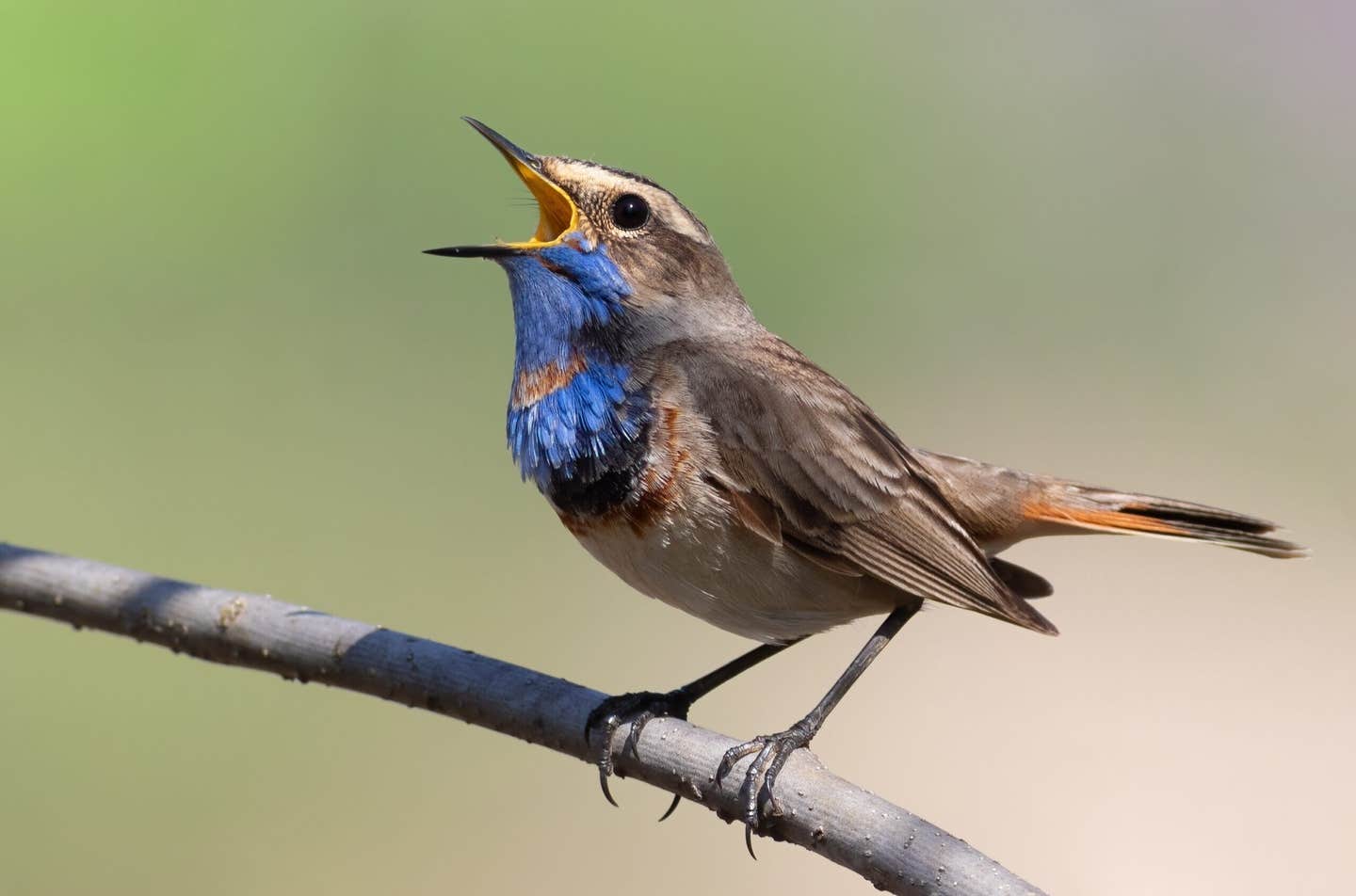
A study of 367 bird species found vocal patterns shared with human speech and song, regardless of whether birds learn their songs. (CREDIT: Shutterstock)
- Recordings from 367 bird species revealed widespread vocal patterns also found in human speech and song across 52 languages.
- Birds favored smaller pitch changes, more evenly timed sounds and longer phrase endings, regardless of whether they learn their vocalizations.
- Shared production constraints may help explain the similarities, but the study did not establish their causes or demonstrate shared language abilities.
A bird’s final note and a person’s last syllable can linger in similar ways. Across hundreds of bird species, researchers found recurring patterns that also shape human speech and song: smaller pitch changes between sounds, relatively regular timing and lengthened phrase endings. These tendencies appeared in birds that learn their songs and birds whose vocalizations develop without imitation.
The findings, published in Science, come from a team led by researchers at McGill University. They compared recordings from 367 bird species with human vocalizations across 52 languages. The analysis suggests that aspects of how bodies produce sound may help organize vocal communication across very different species.
The word “universals” needs qualification here. It describes broadly recurring statistical patterns, rather than rules obeyed by every bird or human utterance. Similar acoustic organization also does not establish that birds possess human language, understand music as people do or acquired these patterns through the same evolutionary route. The sample also represents selected bird lineages, rather than the entire diversity of living birds.
Comparing voices across a broad family tree
The researchers assembled and manually annotated more than 74,500 bird syllables, defined as continuous stretches of sound. Recordings came from xeno-canto, a citizen-science archive of wildlife sounds. This gave the team a broad collection that extended beyond the familiar songbirds often used in vocal-learning research. The researchers defined the songs they analyzed as rapid sequences of vocal elements, rather than every sound a bird can make.
Four groups formed the comparison: oscine songbirds, suboscines, hummingbirds and nightjars. Songbirds and hummingbirds include vocal learners, while the suboscines and nightjars studied represent non-learning lineages. Comparing related groups allowed the researchers to examine whether learned vocal production consistently predicts the acoustic patterns under investigation. Vocal learning evolved independently in songbirds and hummingbirds, making agreement between the two especially useful when evaluating a possible learning effect.
For humans, the team analyzed an existing global collection of speech and song spanning 52 languages. They measured corresponding features in bird and human sequences, rather than relying on whether recordings sounded similar to listeners. Their statistical analyses accounted for evolutionary relationships among birds and relatedness among language families, reducing the risk of treating closely related samples as wholly independent evidence.
Small pitch steps and relatively steady timing
One test examined frequency changes from the end of a syllable to the beginning of the next. Birds generally made smaller jumps than expected when researchers shuffled the sequences for comparison. The result remained when shuffling preserved broader local organization, strengthening the evidence that syllable order contributed to the pattern.
Another test examined the intervals between successive sound onsets. Birds showed more locally even timing, called isochrony, than the randomized comparisons predicted. This resembles a widespread feature of human speech rhythm, although even spacing does not demonstrate that birds perceive or synchronize with a musical beat. Evidence for other simple timing ratios, including intervals related by one-to-two or one-to-three proportions, was limited.
Phrase endings supplied a third connection: final syllables tended to last longer. The team also found that pitch, duration and loudness alternated less frequently than chance predicted across successive elements. Together, these results describe tendencies in sequence organization, not evidence that all birds sing identical melodies or use human musical scales.
Vocal learning did not explain the resemblance
The researchers expected vocal learners to show stronger similarities to humans because people learn speech and song. Learning by imitation provides an obvious potential link between human voices and some bird songs. The broader comparison allowed that expectation to be tested against birds that develop their vocalizations without such imitation.
The prediction received little consistent support. Vocal learning affected some measurements, but its effects varied between the major bird groups instead of producing a reliable pattern. Learned songs therefore did not consistently look more humanlike across the acoustic features the researchers measured.
That finding does not make vocal learning irrelevant to communication. It suggests that imitation alone cannot explain these particular similarities. Other features of sound production, perception and species biology remain plausible contributors, and different aspects of vocal behavior may depend on learning to different degrees.
Bodies may impose common constraints
“We propose that shared acoustic patterns among birds and humans may be due to common vocal production mechanisms or biases,” said first author Logan James, a postdoctoral fellow in biology. His explanation points toward practical constraints on moving between sounds. A vocal system may favor some transitions because they are easier to produce than alternatives.
“For example, birds and humans are unlikely to dramatically change pitch from one note to the next (‘small pitch intervals’) because it is difficult to do. Phrase-final elongation in birds and humans could be due to breathing patterns when we vocalize.” These are proposed explanations for the observed patterns, rather than mechanisms demonstrated experimentally by the recordings.
Birds and humans both generate vocal sound through airflow-driven tissue vibrations. Their anatomy nevertheless differs substantially, including muscular control and respiratory organization. Those differences leave room for shared broad constraints to produce distinct outcomes, rather than requiring identical sound-producing organs or neural systems.
Similar patterns still leave substantial differences
The resemblance depended on the feature being compared. Human song often showed smaller pitch jumps than several bird groups, while human vocalizations often had stronger phrase-final lengthening. Nightjars provided an important exception to a simple body-size explanation, showing stronger elongation than humans despite their smaller bodies.
Loudness also followed different patterns. Human phrases tended to become quieter toward their endings, whereas bird songs did not show the same overall decline. The authors suggest that respiratory differences could contribute: birds may take brief breaths between song syllables, unlike the usual breathing pattern within human phrases.
A broader analysis combined changes in sound frequency and timing. On that measure, bird songs were generally closer to human speech than human song. Other measurements produced different relationships, showing why describing birdsong simply as either “music” or “speech” misses much of the variation.
Listening to overlooked birds
Senior author Jon Sakata, a biology professor, said the findings support looking beyond familiar vocal-learning species. “Given the similarities between all these groups of birds to humans, we hope this research will inspire scientists to investigate groups of birds that have historically been overlooked: namely, birds that do not learn their vocalizations.” Those groups could help separate patterns requiring imitation from patterns arising through other processes.
Future work can test the contributions of muscles, breathing and auditory processing more directly. Recording similarities cannot determine how much each mechanism contributes. Nor does producing a recurring pattern establish what another animal hears, prefers or understands when listening to it.
The authors also identify untested features, including hierarchical organization, discrete pitches and musical scale structure. They suggest extending comparisons to nonvocal communication, such as courtship movements and gestures. The next challenge is to establish which recurring patterns reflect the mechanics of a voice and which depend on the minds producing and receiving it.
Dig deeper into birdsong and human vocal patterns
These studies examine sound preferences, vocal timing and the balance between shared patterns and cultural or biological variation.
Humans share acoustic preferences with other animals
Researchers compared human judgments of animal calls with measured animal preferences, offering context for possible shared perceptual biases. (Science, March 2026)
The Temporal Organization of Learned Vocal Behavior Is Predicted by Species Rather Than Experience
Experiments with finches examined how species identity and early experience shape the timing and organization of learned songs. (The Journal of Neuroscience, January 2025)
A genomic basis of vocal rhythm in birds
Work on vocal non-learning tinkerbirds investigates genetic contributions to rhythm, broadening the focus beyond song-learning species. (Nature Communications, April 2024)
Commonality and variation in mental representations of music revealed by a cross-cultural comparison of rhythm priors in 15 countries
This cross-cultural study identifies both shared tendencies and cultural variation in how people mentally represent rhythm. (Nature Human Behaviour, March 2024)
Universality and diversity in human song
Ethnographic records and song recordings provide a foundational comparison of musical patterns across societies. (Science, November 2019)
Research findings are available online in the journal Science.
The original story "Birds and humans share recurring speech and music patterns across 52 languages" is published in The Brighter Side of News.
Related Stories
- Climate shifts sparked rare bursts of bird evolution
- Inside the Dodo's skull, scientists found a bird unlike any living pigeon
- Identifying bird species by sound, an app opens new avenues for citizen science
Like these kind of feel good stories? Get The Brighter Side of News' newsletter.
Hannah Shavit-Weiner
Medical & Health Writer
Hannah Shavit-Weiner is a Los Angeles–based medical and health journalist for The Brighter Side of News, an online publication focused on uplifting, transformative stories from around the globe. Having published articles on AOL.com, MSN and Yahoo News, Hannah covers a broad spectrum of topics—from medical breakthroughs and health information to animal science. With a talent for making complex science clear and compelling, she connects readers to the advancements shaping a brighter, more hopeful future.