Black hole ‘hair’ could reveal hidden matter after two black holes collide
A new framework shows how hidden black hole “hair” could leave separate fingerprints in the frequency and fading of gravitational waves.
 Nagoya University Writer: Merle Naidoo

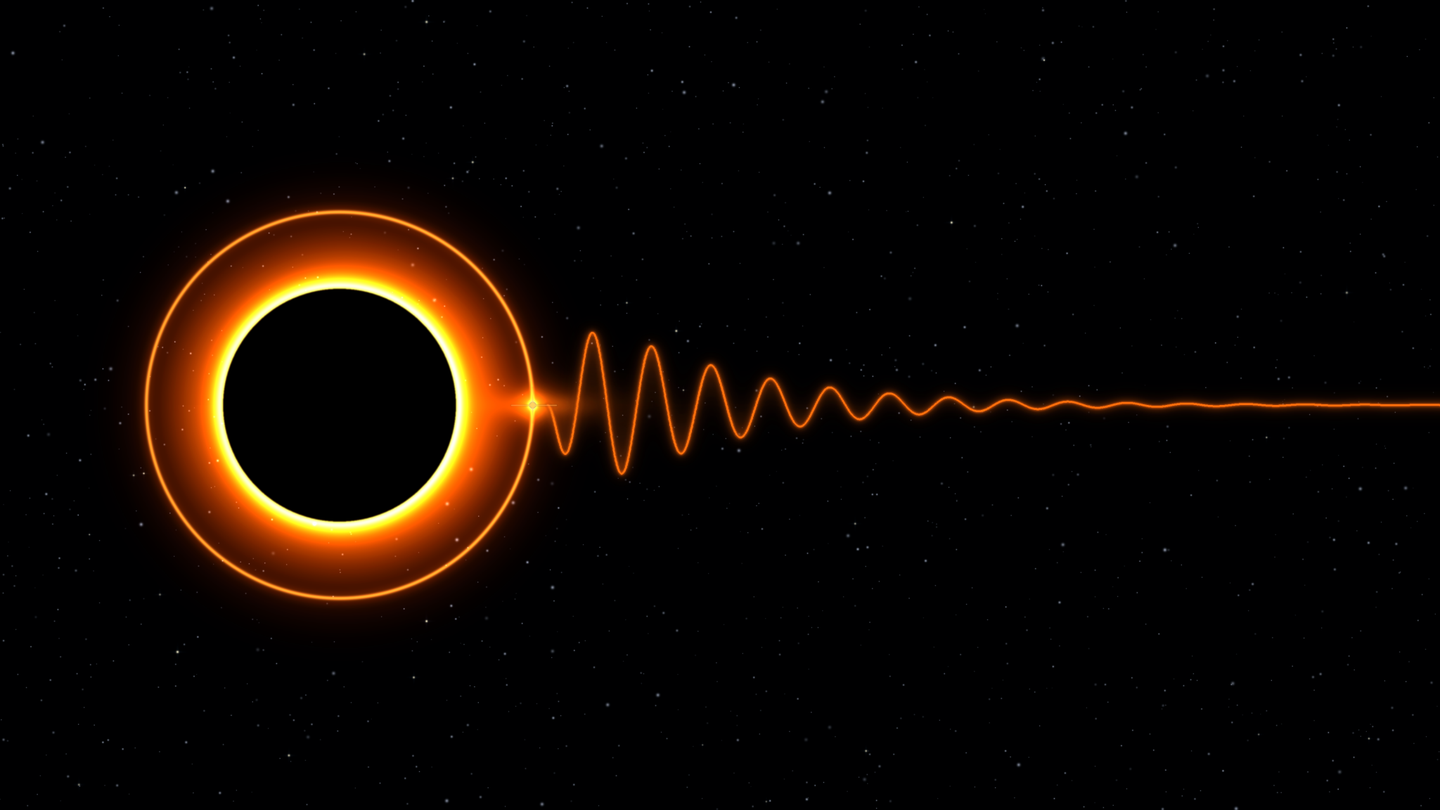
Black hole ringdown waves may reveal hidden matter or new physics through distinct changes in frequency and damping. (CREDIT: Nagoya University)
- A new theoretical framework suggests that “hair” around black holes, representing surrounding matter or departures from the simplest general-relativistic models, could leave distinct signatures in the frequency and damping of gravitational-wave ringdown.
- For static black holes, the researchers found that the frequency shift and damping shift respond differently to the surrounding matter, with their difference carrying information about local energy density and tangential pressure near the photon orbit.
- For spinning black holes, the predicted effect depends on whether the relevant waves move with or against the black hole’s rotation, potentially giving future gravitational-wave observations another way to distinguish ordinary Kerr black holes from more exotic objects.
After two black holes collide, the newly formed object does not immediately become quiet. It vibrates, sending gravitational waves through space as a rapidly fading set of tones.
Physicists call this final stage ringdown. Much like the sound of a struck bell contains information about the bell itself, the frequencies and decay rates of these gravitational waves reveal properties of the black hole that produced them.
A new theoretical study suggests those dying vibrations could reveal something even stranger: whether a black hole carries invisible “hair” created by surrounding matter or physics that departs from the simplest predictions of general relativity.
Researchers led by Nagoya University developed a mathematical framework connecting changes in ringdown frequencies with the properties of hypothetical matter around black holes. Their work, published in the Journal of Cosmology and Astroparticle Physics, focuses on how the oscillation frequency and damping rate respond differently to that hidden material.
“The ringdown waves may not only show that something extra is affecting the black hole; the way the signal changes could also give us clues about what this hidden matter is actually like,” said first author Ariadna Uxue Palomino Ylla of Nagoya University’s Graduate School of Science.
A black hole that rings like a bell
The simplest isolated rotating black hole in general relativity is described by the Kerr solution. Once its mass and angular momentum are known, its fundamental properties are fixed.
When such a black hole is disturbed, it produces characteristic damped vibrations called quasinormal modes. Their real frequencies describe how quickly the waves oscillate, while their imaginary components determine how quickly those oscillations fade.
This predictable relationship forms the foundation of black hole spectroscopy, an effort to test whether observed black holes behave exactly as Einstein’s theory predicts.
The new work considers what would happen if that ideal picture were slightly altered. The researchers modeled small departures from ordinary Schwarzschild and Kerr black holes by surrounding them with an effective anisotropic fluid.
That fluid is not necessarily meant to represent ordinary gas. Instead, it provides a broad mathematical description that could stand for dark-sector fields, exotic matter or some effects of modified gravity.
“Black hole hair may represent matter surrounding the black hole, or deviations from the simplest kind of black hole predicted by general relativity,” Palomino Ylla said.
Light circling a black hole provides the clue
Directly calculating quasinormal modes for every imaginable hairy black hole would be extremely difficult. Each model can require a separate set of perturbation equations and numerical calculations.
The team used a shortcut based on a known correspondence between quasinormal modes and unstable photon orbits.
Close to a black hole, photons can temporarily circle along unstable paths before either plunging inward or escaping. In a particular high-frequency approximation called the eikonal limit, properties of these photon orbits are linked to properties of the black hole’s ringdown.
The orbital frequency corresponds to the oscillation frequency of the quasinormal mode. The instability of the photon orbit, quantified through a quantity called the Lyapunov exponent, corresponds to how quickly the ringdown fades.
The researchers combined this relationship with Einstein’s equations. That allowed them to connect predicted ringdown shifts directly to the density and pressure of hypothetical material around the black hole.
Their framework was then tested on three theoretical examples: the Bardeen, Hayward and Kiselev black holes.
Frequency and damping carry different information
The central finding is that surrounding “hair” does not shift every part of the ringdown signal in exactly the same way.
For static black holes, changes in oscillation frequency depend partly on how the surrounding matter modifies spacetime around the photon orbit.
The damping rate carries an additional contribution.
In the researchers’ formulation, the difference between the fractional damping shift and frequency shift depends on the local combination of energy density and tangential pressure near the unstable photon orbit.
That creates a potential diagnostic. Rather than merely looking for any departure from the expected ringdown frequency, scientists could compare how the frequency and decay time move relative to each other.
Their relationship could provide clues about the properties of whatever is causing the deviation.
For some theoretical matter configurations, the sign of that difference can even indicate whether the effective material satisfies or violates certain energy conditions used in general relativity.
Different kinds of hair leave different patterns
The three example black holes did not behave identically.
For the Bardeen and Hayward models, small deviations from the ordinary vacuum black hole caused characteristic changes in the oscillation and damping rates.
The researchers found that the corresponding small-deviation solutions were incompatible with the dominant energy condition, one of the conditions often imposed when asking whether a theoretical energy distribution behaves like physically conventional matter.
That does not necessarily rule the models out. It could mean that such a signal, if observed, would be better interpreted through modified gravity rather than ordinary material surrounding the black hole.
The Kiselev model behaved differently. Depending on its parameters, it could satisfy standard energy conditions even while producing measurable changes in ringdown.
That diversity demonstrates why a single generic shift in frequency would not be enough to identify black hole hair. Different types of extra physics can alter the signal in different ways.
Rotation adds another layer to the fingerprint
Real astrophysical black holes are generally expected to spin, making the problem more complicated.
Rotation breaks the symmetry between light traveling with the black hole’s spin and light traveling against it. The researchers therefore separated the predicted quasinormal behavior into co-rotating and counter-rotating branches.
Hair affected those branches differently.
In the rotating Bardeen example, the magnitude of the frequency shift was larger for the counter-rotating branch than for the co-rotating one. The damping shifts showed a similar asymmetry.
Both branches smoothly returned to the ordinary Kerr prediction when the hair parameter went to zero.
The result means rotation does more than simply add another correction. It potentially provides an additional observational fingerprint because the direction of orbital motion changes how the surrounding structure influences the waves.
A guide for future gravitational-wave tests
The framework remains theoretical and comes with important limitations.
It relies on the eikonal approximation, which works best for modes with large angular quantum numbers. The gravitational-wave ringdown mode most commonly observed after mergers has much lower angular number, so the formulas are not precision predictions for the signals current detectors actually measure.
The researchers also calculate shifts through photon-orbit behavior rather than deriving the complete gravitational perturbation spectrum for every hairy black-hole model.
Their results should therefore be treated as leading estimates that identify patterns worth searching for, not ready-made templates for analyzing LIGO, Virgo or KAGRA events.
A more complete comparison with observations would require dedicated perturbation equations and numerical quasinormal-mode calculations for each candidate geometry.
Still, the framework provides a useful roadmap. It identifies which properties of hidden matter could affect ringdown frequency and damping, and how rotation may split those effects into separate branches.
If future detectors measure black hole ringdowns with enough precision, those final fading vibrations may offer more than measurements of mass and spin.
They could reveal whether the darkness around a black hole is truly empty.
Dig deeper into black hole ringdown and spectroscopy
These resources explore quasinormal modes, black hole spectroscopy and how future gravitational-wave measurements could test general relativity and search for exotic physics.
Black hole spectroscopy: from theory to experiment: A comprehensive modern review of quasinormal modes, ringdown modeling, observational methods and tests of general relativity with current and future gravitational-wave detectors. (Classical and Quantum Gravity, 2026)
Black hole spectroscopy: status report: Reviews recent progress and unresolved challenges in extracting black hole quasinormal modes from gravitational-wave signals and using them to test the Kerr description. (General Relativity and Gravitation, 2025)
Black hole spectroscopy with nonlinear quasinormal modes: Studies how additional quasinormal modes could improve future strong-field tests of general relativity with next-generation gravitational-wave detectors. (Physical Review D, 2025)
Research findings are available online in the journal arXiv.
The original story "Black hole 'hair' could reveal hidden matter after two black holes collide" is published in The Brighter Side of News.
Related Stories
- The universe may contain a staggering 40 quintillion black holes
- JWST’s mysterious ‘little red dots’ may hide early black holes inside tiny galaxies
- JWST finds three feeding black holes packed into one early galaxy
Like these kind of feel good stories? Get The Brighter Side of News' newsletter.
Joseph Shavit
Writer, Editor-At-Large and Publisher
Joseph Shavit, based in Los Angeles, is a seasoned science journalist, editor and co-founder of The Brighter Side of News, where he transforms complex discoveries into clear, engaging stories for general readers. With vast experience at major media companies like The Los Angeles Times, Times Mirror and Tribune Publishing, he writes with both authority and curiosity. His writing focuses on space science, planetary science, quantum mechanics, geology. Known for linking breakthroughs to real-world markets, he highlights how research transitions into products and industries that shape daily life.