Twelve fading galaxies expose a missing stage in the life of black hole jets
Twelve fading radio galaxies expose a young, distant population that could reshape estimates of how long black hole jets stay quiet.
 University of Cape Town Writer: Hishamodien Hoosain

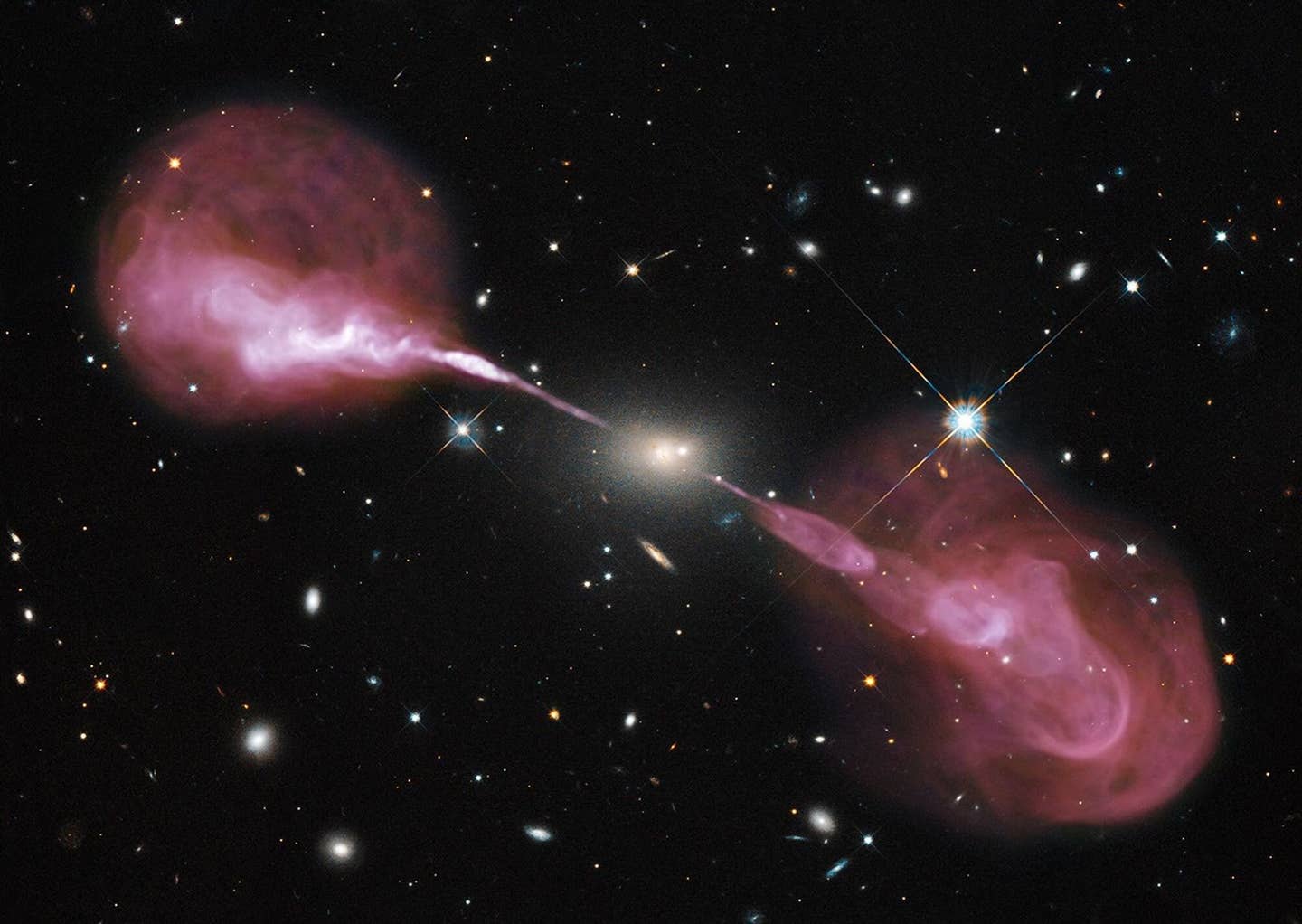
Remnant radio galaxies reveal how quickly giant black hole jets fade, with many distant examples surviving for only millions of years. (CREDIT: NASA, ESA, S. Baum and C. O’Dea (RIT), R. Perley and W. Cotton (NRAO/AUI/NSF), and the Hubble Heritage Team (STScI/AURA))
- Astronomers confirmed 12 faint radio galaxies whose giant jets have switched off, revealing a younger population of cosmic remnants than many found before.
- The galaxies appear to fade especially quickly at greater distances, where energetic particles lose more energy through interactions with the cosmic microwave background.
- Better coverage across many radio frequencies could help future surveys uncover far more of these short-lived galaxies and clarify how often supermassive black holes switch their jets on and off.
Radio galaxies can stretch across hundreds of thousands of light-years, yet their most dramatic structures eventually go quiet. A new analysis has caught 12 such galaxies after their enormous jets shut down, exposing a faint population that appears to fade faster and die younger than many previously known remnants.
Researchers at the University of Cape Town and the Inter-University Institute for Data Intensive Astronomy examined 14 suspected remnant radio galaxies in the XMM–Newton Large-Scale Structure field. Twelve passed detailed spectral tests. Two turned out to still be active.
The distinction matters because a radio galaxy does not simply vanish when its central engine shuts off. Its lobes can continue glowing long after the supermassive black hole stops feeding powerful jets with fresh particles.
Those lingering structures offer astronomers a way to reconstruct the active and quiet phases of a galaxy's central black hole.
When enormous radio jets go dark
Active radio galaxies contain a central active galactic nucleus, or AGN, that can launch two relativistic jets in opposite directions. Those jets terminate in vast radio-emitting lobes and can extend for hundreds of kiloparsecs or even several megaparsecs.
That activity can continue for millions of years. During that time, the jets interact with the surrounding intergalactic environment and deposit energetic plasma beyond the galaxy itself.
Eventually, however, the active phase ends.
Once the jets switch off, the lobes stop receiving new high-energy particles. The particles already inside begin losing energy, and the radio emission weakens. Higher-energy electrons cool faster than lower-energy ones, causing the radio spectrum to become progressively steeper.
Astronomers call this final stage the remnant phase.
Remnant radio galaxies are unusually difficult to find because their fading lobes can become faint and diffuse. Previous deep-field studies have placed the remnant fraction at only about 5 to 8 percent of radio galaxies, although that fraction depends on survey sensitivity.
Six radio frequencies expose false remnants
The team used unusually broad frequency coverage to test the 14 candidates.
Observations came from LOFAR at 144 MHz, GMRT at 323 MHz, upgraded GMRT observations near 400 and 650 MHz, MeerKAT at 1.284 GHz and the Jansky Very Large Array at 1.5 GHz.
That wide frequency span let the researchers measure how each galaxy's radio spectrum curved as its electron population aged.
They modelled the spectra with tools designed to track synchrotron ageing, the gradual energy loss of relativistic electrons that produce radio emission in magnetic fields.
Twelve sources were best described by a model in which particle injection had stopped. Two sources, J021646−051004 and J022433−043709, required continued particle injection and were reclassified as active galaxies.
Both had previously been considered remnant candidates using radio spectra based on only three frequency measurements.
Their reclassification shows how sparse observations can misidentify fading radio galaxies. Dense multifrequency coverage gives astronomers a stronger test of whether the central engine has actually shut down.
A surprisingly young population emerges
The confirmed remnants have total spectral ages ranging from about 8.06 million to 41.97 million years. Their median age is roughly 12 million years.
Those ages are systematically younger than many classical remnants described in earlier work.
The researchers argue that the sample may therefore represent an underexplored population of short-lived radio remnants, with both relatively brief active periods and short quiet phases.
Their evolutionary states vary considerably.
The fraction of each galaxy's lifetime spent in the remnant phase ranges from about 4 percent to 83 percent. One source, J022302−042849, appears to have spent only about 4 percent of its lifetime as a remnant. Another, J021917−042654, has spent roughly 83 percent of its lifetime in that state.
That spread indicates that the sample includes galaxies whose jets shut down recently alongside systems that have remained inactive for much longer.
Most also lie outside dense galaxy clusters. Of the 14 original candidates, only J021528−044045 was associated with a cluster environment.
Distance may shorten the visible afterlife
Redshift appears to play an important role in how long these remnants remain detectable.
Most sources in the sample lie at redshifts between 0.67 and 2.85, apart from one at 0.35. That makes them considerably more distant than many remnants examined in earlier studies.
At higher redshifts, relativistic electrons encounter a denser cosmic microwave background. Those interactions increase inverse Compton energy losses, causing the particles to cool more rapidly.
The analysis found a negative relationship between redshift and spectral age, with younger remnants appearing more often at greater distances.
The authors caution that observational selection also matters. More luminous radio sources are easier to detect far away, producing a relationship between radio luminosity and redshift.
Even so, the redshift-age relationship persisted in their statistical analysis after accounting for radio luminosity.
The findings are consistent with a picture in which high-redshift radio remnants fade faster and therefore remain visible for shorter periods.
Radio lobes keep changing after shutdown
Spatial maps of particle ages showed that radio lobes do not become static once their jets disappear.
Large, well-resolved systems such as J021659−044918 and J022318−044522 displayed organized age gradients. Younger plasma appeared toward the lobe extremities, while older material lay closer to the core.
That pattern matches backflow, in which plasma moves inward from the ends of the lobes while continuing to lose energy.
Compact remnants showed less orderly patterns. Their irregular ageing may reflect environmental differences, magnetic-field variations, projection effects or limits in spatial resolution.
The researchers also stressed that spectral ages are not exact clocks. Model-fitting uncertainties are generally below 10 percent, but larger systematic uncertainties can arise from assumptions about magnetic fields, source geometry and the ageing models themselves.
Practical implications of the research
The work gives astronomers a clearer route for finding radio galaxies during one of the least understood stages of their lives.
Using broad frequency coverage can reduce false classifications and reveal remnants that would be difficult to recognize from only a few radio measurements.
Finding more young, faint and distant remnants could also improve estimates of AGN duty cycles, including how long supermassive black holes remain active, how quickly their radio structures fade and how often activity restarts.
The results also offer a preview of what deeper radio surveys may uncover. Future Square Kilometre Array continuum observations are expected to reach far fainter sources, opening the possibility of detecting a much larger population of high-redshift remnants that current surveys only begin to reveal.
Dig deeper into remnant radio galaxies and black hole jet lifecycles
These resources explore how radio galaxies fade after their jets switch off, how astronomers estimate AGN lifetimes, and how environment and survey methods shape the remnants we detect.
AGN energetics and lifetimes from remnant radio galaxies
Using 79 low-redshift remnant radio galaxies, researchers constrained the distribution of jet powers and active lifetimes, helping connect fading radio lobes with the long-term duty cycles and feedback of supermassive black holes. (Monthly Notices of the Royal Astronomical Society, 2025)
CosmoDRAGoN II: Remnant radio galaxies in group and cluster environments
Three-dimensional simulations show that remnant lobes can evolve very differently depending on their surroundings, with low-density environments allowing some lobes to remain overpressured and dynamically active long after their jets shut down. (Publications of the Astronomical Society of Australia, 2025)
What Have We Learned about the Life Cycle of Radio Galaxies from New Radio Surveys
This review examines how modern low-frequency radio surveys are uncovering dying and restarted AGN, revealing a more varied population and a more complicated cycle of activity and quiescence than earlier observations suggested. (Galaxies, 2024)
The Dynamics and Energetics of Remnant and Restarting RLAGN
This expert review covers the radiative lifetimes, population statistics, dynamics and energetics of remnant and restarting radio galaxies, along with the observations and simulations used to reconstruct their histories. (Galaxies, 2023)
Selecting and modelling remnant AGNs with limited spectral coverage
Researchers developed and tested a method for distinguishing active and remnant radio galaxies when extensive frequency coverage is unavailable, addressing a central challenge in identifying fading sources across large radio surveys. (Monthly Notices of the Royal Astronomical Society, 2022)
Research findings are available online in the journal Monthly Notices of the Royal Astronomical Society.
The original story "Twelve fading galaxies expose a missing stage in the life of black hole jets" is published in The Brighter Side of News.
Related Stories
- ‘Dancing jets’ from black hole reveal their immense power
- Cosmic first: Astronomers observed real-time formation of black hole jets
- How black holes generate massive magnetic and particle-driven jets
Like these kind of feel good stories? Get The Brighter Side of News' newsletter.
Joseph Shavit
Writer, Editor-At-Large and Publisher
Joseph Shavit, based in Los Angeles, is a seasoned science journalist, editor and co-founder of The Brighter Side of News, where he transforms complex discoveries into clear, engaging stories for general readers. With vast experience at major media companies like The Los Angeles Times, Times Mirror and Tribune Publishing, he writes with both authority and curiosity. His writing focuses on space science, planetary science, quantum mechanics, geology. Known for linking breakthroughs to real-world markets, he highlights how research transitions into products and industries that shape daily life.