Buried volcanic structure suggests that our Moon once had a powerful magnetic field
Gravity and magnetic measurements reveal buried lunar magma that may preserve evidence of an ancient core-powered dynamo.

 Edited By: Joshua Shavit

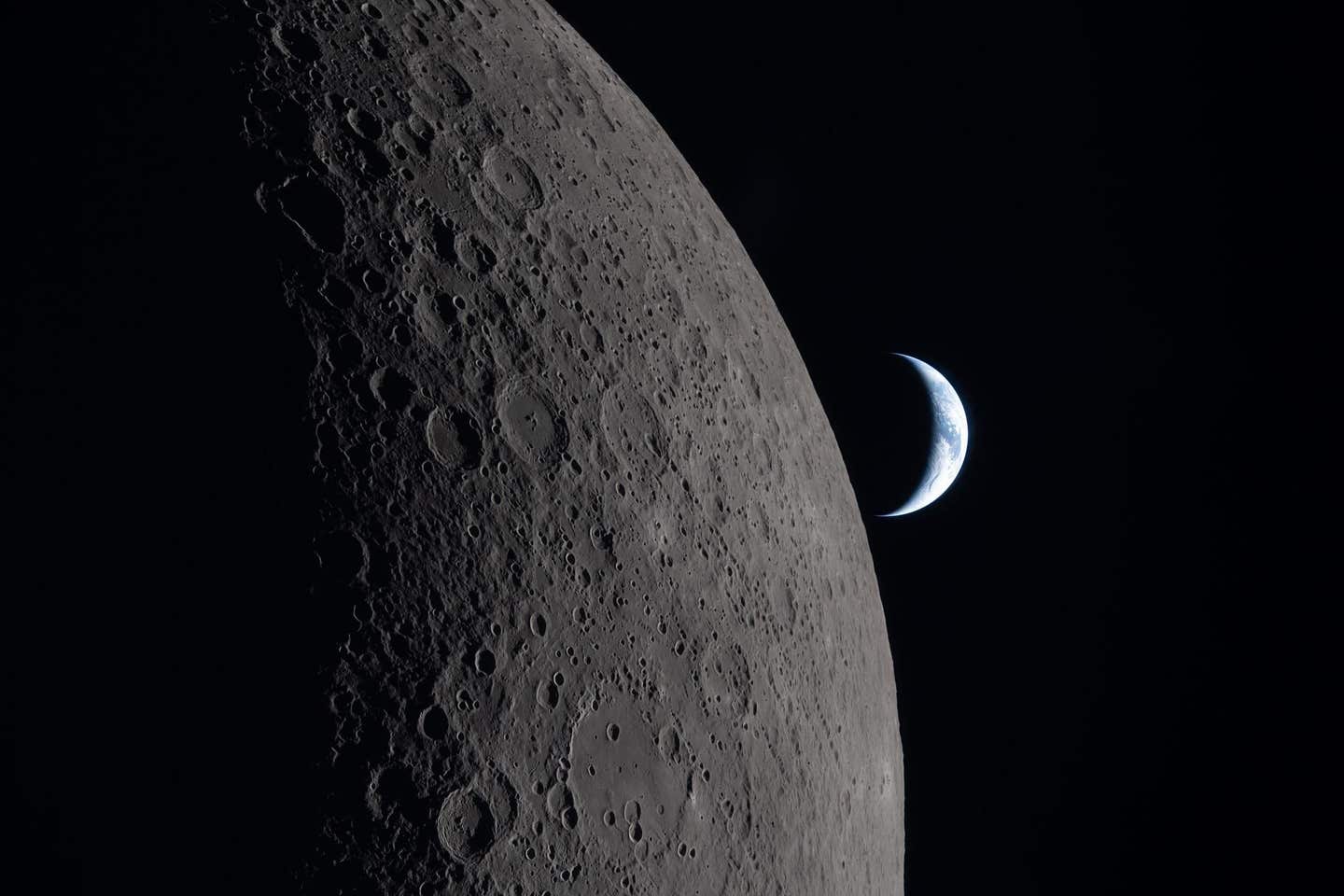
The Moon is magnetically quiet today, but a buried volcanic structure on its far side may preserve evidence of a very different past. (CREDIT: NASA)
- Orbital gravity and magnetic measurements point to a buried, strongly magnetized volcanic body beneath the Moon’s far-side Dewar swirl, dating to about 4.22 billion years ago.
- Researchers estimate the ancient magnetic field needed to magnetize the slowly cooling magma was at least about 11.4 microtesla, supporting the existence of an active lunar dynamo at that time.
- The finding offers evidence independent of disputed Apollo rock measurements, but it deepens another mystery: how the Moon’s relatively small core could have generated such a strong magnetic field.
The Moon is magnetically quiet today, but a buried volcanic structure on its far side may preserve evidence of a very different past.
Researchers have identified a dense, strongly magnetized body beneath a bright lunar feature called the Dewar swirl. Their analysis indicates that molten rock cooled there about 4.22 billion years ago while immersed in a magnetic field exceeding 11 microtesla.
That field was probably generated inside the Moon rather than produced briefly by an asteroid impact, the researchers conclude.
The findings, published in Science Advances, provide a new line of evidence in a long-running debate over whether the young Moon once operated a core dynamo similar in principle to Earth's.
The ETH Zurich-led team reached its conclusion without relying on lunar rocks returned by Apollo astronauts. Instead, researchers combined measurements of the Moon's gravity, magnetism, surface composition and topography collected from orbit.
“We have found that the magnetic field on the Moon at that time was very likely stronger than 10 microtesla,” said Xi Yang of ETH Zurich.
A decades-old lunar mystery
Earth's magnetic field originates largely from the movement of electrically conducting liquid iron in its outer core. This geodynamo creates a global field measuring roughly 50 microtesla at Earth's surface, although the strength varies geographically.
The Moon has no comparable global field today.
Yet portions of its crust remain magnetized, suggesting they cooled or were otherwise altered while magnetic fields were present billions of years ago.
Apollo samples have complicated the picture. Some paleomagnetic studies indicate that the Moon maintained a substantial dynamo between roughly 4.25 billion and 3.5 billion years ago. Other analyses have found little or no evidence for such a field during parts of the same interval.
Impacts provide another possible explanation. Large collisions can briefly generate or amplify magnetic fields and shock lunar rocks, potentially creating magnetization without requiring a long-lived core dynamo.
That uncertainty has left researchers searching for evidence that can be tied to a specific geological structure and formation process.
The Dewar region offered an unusual opportunity.
Gravity and magnetism converge beneath Dewar
Dewar sits on the Moon's far side near the equator, northwest of the enormous South Pole-Aitken basin.
It contains both a strong magnetic anomaly and an unusual gravity signal. That overlap matters because gravity can reveal variations in subsurface density while magnetic observations reveal magnetized material.
“The Dewar region is a genuine stroke of luck: one of the strongest magnetic field anomalies on the far side of the Moon and a distinct gravity anomaly coincide spatially there,” said ETH Zurich geophysicist Anna Mittelholz.
The team combined gravity information, including measurements derived from NASA's GRAIL mission, with lunar magnetic-field models based on orbital observations.
Using a joint inversion technique, the researchers reconstructed a three-dimensional picture of material hidden beneath the surface.
The strongest Dewar structure is about 60 kilometers wide and extends to approximately 9 kilometers deep. It is denser than the surrounding lunar crust and strongly magnetized.
Its maximum modeled magnetization reaches about 0.4 amperes per meter, while portions of the body are roughly 250 kilograms per cubic meter denser than neighboring crust.
Evidence points toward buried magma
Several clues indicate that the structure originated from magma rather than an impact.
The region contains elevated iron, titanium, thorium and pyroxene. Researchers have previously interpreted some of those signatures as evidence of ancient basalt buried beneath later material, known as cryptomare.
The team also identified mound-like topography above the anomaly resembling features associated with lunar volcanic complexes.
Together, the density, composition, topography and magnetic data support an intrusive volcanic body. Magma appears to have risen from deeper inside the Moon and slowly solidified underground.
Deposits from later impacts constrain its formation to roughly 4.22 billion years ago, with an uncertainty of about 80 million years.
That slow cooling is crucial. A short-lived magnetic pulse generated during an impact would last only hours, according to the study, and could magnetize only a small part of such a large intrusive body.
A persistent magnetic field offers a better explanation.
The young Moon had a surprisingly strong field
Once researchers estimated how much magnetic material the buried magma could contain, they calculated the minimum external field required to produce its observed magnetization.
The average properties require at least about 11.4 microtesla. Explaining the most strongly magnetized material raises the lower estimate to about 22 microtesla.
Both values fall within the range expected from previous evidence for a lunar dynamo.
The result is particularly important because it comes from orbital geophysics rather than a returned rock sample. It therefore provides an independent test of the magnetic history inferred from Apollo material.
The researchers cannot yet explain precisely how the Moon generated such a field.
Several conventional mechanisms struggle to create fields stronger than a few microtesla in the Moon's relatively small core. Proposed alternatives include motion caused by interactions between the mantle and core, convection associated with a basal magma ocean or combinations of several mechanisms.
The evidence therefore shifts the question rather than settling everything.
As Mittelholz put it, the problem is moving from whether a dynamo existed toward understanding how it worked.
Lunar swirls provide another clue
The work may also help explain the strange bright markings known as lunar swirls.
Dewar contains one of these twisting high-albedo features directly above its magnetic anomaly. Swirls occur in magnetized regions, but not every magnetic anomaly produces one.
One explanation is that local magnetic fields deflect charged particles in the solar wind. Reduced bombardment slows space weathering, allowing protected material to remain brighter than surrounding terrain.
The new study suggests horizontal magnetic fields and iron-rich surface material may both be important for producing that contrast.
Future missions could test these ideas directly. Farside samples, seismic measurements and surface magnetic observations could determine whether the buried structure really records the field generated by an ancient lunar core.
If so, Dewar represents more than an unusual patch of bright lunar soil. Buried beneath it may be a frozen record of a time when the Moon itself generated a planetary magnetic field.
Dig deeper into the Moon’s ancient magnetic field
These resources explore lunar dynamos, paleomagnetism, magnetic anomalies and the mysterious bright swirls found across the Moon.
A Long-Lived Lunar Core Dynamo: Paleomagnetic measurements of a 3.7-billion-year-old Apollo basalt provided evidence for a substantial lunar magnetic field hundreds of millions of years after the Moon formed. (Science, 2012)
A long-lived lunar dynamo driven by continuous mechanical stirring: This study explores how differential motion between the lunar mantle and liquid core could have powered a magnetic dynamo for an extended period. (Nature, 2011)
Magnetic fidelity of lunar samples and implications for an ancient core dynamo: Researchers examine how reliably lunar rocks preserve ancient magnetic signals and what those measurements imply about a former core dynamo. (Earth and Planetary Science Letters, 2012)
Lunar swirls: Examining crustal magnetic anomalies and space weathering trends: Orbital observations investigate the close relationship between bright lunar swirls, magnetized crust and reduced space weathering. (Journal of Geophysical Research: Planets, 2011)
Key Questions of Solar Wind–Moon Interaction: This review examines how lunar magnetic anomalies interact with the solar wind and why those interactions matter for swirls and future surface exploration. (Space: Science & Technology, 2023)
Research findings are available online in the journal Science Advances.
The original story "Buried volcanic structure suggests that our Moon once had a powerful magnetic field" is published in The Brighter Side of News.
Related Stories
- Earth’s magnetic field funneled atmospheric elements to the Moon over billions of years
- The Moon once had magnetic fields as strong as Earth’s
- Chang’e-6 samples reveal how Earth's magnetosphere changed the solar wind reaching the Moon
Like these kind of feel good stories? Get The Brighter Side of News' newsletter.
Joseph Shavit
Writer, Editor-At-Large and Publisher
Joseph Shavit, based in Los Angeles, is a seasoned science journalist, editor and co-founder of The Brighter Side of News, where he transforms complex discoveries into clear, engaging stories for general readers. With vast experience at major media companies like The Los Angeles Times, Times Mirror and Tribune Publishing, he writes with both authority and curiosity. His writing focuses on space science, planetary science, quantum mechanics, geology. Known for linking breakthroughs to real-world markets, he highlights how research transitions into products and industries that shape daily life.