Hairy legs and red eyes: Two bizarre new sea spiders found in British Columbia’s Salish Sea
Microscopy and DNA revealed two overlooked marine arthropods with unusual mouths, grooming limbs and extraordinary reproductive biology.
 UBC Writer: Alex Walls

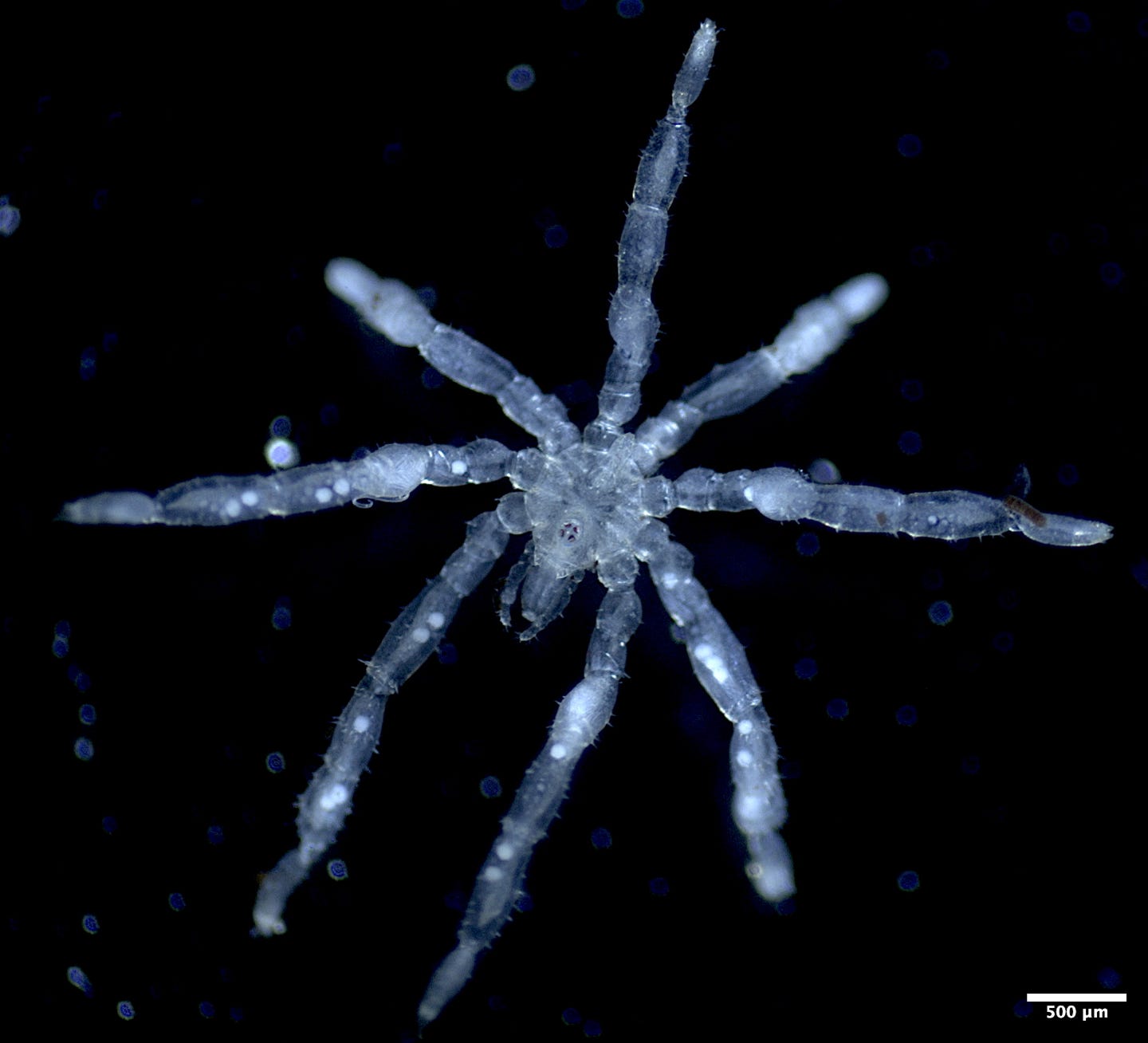
A photo of a new species of sea spider Tanystylum kiixin with eggs shown forming along the limbs. (CREDIT: Cormac Toler-Scott)
- Researchers at the University of British Columbia have described two sea spider species new to science from British Columbia waters, the first new species described from the Salish Sea in almost a century.
- Callipallene pilosuspedes has conspicuously hairy lower legs, red eyes, grooming appendages and a three-lipped mouth, while Tanystylum kiixin often carries tiny organisms on its body because its shorter appendages are poorly suited for grooming.
- The study combined scanning electron microscopy with DNA sequencing to examine seven regional sea spider species, providing new genetic data and a clearer baseline for tracking marine biodiversity as coastal ecosystems change.
Long-legged marine creatures with sucking mouthparts, egg-carrying males and bodies that can host other organisms have been hiding in the waters around British Columbia.
Now, scientists have given two of them names.
Researchers at the University of British Columbia identified two sea spider species new to science after collecting animals from coastal habitats around Vancouver Island and the Salish Sea. The discoveries are the first new sea spider species described from the region in almost a century.
The study, published in Organisms Diversity & Evolution, examined seven coastal species using detailed anatomy and DNA. The newly named Callipallene pilosuspedes and Tanystylum kiixin add to a poorly documented branch of marine biodiversity that scientists suspect contains many more surprises.
“I only had one field season but there’s definitely more diversity out there that we haven’t documented,” lead author Cormac Toler-Scott said.
Sea spiders are stranger than their name suggests
Sea spiders, formally called pycnogonids, are marine arthropods related to the evolutionary branch containing spiders, scorpions and horseshoe crabs.
Their lineage stretches back roughly 500 million years, yet they have developed an anatomy unlike almost anything found on land.
A sea spider’s body can appear almost secondary to its legs. The animals possess a prominent proboscis used for feeding, a greatly reduced abdomen and specialized appendages around the head. Some species prey on small soft-bodied animals, while others feed on organisms such as hydroids, bryozoans and sponges.
Many small coastal species live on or around larger invertebrates.
Sea spiders also breathe across their body surfaces rather than using lungs or gills. Their reproductive system is equally unusual. Females can carry developing ovaries through portions of their legs, while males take responsibility for carrying fertilized eggs.
Males use appendages called ovigers to collect the eggs. Secretions help attach the eggs into clusters that remain with the male while they develop.
Despite that unusual biology, many coastal sea spiders remain poorly studied.
Divers searched British Columbia’s coast
Toler-Scott and colleagues collected specimens between September 2023 and August 2024 from sites around Quadra Island, Vancouver, Victoria and Bamfield.
Divers searched habitats from the intertidal zone to depths of 18 meters. They collected algae, hydroids and other potential sea spider habitat, then examined the material under microscopes back in the laboratory.
The surveys recovered five species directly, including 82 specimens of the newly described T. kiixin. By comparison, researchers found only one C. pilosuspedes.
Additional archived specimens expanded the analysis to seven species.
The team used scanning electron microscopy to reveal structures too small for ordinary examination. DNA sequencing targeted mitochondrial COI and nuclear 18S ribosomal RNA, allowing researchers to compare physical anatomy with evolutionary relationships.
For five of the species, the work produced molecular data that had not previously been available.
One species has unusually hairy feet
The name Callipallene pilosuspedes refers to one of the animal’s most conspicuous characteristics: long, curved spines covering portions of its lower legs.
The species also has strongly pigmented reddish eyes and a short proboscis. At its tip sits a three-part mouth surrounded by tiny sensory structures.
Its specialized ovigers proved surprisingly dexterous.
Under a microscope, researchers watched the animal bend these appendages around its walking legs. Comb-like spines on the ovigers scraped along the limbs, apparently allowing the animal to groom itself.
That level of detail illustrates why microscopic examination was important. Features such as spines, mouth structures, sensory organs and appendage proportions can distinguish species that might otherwise look nearly identical.
The discovery is also based on a single collected specimen, making future sampling particularly valuable for understanding its range, abundance and natural history.
The second species carries its own tiny community
The other new species has a different problem.
Tanystylum kiixin was named after Kiix̣in, the ancient Indigenous village site near where specimens were first collected. The name is pronounced approximately “kee-hin” and derives from the sound of waves breaking near the site.
Unlike C. pilosuspedes, this animal has relatively small, less dexterous ovigers. That may leave it poorly equipped to clean its body.
Researchers repeatedly found specimens carrying debris and tiny organisms, including protist parasites.
Toler-Scott described the arrangement as “an ecosystem within an ecosystem within an ecosystem.”
The researchers collected 82 individuals, making T. kiixin far more common in their sampling than the single known specimen of C. pilosuspedes. That difference does not necessarily show how abundant either species is across the region because sea spider populations can be highly patchy.
Identifying species comes before protecting them
The discoveries have significance beyond adding two unusual names to the catalogue of life.
The Salish Sea supports kelp forests, eelgrass beds, rocky shores, mudflats, reefs and other habitats while also experiencing intense human pressure. Climate change, development and other disturbances can reshape those communities, but measuring biological change requires knowing what lives there first.
“I was interested in how sea spiders are impacted by climate change and human disturbance, because marine invertebrates in the Salish Sea are particularly at-risk, and I couldn’t find anything,” Toler-Scott said.
The study provides the first comprehensive regional sea spider analysis combining scanning electron microscopy with molecular phylogenetics. The researchers also produced an identification resource intended to make future species surveys easier.
That baseline may become increasingly important as scientists track how coastal ecosystems respond to warming waters and environmental disturbance.
For now, the two species offer a reminder of how much diversity can remain undocumented even near heavily populated coastlines.
Some of the strangest animals in the Salish Sea were not hiding in an unexplored abyss. Scientists simply had not looked closely enough.
Dig deeper into sea spiders and marine biodiversity
These resources provide broader context on sea spider evolution, feeding, anatomy and biodiversity.
Feeding ecology in sea spiders (Arthropoda: Pycnogonida): what do we know?: This comprehensive review examines what sea spiders eat, how they feed and the ecological relationships known across different pycnogonid groups. (Frontiers in Zoology, 2018)
Phylogenomic Resolution of Sea Spider Diversification through Integration of Multiple Data Classes: Genetic, genomic and fossil evidence helped researchers reconstruct the deep evolutionary history and relationships of major sea spider lineages. (Molecular Biology and Evolution, 2021)
Pycnogonid affinities: A review: This review explores the long-running scientific debate over where sea spiders belong within the arthropod evolutionary tree. (Journal of Zoological Systematics and Evolutionary Research, 2005)
From egg to “no-body”: An overview and revision of developmental pathways in the ancient arthropod lineage Pycnogonida: Researchers examine the unusual reproductive biology and developmental strategies found across sea spider species. (Frontiers in Zoology, 2017)
Toward an atlas of Salish Sea biodiversity: The flora and fauna of Galiano Island, British Columbia, Canada. Part I. Marine zoology: This regional biodiversity survey documents the extraordinary range of marine animals inhabiting one part of the Salish Sea. (Biodiversity Data Journal, 2022)
Research findings are available online in the journal Organisms Diversity & Evolution.
The original story "Hairy legs and red eyes: Two bizarre new sea spiders found in British Columbia’s Salish Sea" is published in The Brighter Side of News.
Related Stories
- 518-million-year-old fossil reveals where spider fangs came from
- Spider and horseshoe crab relatives emerged 20 million years earlier than scientists thought
- Ancient fossil reveals spiders and their relatives originated in the ocean, not on land
Like these kind of feel good stories? Get The Brighter Side of News' newsletter.
Joshua Shavit
Writer and Editor
Joshua Shavit is a NorCal-based science and technology writer with a passion for exploring the breakthroughs shaping the future. As a co-founder of The Brighter Side of News, he focuses on positive and transformative advancements in technology, physics, engineering, robotics, and astronomy. Having published articles on AOL.com, MSN, Yahoo News, and Ground News, Joshua's work highlights the innovators behind the ideas, bringing readers closer to the people driving progress.