Cosmic dust reveals what happened inside Cassiopeia A before it exploded
Webb found silica-rich and carbon-rich dust in separate clumps of Cassiopeia A. Their chemistry suggests that layers inside the star may have merged shortly before it exploded.
 Purdue University Writer: Brittany Steff

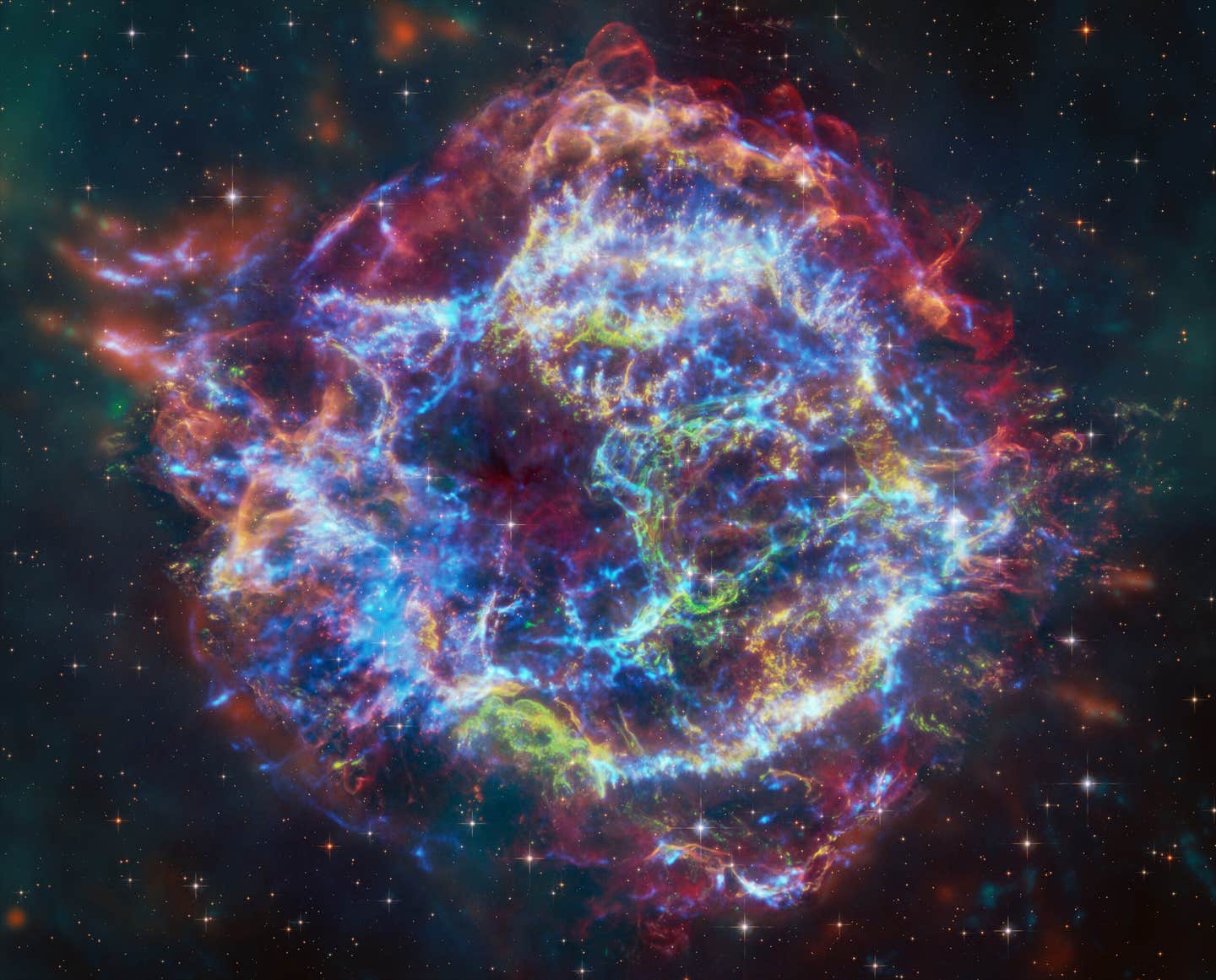
Cassiopeia A, an expanding field of stellar debris left behind by a massive star’s explosive death, is a major focus of Purdue University astronomer Danny Milisavljevic’s research. (CREDIT: NASA)
Silica dominates the infrared dust emission from one clump in Cassiopeia A, while carbon grains dominate in another. Both clumps came from the same exploded star, but their contrasting chemistry suggests the grains formed under different conditions.
Tea Temim of Columbia University led the research, published in The Astrophysical Journal Letters. The team used the James Webb Space Telescope to distinguish clumps about the size of our solar system and analyze their dust. The results suggest that two burning shells inside the star may have mixed shortly before its core collapsed. The dust itself formed after the explosion.
Cassiopeia A lies roughly 11,000 light-years away in the Milky Way. Light from the explosion reached Earth more than three centuries ago, and the supernova remnant is still expanding. The chemistry of its debris offers a record of events astronomers can no longer observe directly.
Interpreting the Dust Grains of Dying Stars
Dust grains form as ejected material cools and atoms join into solid particles. Which grains form depends on the elements present in each clump. That makes dust grains a clue to the chemical conditions in the gas from which they condensed.
The researchers used archival data from the Spitzer Space Telescope to select three targets. Webb’s sharper view let them distinguish smaller structures and split their mid-infrared light into spectra. Two clouds may look similar in an image even when they contain different minerals.
Materials leave distinctive features at particular wavelengths. By comparing the observed features with those expected from different grains, the team could identify the likely sources of emission in individual clumps.
“Once Tea and the team made this very detailed dust map using spectroscopy of small regions, that gave us the decoder ring needed to understand the picture,” said Danny Milisavljevic of Purdue University. The colors in the composite images represent selected wavelengths. Spectroscopy helps researchers identify the materials that emit at those wavelengths and use that information to interpret other parts of the remnant.
A Clue to the Star's Final Stage
A massive star has layers that burn different fuels. Late in its life, convection carries hot material upward and cooler material downward. Under some conditions, turbulent flow can mix material across shell boundaries. Those final stages can shape the debris a star leaves behind.
The team tested whether Cassiopeia A’s oxygen- and carbon-burning shells merged before the explosion. Among the models they examined, those that included a shell merger better matched the combination of conditions inferred from the two clumps. The comparison supports that explanation for the stellar explosion.
A shell merger would alter the mix of elements before the explosion dispersed them. When separate pockets of gas cooled, those chemical differences could favor silica grains in one place and carbon grains in another.
The mixing might have happened only hours before the collapse. Because the grains formed afterward, they can constrain the chemistry at the time of the explosion, while the timing of the merger remains uncertain. Observations of more clumps could show how widespread the pattern is in Cassiopeia A and whether it appears in other remnants.
Three Targets and Two Sources of the Dust
Two Webb targets lay in debris heated by a reverse shock. When an expanding blast wave interacts with surrounding gas, it can drive a second shock back through the ejecta. That shock heats the material and makes its dust easier to see in infrared light.
The third target was part of a feature called the Green Monster. Its infrared dust emission was dominated by magnesium silicates. The material came from gas the star had shed before exploding, so it traces a different part of the star’s history than the two clumps of ejecta.
The three targets show why identifying the source of the dust matters. The ejecta preserve clues to material inside the star when it exploded. The Green Monster instead records material the star released into its surroundings earlier. Both pathways help return stellar material to interstellar space.
Still Moving Cloud of Dust
Some debris travels at about 5,000 kilometers per second, fast enough for astronomers to track changes in successive images taken a few years apart. Spectroscopy adds information about which clumps are moving toward or away from Earth. Together, those measurements help reveal the geometry of the expanding debris.
A three-dimensional reconstruction shows where material lies in the remnant, while spectra reveal what it contains. Those details help astronomers study how the products of stellar explosions can supply raw material for later generations of stars and planets.
Cassiopeia A is still changing as its debris interacts with surrounding gas. Webb’s dust measurements also let astronomers look backward, using the surviving grains to test what may have happened inside the star in its final hours.
Dig Deeper into Cassiopeia A
These studies and telescope reports trace how astronomers learned to read the remnant.
- NASA Telescopes Chase Down “Green Monster” in Star’s Debris: Chandra and Webb observations help trace the Green Monster to material around the star. (Chandra X-ray Observatory, January 2024)
- NASA’s Webb Stuns With New High-Definition Look at Exploded Star: Webb’s near-infrared view reveals compact knots of ejecta and shows how the remnant changes appearance with wavelength. (NASA, December 2023)
- Webb Reveals Never-Before-Seen Details in Cassiopeia A: An earlier mid-infrared view shows the remnant’s dust and the feature nicknamed the Green Monster. (NASA, April 2023)
- The Bubble-like Interior of the Core-Collapse Supernova Remnant Cassiopeia A: Researchers reconstruct the remnant’s interior and identify large cavities among the expanding debris. (Science, January 2015)
- Freshly Formed Dust in the Cassiopeia A Supernova Remnant as Revealed by the Spitzer Space Telescope: Spitzer spectroscopy identifies dust associated with the supernova ejecta and provides a baseline for Webb’s finer measurements. (The Astrophysical Journal, January 2008)
Research findings are available online in The Astrophysical Journal Letters.
The original story "Cosmic dust reveals what happened inside Cassiopeia A before it exploded" is published in The Brighter Side of News.
Related Stories
- Astronomers trace a star’s death spiral into its giant companion
- Fist-of-its-kind supernova offers rare look into the explosive death of a star
- Unusual supernova solves 1,000 year mystery revealing a third way stars might explode
Like these kind of feel good stories? Get The Brighter Side of News' newsletter.
Joseph Shavit
Writer, Editor-At-Large and Publisher
Joseph Shavit, based in Los Angeles, is a seasoned science journalist, editor and co-founder of The Brighter Side of News, where he transforms complex discoveries into clear, engaging stories for general readers. With vast experience at major media companies like The Los Angeles Times, Times Mirror and Tribune Publishing, he writes with both authority and curiosity. His writing focuses on space science, planetary science, quantum mechanics, geology. Known for linking breakthroughs to real-world markets, he highlights how research transitions into products and industries that shape daily life.