Interstellar lightsails resist acceleration above 75% of light speed
A preprint finds that one scattered-light force contribution can turn negative at relativistic speeds, with the threshold depending on the model.

 Editor: Joseph Shavit

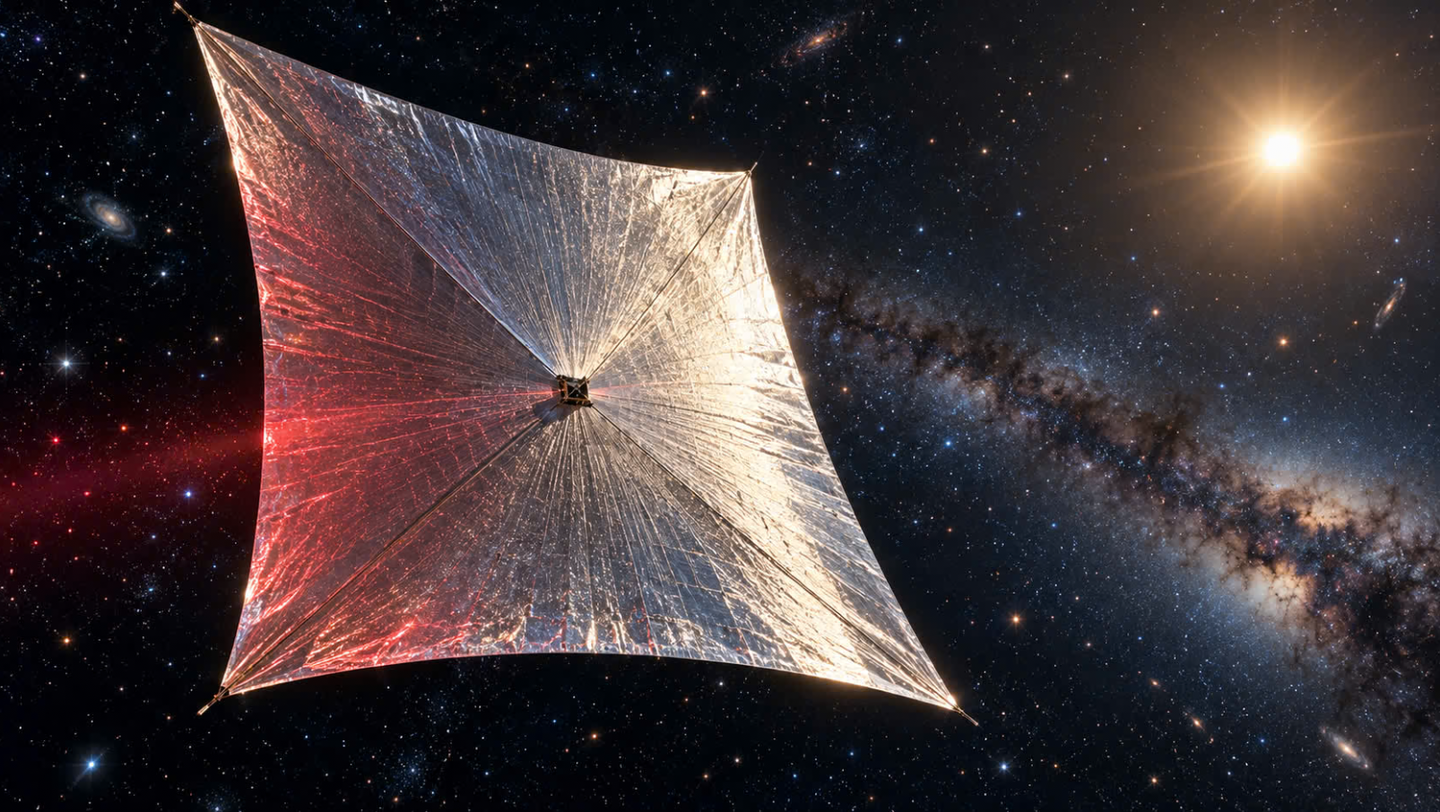
A theoretical lightsail study predicts scattered-light drag at extreme speeds, while total laser thrust stays forward. (CREDIT: The Brighter Side of News)
Light can accelerate a small spacecraft to another star but its interaction with a fast-moving sail brings additional complications. The theoretical study of relativistic lightsail propulsion shows that one of the factors created by scattered light may counteract motion at very high speeds even as the entire beam provides propulsion.
Chao Shen and Jiaze Li of the Harbin Institute of Technology describe their calculations in a preprint uploaded on arXiv. Their analysis follows the exchange of momentum between incoming, reflected, and diffusely scattered radiation and an accelerating lightsail.
The research adds the theoretical dimension to interstellar travel engineering challenges. It neither reports an experiment with spacecraft, nor claims that laser propulsion is impossible at three-quarters of light speed.
The mission designs for reaching Alpha Centauri already show the dependence of journey times on propulsion techniques chosen. Shen and Li investigate the physics of radiation forces within an idealized system, not build a mission.
How light transfers momentum to a sail
Photons—the quanta of light—are massless particles carrying momentum. When a surface absorbs or reflects them, the momentum changes. Over a large and light sail, it generates the radiation pressure providing the acceleration of the spacecraft.
In most cases, solar sails use ambient sunlight, whereas laser-driven systems focus the artificial beam onto a spacecraft. Separating the primary energy source makes the payload of the probe lighter, though not makes it unnecessary to create and aim the powerful transmitter.
The authors divide the force into three parts. The incoming light provides the momentum upon its incidence on the sail, the specular reflection reflects the light like a mirror does. The diffuse model considers the rest of the light as absorbed and emitted over many directions.
The experiments with laser-powered metajets demonstrate the general principle that control of outgoing light is the key of the recoil. The primary question in the paper is how this recoil works at exceptionally high speeds of the reflecting surface.
A specular reflection reverses the direction of a photon and transfers the momentum to the sail. The diffusely re-emitted light distributes the outgoing momentum over many angles, so the distribution becomes essential. To treat all scattered light as a single backward beam means to miss the difference.
These contributions form the components of the same momentum calculation, not the three propulsion techniques. In the paper, the ranking of individual terms does not mean that the absorption outperforms the reflection. The numerical solutions identify the perfect specular reflection without any diffuse scattering as the most efficient case among all considered.
Relativistic limitations of lightsail propulsion
The sail that flies away from its source of the radiation experiences redshift of the radiation in its own frame of reference. In other words, a reference frame is the set of measurements carried out by the observer traveling in a certain way; in this case, the observer attached to the sail measures the lower frequency of a photon than the source.
It is the relativistic Doppler effect. Lower frequencies correspond to lower energies, so the interaction of a sail with the radiation beam becomes less efficient. In the author's formulation, the contributions of the radiation pressure approach zero as the speed of the sail tends to light speed.
An additional factor in the slowdown is the relativistic relation between the force and acceleration, different from the usual one at high velocities. The authors solve the dynamics based on relativistic momentum, not assume that the equal intervals of the laser radiation yield the same speed increase. Therefore, the resulting curves represent the velocity dependence on acceleration.
The fact has importance for the lightsail development since the constant-intensity beam does not accelerate equally in each point of the trajectory. Even the powerful initial impulse will not help the acceleration at higher speeds. The solutions of the authors reveal the decreasing increments of velocity.
The wavelength shifts also affect the reflective surface. The engineered photonic crystals exploit the well-designed structures to regulate the light propagation. In order to develop the practical sail, it would be necessary to provide the optimal optical characteristics at all wavelengths of the beam.
The simplified model of Shen and Li uses the specified reflection and scattering behavior of light, not the full response of the manufactured material. It does not identify the particular sail membrane that would optimize the performance. Establishing the connection between the relativistic lightsail propulsion and measured optical properties is still the engineering problem.
The 75% threshold and the scattering model
The most remarkable crossover appears in the case of one-sided Lambertian scattering. The idealized model distributes the outgoing radiation over a hemisphere according to the defined angular distribution. In the sail's frame, the radiation leaves the sail from the side facing the source.
The relativistic aberration—the change of the description of the photons of the source due to the motion of the observer—affects the apparent directions of these photons. The authors calculate that the diffuse contribution to the force in the ground frame changes the sign once the speed of the sail exceeds 75% of light speed.
However, the negative term does not make the entire sail decelerating. The incoming radiation still gives the positive momentum to the sail, so the total force remains propelling. The perfectly specular sail does not have any diffuse component to change the sign in this way.
The changes in numerical values take place when the authors use the one-sided blackbody emission model, an idealization of the thermal radiation. The authors report the crossover at two-thirds of the speed of light, contrary to the previous estimation. The reason for the difference is the limitation of the 75%: it applies to the particular set of assumptions.
The speculative laser-sail missions usually consider lower velocities, including about one-third of the speed of light. Breakthrough Starshot's popularly discussed target is about one-fifth of the speed of light. Therefore, the reported crossover happens at the higher speeds than those particular operation regimes.
On the general basis, the principle of the recoil is also employed in the work on the controllable optical forces. Using the scattering pattern to steer a laboratory object does not prove the relativistic spacecraft model. The high-speed predictions in the preprint require independent evaluation.
Practical implications
For scientists studying the relativistic lightsail propulsion, the paper emphasizes the need to consider the outgoing radiation together with the incoming power. The optical surface can re-direct the energy and momentum in the speed-dependent manner, and the useful calculation should specify the assumptions regarding the scattering behavior.
The materials research offers ways to modulate these interactions, yet the readily available solution does not appear directly from the analysis. The research in photonic design investigates the influence of the patterning on reflection and other optical properties. To verify whether the particular design remains functional at higher speeds is the independent task.
Also, the paper neglects some important elements of a mission. It assumes the flat spacetime with the absence of gravity and does not model the interstellar dust forces. Its framework does not allow the calculation of the thermal resistance and the resilience to the damage from the impacts of particles.
The laboratory lightsail experiments can measure the forces, heating, and material behavior at accessible speeds. The results may give the input parameters to the theoretical models, but they stay far from the goal to accelerate the spacecraft to the considerable fraction of the speed of light.
The future investigations include three-dimensional motion, changing sail orientation and the real wavelength-dependent materials. The authors identify the arbitrary sail directions and the changing sail areas as the topics to investigate in the future. Understanding these effects will help to relate the acceleration calculation to the beam alignment and flight stability.
At the moment, the study describes the model-dependent efficiency reduction rather than the new obstacle on the way to interstellar travel. The principal conclusion is that increasing laser power is only one of the tasks. It is also necessary to find where the light goes after impacting the sail.
Dig deeper into lightsail propulsion and materials
These resources examine optical forces, sail fabrication, heating and flight stability.
Lightsails for Interstellar Travel: Photonics for Propulsion, Thermal Management and Stability: This review connects the optical, thermal and stability requirements that practical laser-driven sails would need to meet. (ACS Photonics, 2025)
Pentagonal photonic crystal mirrors: scalable lightsails with enhanced acceleration via neural topology optimization: This study combines optimized reflector designs with fabrication of a thin patterned membrane, addressing the challenge of making larger lightsails. (Nature Communications, 2025)
Direct radiation pressure measurements for lightsail membranes: This laboratory study measures tiny optical forces and heating responses in suspended silicon nitride membranes. (Nature Photonics, 2025)
Dynamically stable radiation pressure propulsion of flexible lightsails for interstellar exploration: These simulations examine whether flexible nanophotonic sails can maintain structural and beam-riding stability during acceleration. (Nature Communications, 2024)
Materials challenges for the Starshot lightsail: This perspective outlines the demanding material properties required for a laser-driven interstellar sail, including reflection and heat management. (Nature Materials, 2018)
Research findings are available online in the journal arXiv.
The original story "Interstellar lightsails resist acceleration above 75% of light speed" is published in The Brighter Side of News.
Related Stories
- Race to Sedna: New fusion and solar sail engines could reach distant world in 10 years
- Interstellar travel faces steep hurdles, but recent research is paving a new path to the stars
- Laser-powered, ‘metajets’ could be the future of interstellar flight
Like these kind of feel good stories? Get The Brighter Side of News' newsletter.
Joshua Shavit
Writer and Editor
Joshua Shavit is a NorCal-based science and technology writer with a passion for exploring the breakthroughs shaping the future. As a co-founder of The Brighter Side of News, he focuses on positive and transformative advancements in technology, physics, engineering, robotics, and astronomy. Having published articles on AOL.com, MSN, Yahoo News, and Ground News, Joshua's work highlights the innovators behind the ideas, bringing readers closer to the people driving progress.