New simulation tool helps scientists predict how dark matter collisions shape galaxies
Researchers can now test a wider range of rules for dark matter collisions in the same simulation framework, helping them predict what astronomers might see if the particles interact.
 University of Southern Denmark Writer: Birgitte Svennevig

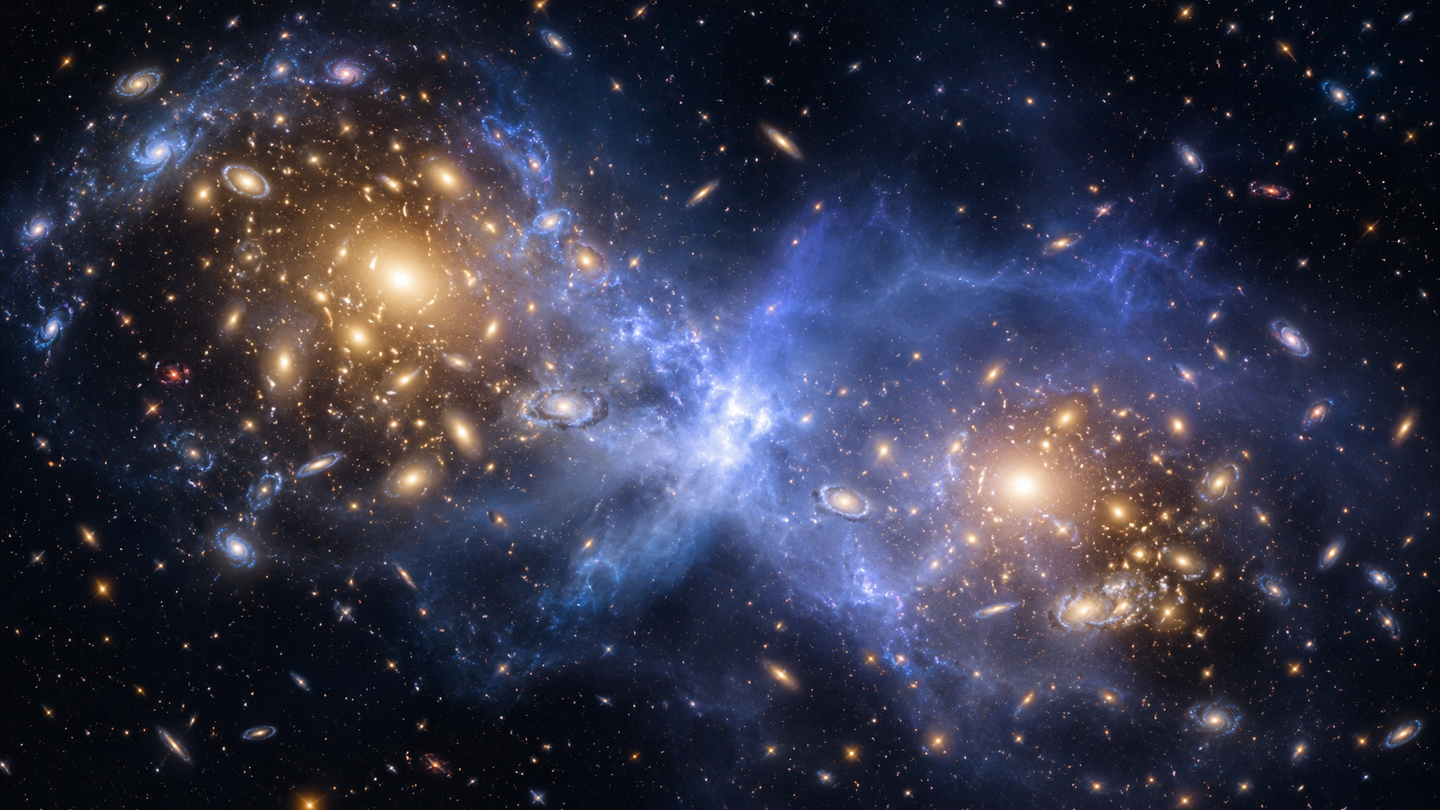
An artist’s impression shows two galaxy clusters colliding, with hot gas glowing blue between them. Researchers use simulations of such collisions to predict how the distribution of dark matter might shift if its particles scatter off one another. (CREDIT: The Brighter Side of News)
Dwarf galaxy and collision of two galaxy clusters seem to be unexpected objects for providing common evidence. Still, they both include dark matter, and each system can contain the traces of inter-particle interactions among this matter. For a dwarf galaxy, the evidence can be represented by the change in the distribution of mass at the center of the system. As for the collision of two clusters, the trace can be found in the rearrangement of the location of that mass.
Oliver Zier and his team from the Center for Astrophysics | Harvard & Smithsonian have developed a tool that helps to make predictions regarding such traces of evidence. The paper, published in Monthly Notices of the Royal Astronomical Society, expands a simulation framework that was used for studying galaxy and structure formation.
The framework can become a universal tool for running simulations that incorporate different collision assumptions of dark matter.
Co-author Martin Rosenlyst Jørgensen, an astroparticle physicist from MIT Kavli Institute for Astrophysics and Space Research, explained the purpose of the study in terms of observation for astronomers. "If we can identify the fingerprints that various forms of dark matter imprint on galaxies and galaxy clusters, we may be able to determine which fundamental particles and forces are concealed within the dark sector of the Universe," he said.
What can a collision change
Dark matter takes up about 85 percent of the Universe's mass. In order to define its location, astronomers analyze the motion of the stars under the gravity field and gravitational lensing. The dark matter map tells us where the mass is accumulated, while the matter itself is invisible and produces no detectable light.
In the framework of standard cold dark matter paradigm, particle interactions except the gravity ones are very uncommon; hence, they can be treated as collisionless. The alternative paradigm suggests that dark matter particles can scatter. Even a few scatterings can change the way of energy transfer in the course of cosmic timescale. That way, the density profile near the galactic centers can be changed.
Dark matter forms large structures that are called halos and surround the galaxies and clusters. Processes of scattering can lead to the transfer of energy inside the halo. Depending on the halo characteristics and its history, it can firstly disperse the mass in the central region and then form a dense core in the center because of the loss of energy and contraction.
It is important for explaining the unusual appearance of galaxies. With one theoretical framework, we can obtain both diffuse and dense halos depending on the conditions. The simulations allow determining the sequence of events and evaluate whether the predicted mixture corresponds to the real-world observations of astronomers. Time factor is also crucial – two halos with the same mass at the present day can be formed at different epochs; therefore, they can have different periods of scattering. That way, the history can help to explain why two neighboring galaxies of the same size have different inner structure.
Special calculation for the collisional process
The scientists included the new method in AREPO-2, which is a computational framework for tracking of the movement and aggregation of the matter under the influence of gravity. The previous cosmological simulations illustrate the scale of the task – a single simulation can track the evolution of a large volume of space that shows different growth rate over time.
The inclusion of the collision needs to know which particles interact in the simulation and which particles undergo scattering. The researchers have implemented the special search algorithm that is designed specifically for dark matter interactions. Gravity remains the same; hence, it is calculated by the same solver, while another calculation is needed for close interactions that can cause the formation of dense clumps.
The software is capable of performing several collisions during one step of calculation with the energy and momentum conservation throughout the computation cluster. It also allows defining the collision probability that depends on the relative velocity of the interacting particles. The framework can perform encounters that can change the energy of the particles as well.
Validation and performance assessment
Authors have verified the method with elastic scattering without preference of the direction. They made the test in both simplified systems and simulations of the cosmic structure. They have also evaluated the performance in the simulations with dark matter only and with ordinary matter.
These verification experiments have shown the behavior of the implementation under the tested conditions. The more complicated interaction models will need the additional verification.
A unified set of rules with significantly different galactic outcomes
The velocities of dark matter particles in the dwarf galaxy are smaller than in the cluster. Therefore, the theoretical framework that includes the scattering probability depending on the velocity will provide significantly different results for the faint galaxy and the cluster. Still, the rules remain the same.
It gives a possibility for comparative analysis of the results in different systems. The model that can predict the central-density profile of the dwarf galaxy should remain valid in regimes of higher particle velocities or different densities. Observational data from stellar streams can give an additional validation since the influence of the invisible clump can affect the elongated stream of the stars.
Even well-studied galaxy can provide difficulties in the interpretation of the result. The baryonic matter and stellar components can affect the distribution of mass, and the galaxy's history can change the observational evidence that can be obtained now. Simulations with baryons allow evaluating whether the feature attributed to dark matter self-interaction can emerge from other processes.
According to the University of Southern Denmark, the researchers received 37 million CPU hours through the U.S. ACCESS program for this part of the work, which exceeds 4,000 years of calculation of a single core. Using the multiple cores allows the researchers to explore the greater set of models and conditions.
Conversion of the predictions to observable values
The next task is to transform the predictions into measurable quantities. While the simulation can draw the dark matter density on the screen, the observational data comes from the measurements of the light – from stellar kinematics and gravitational lensing distortions of the distant galaxies. A strong prediction should connect the simulated dark matter halo with the empirical data like galactic motions.
Jørgensen believes that machine learning algorithms will help in making this connection. The algorithms can be trained with the simulations performed with different particle physics rules and search for similar patterns in the observational data. This is a prospective next step that will be useful if the simulations will be able to resolve enough details for distinguishing the competing explanations, including different masses of dark matter particles.
The strength of the evidence will increase with the incorporation of the greater amount of observations. The pattern that seems to be convincing in one dwarf galaxy can be caused by the uncertainty of mass measurement or the galaxy's history. If the pattern emerges where the model predicts it and disappears where the model predicts otherwise, it is less probable to be caused by coincidence.
The newly developed tool makes the comparative analysis easy. The researchers can find out how the certain rule will influence the quiet dwarf galaxy and use the same rule for much faster interaction between the clusters. The search for the dark matter signatures will depend on the ability of the model to explain the observational data in both regimes.
Dig deeper into self-interacting dark matter
These papers trace the idea from early proposals to simulations and astronomical tests.
- Simulating realistic self-interacting dark matter models including small and large-angle scattering: This study examines how the direction of particle scattering can change predictions for merging galaxy clusters. (Astronomy & Astrophysics, February 2025)
- A Self-interacting Dark Matter Solution to the Extreme Diversity of Low-mass Halo Properties: The authors simulate how self-interactions could produce both unusually dense and diffuse halos. The link opens a freely available version of the journal paper. (The Astrophysical Journal Letters, December 2023)
- Dark matter self-interactions and small scale structure: This review connects possible particle interactions with observations of galaxies and other small cosmic structures. (Physics Reports, February 2018)
- A Direct Empirical Proof of the Existence of Dark Matter: The Bullet Cluster study uses gravitational lensing to show that most of the inferred mass lies apart from the collision’s hot gas. (The Astrophysical Journal Letters, September 2006)
- Observational Evidence for Self-Interacting Cold Dark Matter: This foundational paper proposed that scattering between dark matter particles could change the inner structure of halos. (Physical Review Letters, April 2000)
Research findings are available online in the journal Monthly Notices of the Royal Astronomical Society.
The original story "New simulation tool helps scientists predict how dark matter collisions shape galaxies" is published in The Brighter Side of News.
Related Stories
- The Sun, Earth, Jupiter and white dwarfs offer another way to test dark matter
- Big Bang afterglow rules out giant black holes as a major dark matter source
- Five-dimensional black holes offer a possible explanation for dark matter and neutrinos
Like these kind of feel good stories? Get The Brighter Side of News' newsletter.
Joseph Shavit
Writer, Editor-At-Large and Publisher
Joseph Shavit, based in Los Angeles, is a seasoned science journalist, editor and co-founder of The Brighter Side of News, where he transforms complex discoveries into clear, engaging stories for general readers. With vast experience at major media companies like The Los Angeles Times, Times Mirror and Tribune Publishing, he writes with both authority and curiosity. His writing focuses on space science, planetary science, quantum mechanics, geology. Known for linking breakthroughs to real-world markets, he highlights how research transitions into products and industries that shape daily life.