Cosmic simulations reveal how galaxies formed and evolved over billions of years
COLIBRE simulations add cold gas and dust, producing virtual galaxies that closely match what astronomers observe.

 Edited By: Joseph Shavit

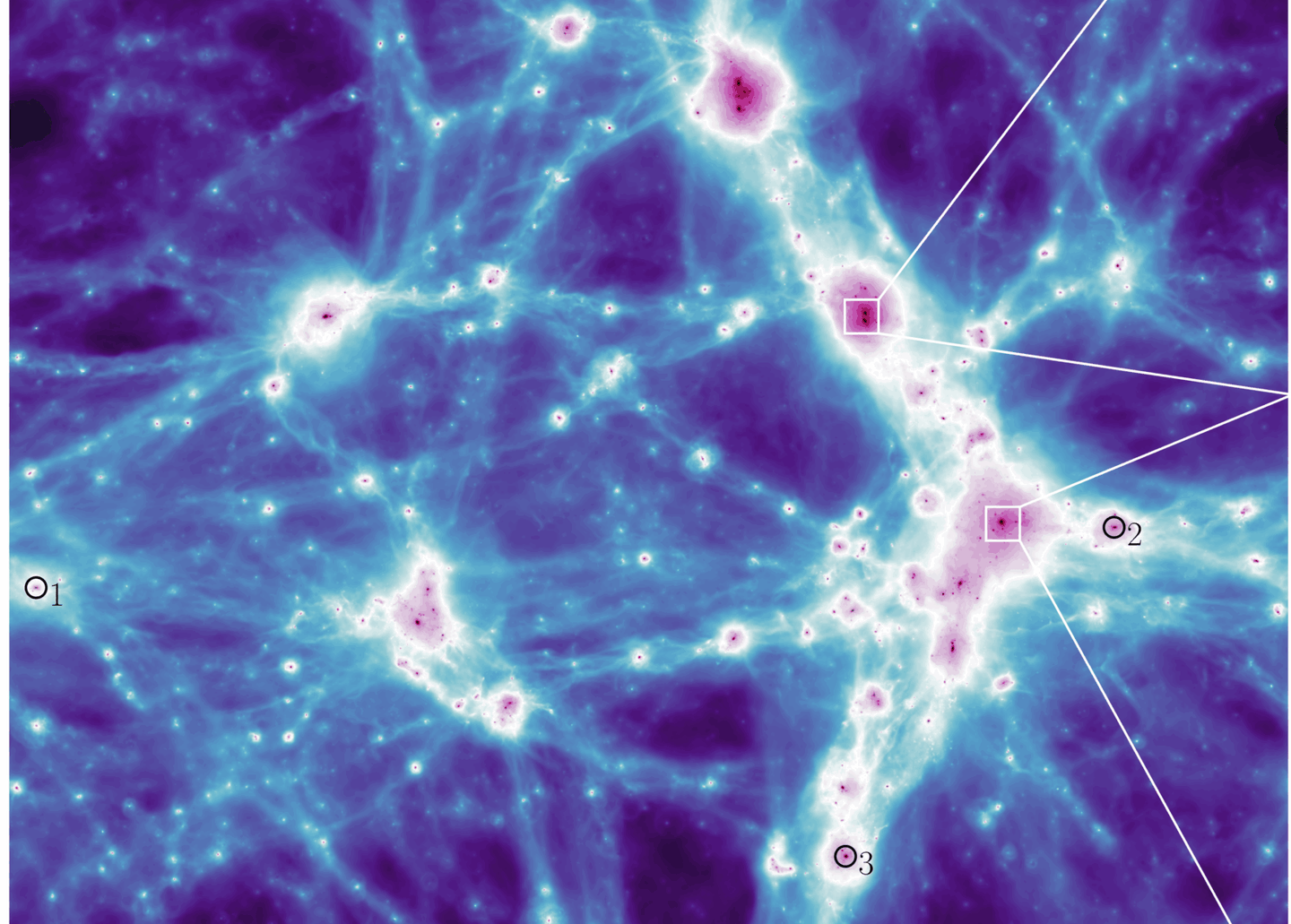
New COLIBRE simulations show how cold gas and dust help galaxies evolve from the early universe to today. (CREDIT: Monthly Notices of the Royal Astronomical Society)
Cold gas does not look dramatic at first glance. Neither does dust. Yet those two quiet ingredients sit at the center of a new effort to build a far more realistic picture of how galaxies formed. They help explain how galaxies changed and spread across the universe over billions of years.
A new suite of simulations called COLIBRE now tracks both, along with the violent push and pull from stars and black holes, in a way earlier large-scale models usually could not. The result is a set of virtual universes that, according to the research team, reproduces real galaxies with striking accuracy, from the nearby universe to the distant young cosmos seen by the James Webb Space Telescope.
That matters because galaxy simulations have become one of astronomy’s main testing grounds. They let scientists check whether the standard cosmological model can actually produce the kinds of galaxies telescopes observe. In this case, the answer looks stronger than before.
Essential components
“Much of the gas inside real galaxies is cold and dusty, but most previous large simulations had to ignore this,” said project leader Professor Joop Schaye of Leiden University. “With COLIBRE, we finally bring these essential components into the picture.”
For years, many major simulations handled galaxy gas with a workaround. They stopped it from cooling below about 10,000 degrees Fahrenheit, a temperature hotter than the Sun’s surface, because colder gas is much harder to model. That shortcut helped keep the calculations manageable, but it also left out the physical state where stars actually form.
COLIBRE takes a different path. It allows gas to cool far further and includes the chemistry and shielding effects needed to follow cold interstellar gas more directly. The model also tracks tiny dust grains, which play an outsized role in galactic life. Dust helps hydrogen molecules form, shields gas from harsh ultraviolet light, and changes how galaxies appear when astronomers observe them. It can block ultraviolet and visible light from stars, then re-emit that energy in the infrared.
Where stars really begin
That combination of cold gas and dust turns out to be more than a cosmetic fix. It changes the way galaxies grow inside the simulation and how closely they resemble the real thing.
The team says the new runs can match a broad set of observed galaxy properties, including their numbers, sizes, colors, luminosities, and gas content. They also perform well not just for present-day galaxies, but for galaxies in the early universe, a region of cosmic history that has drawn intense attention since JWST began returning images.
Some of JWST’s early results raised questions about whether the standard cosmological model could fully explain surprisingly massive galaxies seen in the young universe. The COLIBRE researchers argue that once key physics is treated more realistically, those tensions ease.
“Some early JWST results were thought to challenge the standard cosmological model,” said Dr. Evgenii Chaikin of Leiden University. “COLIBRE shows that, once key physical processes are represented more realistically, the model is consistent with what we see.”
Simulations and numerical symmetry
The simulations also improve the underlying numerical machinery. COLIBRE uses up to 20 times more resolution elements than earlier efforts in the same family of models. It also uses four times more dark matter particles than baryonic particles, a design choice meant to reduce spurious numerical effects that can distort galaxies in a simulation.
Even with all of that detail, the project still spans huge cosmic volumes. Its largest runs follow billions of particles across boxes as large as 400 comoving megaparsecs on a side. That lets the team study both the grand cosmic web and the internal structure of galaxies in the same framework.
Carlos Frenk, Ogden Professor of Fundamental Physics at Durham University and a core member of the team, said one of the striking outcomes is just how believable the simulated galaxies now look.
“It is exhilarating to see ‘galaxies’ come out of our computer that look indistinguishable from the real thing and share many of the properties that astronomers measure in real data such as their number, luminosities, colours and sizes,” he said.
He added, “What is most remarkable is that we are able to produce this synthetic universe purely by solving the relevant equations of physics in the expanding universe.”
A tougher test for cosmic theory
The project does not claim to have solved every mystery. One notable omission is the class of odd objects nicknamed “Little Red Dots,” discovered by JWST and sometimes discussed as possible seeds of supermassive black holes. COLIBRE does not predict them. Its black hole model begins with seeds already in place. So, it is not designed to explain how those seeds formed in the first place.
That missing piece points to the next frontier. To reach it, researchers will need even higher resolution and probably new physics.
Still, the broader picture is impressive. The simulations suggest that the standard cosmological model, often called Lambda-CDM, remains compatible with galaxy evolution across cosmic time. This includes some cases that had looked awkward or uncertain. The work also hints that earlier mismatches between simulations and observations may have come as much from missing galactic physics as from problems with the cosmological framework itself.
The computing effort behind this was enormous. The simulations ran with the SWIFT code on the COSMA8 supercomputer at Durham University’s Institute for Computational Cosmology, hosted for the DiRAC national facility in the UK. The largest run required 72 million CPU hours. The full model took nearly a decade to develop, with scientists across Europe, Australia, and the United States contributing.
Even now, the work is not finished. Most simulations were completed in 2025, but some of the highest-resolution runs are still being completed. The researchers say it will take years to fully analyze the data already produced.
A universe built to explore
COLIBRE is also unusual in how it invites people into the science. The team has created sonified videos and interactive maps that let users move through the virtual universes in ways that go beyond static images. In those videos, sound carries extra physical information. Therefore, it gives researchers another way to spot structure and patterns.
Dr. James Trayford of the University of Portsmouth, who led the dust model and the sonification work, said the goal was not only to improve the science but also to broaden how people can engage with it.
“We’re excited not just about the science, but also about creating new ways to explore it,” he said. “These tools could provide new insights, make our field more accessible, and help us build intuition for how galaxies grow and evolve.”
That may end up being one of COLIBRE’s lasting strengths. It is not just a better simulation. It is also a better laboratory, one that can generate virtual observations, test how astronomers interpret data, and show where the next blind spots might still be hiding.
Practical implications of the research
This work gives astronomers a stronger tool for checking whether their theories of galaxy formation line up with what telescopes actually see.
It should help researchers interpret JWST observations, improve future sky surveys, and test how dust, gas, stars, and black holes shape galaxies over time.
It also offers new ways to turn simulation data into images, sound, and interactive maps that can support both research and public understanding.
Research findings are available online in the journal Monthly Notices of the Royal Astronomical Society.
The original story "Cosmic simulations reveal how galaxies formed and evolved over billions of years" is published in The Brighter Side of News.
Related Stories
- Most distant spiral galaxy ever found shatters theories of cosmic formation
- ‘Space archaeologists’ use oxygen map to reconstruct a galaxy’s 12-billion-year past
- JWST solves a longstanding mystery of giant planet formation
Like these kind of feel good stories? Get The Brighter Side of News' newsletter.
Joshua Shavit
Writer and Editor
Joshua Shavit is a NorCal-based science and technology writer with a passion for exploring the breakthroughs shaping the future. As a co-founder of The Brighter Side of News, he focuses on positive and transformative advancements in technology, physics, engineering, robotics, and astronomy. Having published articles on AOL.com, MSN, Yahoo News, and Ground News, Joshua's work highlights the innovators behind the ideas, bringing readers closer to the people driving progress.