Diamond’s extreme melting point could unlock more fusion energy
X-rays caught diamond melting near 1 terapascal, settling a 20-year puzzle and pointing toward more efficient fusion implosions.
 LLNL Writer: Ashley Piccone

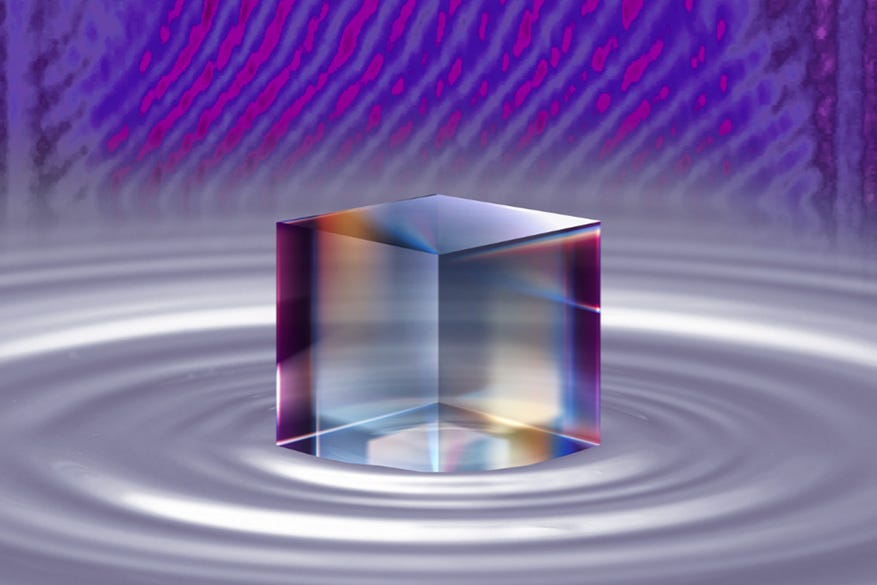
New melting experiments confirm that diamond floats in metallic liquid carbon at high pressures, much like ice cubes float in a glass of water. (CREDIT: James Wickboldt/LLNL)
- Diamond melts under extreme pressure in a way that now closely matches quantum-based simulations, resolving a disagreement that lasted about 20 years.
- X-ray measurements show the familiar diamond crystal survives until melting, rather than first changing into the proposed BC8 form during a single shock.
- The revised melting conditions could allow weaker initial shocks in fusion experiments, potentially increasing energy output, while improving models of “diamond rain” inside ice giant planets.
Diamond can survive conditions that would destroy most materials, but under the immense pressures used in fusion experiments it eventually gives way. New measurements now pin down how that melting happens, resolving a 20-year disagreement between experiments and theory.
The work by researchers at Lawrence Livermore National Laboratory, tracks diamond as it is shock-compressed to pressures around one terapascal, roughly three times greater than conditions at Earth’s core. The experiments also reached pressures above those expected inside Neptune and Uranus.
A 20-year temperature gap closes
LLNL researchers have studied diamond under extreme pressure for decades. About 20 years ago, Jon Eggert and colleagues found that diamond becomes denser when it melts under high pressure, an unusual behavior for most materials.
Those early experiments created a stubborn problem. Measured melting temperatures differed from theoretical predictions by roughly 20%, or about 1,500 kelvin in later comparisons. Advanced simulations could not reproduce the experimental values.
Another question came from work at Sandia National Laboratories. Those results had been interpreted as possible evidence that diamond transforms into a different crystalline phase, called BC8, before melting.
The new LLNL experiments set out to tackle both disputes directly.
X-rays catch diamond at the edge of melting
At the Omega Laser Facility at the University of Rochester’s Laboratory for Laser Energetics, researchers fired powerful ultraviolet laser pulses at synthetic diamond samples. The lasers drove shock waves through the material.
The compressed states lasted only about a billionth of a second. During that interval, the team measured shock speed, reflectivity, thermal radiation and X-ray diffraction, which reveals atomic structure.
“This was the first time that shock-compressed diamond was probed with X-ray diffraction all the way up to melting,” said LLNL scientist Marius Millot. “These measurements are extremely difficult because carbon is a small and lightweight atom. It scatters very few X-rays, so the signal we needed to measure was quite faint.”
The team conducted 12 steady-shock experiments and seven experiments using shocks that weakened as they traveled through the sample.
The measurements showed a broad melting region. Between about 750 and 1,000 gigapascals, shock temperature decreased slightly as pressure rose, direct evidence for a melting curve with a negative slope. Temperatures stayed near 7,000 kelvin.
Reflectivity also climbed sharply as the shock strengthened, indicating more electrically conducting liquid carbon. At the same time, X-ray diffraction from the crystalline sample weakened by about tenfold and approached zero near 24.2 ± 0.2 kilometers per second.
Together, those signals closely matched simulations based on quantum-mechanical calculations.
“While it was frustrating to discover that our original temperature measurements were off by more than 1,000 degrees, it is exciting to see such a dramatic improvement in data quality with our new diagnostics,” Eggert said. “Even better, our original inference of melting has now been confirmed directly with X-ray diffraction.”
Diamond stays diamond until it melts
The X-ray data also addressed the suspected intermediate crystal phase.
Researchers found strong evidence that the compressed solid retained the ordinary cubic diamond structure all the way to melting. Assigning the measured diffraction peak to BC8 produced density values about 30% away from earlier measurements.
The team also found no additional diffraction lines expected from a substantial amount of BC8.
That result conflicts with earlier interpretations that placed a transition to BC8 above roughly 875 to 900 gigapascals. But it agrees with molecular-dynamics simulations suggesting that strong carbon bonds create an energy barrier that prevents the rearrangement during a single shock.
“We think that is because the sample does not have time to change when it only experiences a single shock. It remains ‘trapped’ in the diamond structure,” Millot said.
The experiments lasted only a few nanoseconds. An earlier study suggesting a BC8 transition involved shock transit lasting about 40 nanoseconds. The authors say that timescale difference may help reconcile the results.
A weaker first shock could boost fusion output
The melting measurements matter directly for inertial confinement fusion at the National Ignition Facility.
NIF uses millimeter-scale diamond capsules containing a frozen deuterium-tritium fuel layer. Lasers drive the capsule inward at speeds above 400 kilometers per second. The implosion eventually creates pressures above 30 petapascals and temperatures above 100 million kelvin.
Current designs use a first shock stronger than 1.2 terapascal to ensure the diamond melts completely. A smooth liquid shell helps limit imperfections during implosion.
The new data indicate that complete melting can occur with a weaker initial shock. That would allow a lower-entropy compression path and make the fusion fuel more compressible.
“Our work indicates that we could use slightly slower initial shocks and still achieve full melting of the diamond in our NIF implosions,” Millot said. “This is exciting because such a slower shock would make the fusion fuel more compressible. That in turn increases the maximum energy yield we could obtain with the same laser energy.”
Models cited by the team indicate that higher compression could triple the released fusion energy compared with current designs, provided other degradation mechanisms can be controlled.
Practical implications of the research
The revised melting curve gives fusion researchers a firmer basis for choosing the strength and timing of shocks that drive diamond capsules. It may allow higher compression without increasing laser energy, although the predicted gain still depends on controlling other sources of performance loss.
The measurements also provide stronger benchmarks for simulations of carbon under extreme pressure.
For planetary science, the results cover pressures greater than those inside Neptune and Uranus. That gives researchers better experimental constraints for models in which carbon crystallizes deep inside ice giants and falls through their interiors as “diamond rain.”
LLNL plans to use the National Ignition Facility to explore harder-to-reach conditions, including multiple-shock compression. Those experiments could test where the familiar diamond structure finally loses stability and how the capsule behaves during later stages of a fusion implosion.
Dig deeper into diamond melting, fusion energy and diamond rain
These resources explore how carbon behaves under extreme pressure, why diamond matters to inertial fusion, and how similar physics could shape the interiors of Neptune-like planets.
The structure of liquid carbon elucidated by in situ X-ray diffraction
Using shock compression and X-ray diffraction, researchers directly measured liquid carbon’s atomic structure and documented diamond-liquid coexistence before complete melting. The work provides experimental benchmarks for carbon models used in fusion and planetary science. (Nature, 2025)
From diamond to BC8 to simple cubic and back: Kinetic pathways to post-diamond carbon phases from metadynamics
Simulations examine how diamond could transform into ultra-dense BC8 and simple-cubic carbon at pressures above 1.5 terapascals, identifying narrow pressure-temperature conditions that may favor BC8 formation. (Physical Review B, 2026)
Achievement of Target Gain Larger than Unity in an Inertial Fusion Experiment
This landmark National Ignition Facility experiment produced 3.1 megajoules of fusion energy from 2.05 megajoules of laser energy delivered to the target, demonstrating target gain above one and providing critical context for efforts to improve diamond-capsule implosions. (Physical Review Letters, 2024)
Diamond precipitation dynamics from hydrocarbons at icy planet interior conditions
High-pressure experiments examined diamond formation from hydrocarbons under conditions relevant to icy planets, strengthening the case that diamond precipitation could occur inside Uranus, Neptune and similar exoplanets. (Nature Astronomy, 2024)
Thermodynamics of diamond formation from hydrocarbon mixtures in planets
Quantum-accurate simulations mapped conditions where diamonds can form from carbon-hydrogen mixtures and identified a high-pressure regime where phase separation strongly favors diamond formation, particularly under conditions associated with Neptune’s interior. (Nature Communications, 2023)
Research findings are available online in the journal Nature Physics.
The original story "Diamond’s extreme melting point could unlock more fusion energy" is published in The Brighter Side of News.
Related Stories
- Mercury has a 10-mile-thick layer of diamonds under its surface
- Pure hexagonal diamonds are real and harder than natural diamonds
- 50,000-year-old meteorite helps scientists create the hardest diamonds on Earth
Like these kind of feel good stories? Get The Brighter Side of News' newsletter.
Joshua Shavit
Writer and Editor
Joshua Shavit is a NorCal-based science and technology writer with a passion for exploring the breakthroughs shaping the future. As a co-founder of The Brighter Side of News, he focuses on positive and transformative advancements in technology, physics, engineering, robotics, and astronomy. Having published articles on AOL.com, MSN, Yahoo News, and Ground News, Joshua's work highlights the innovators behind the ideas, bringing readers closer to the people driving progress.