EpiPad wristband turns your forearm into a smartwatch trackpad
NC State researchers developed a radar wristband that reads finger movements and pressure on skin, expanding controls beyond a smartwatch screen.
 NC State Writer: Matt Shipman

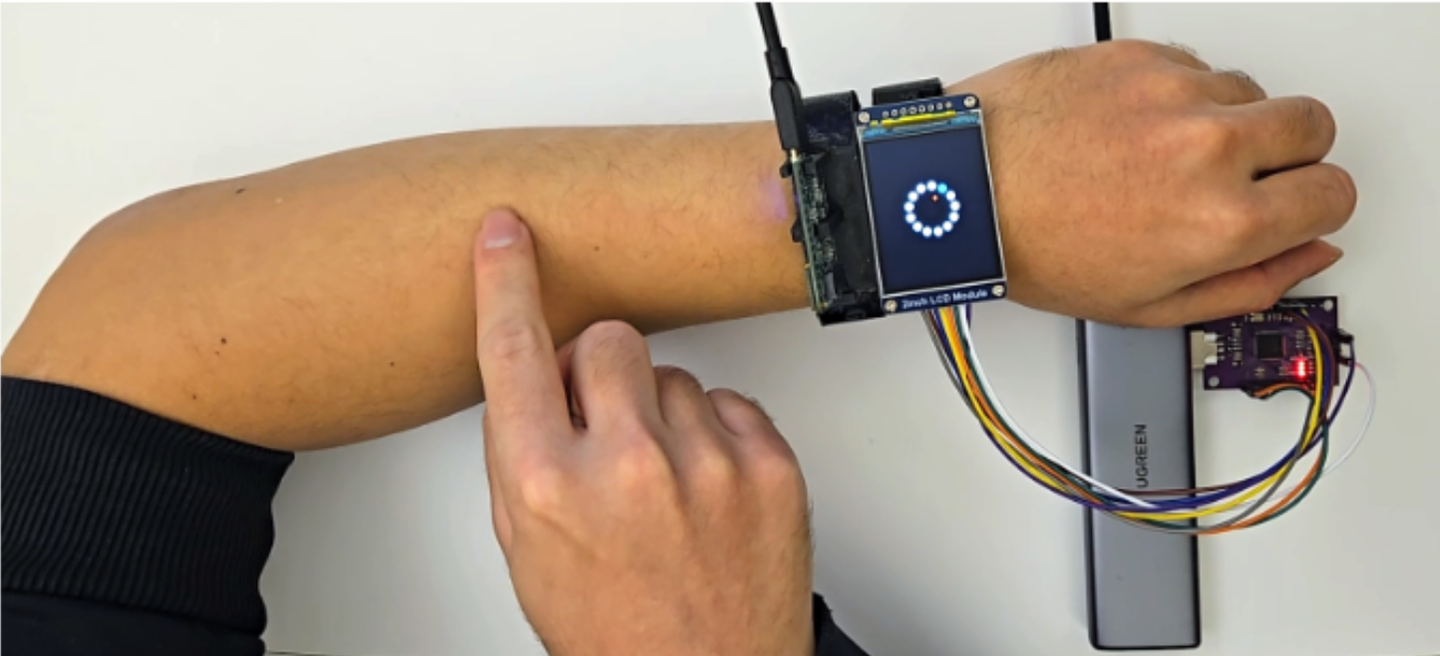
EpiPad uses tiny radar sensors to turn forearm skin into a smartwatch trackpad that recognizes gestures and pressure. (CREDIT: Chenhan Xu et al, Proceedings of the ACM on Interactive, Mobile, Wearable and Ubiquitous Technologies 2026)
- NC State’s EpiPad uses miniature radar to track finger movements and pressure on forearm skin.
- In laboratory tests, the prototype recognized gestures and pressure levels with roughly 90% accuracy.
- The approach could expand wearable controls, although clothing, power consumption and hardware integration remain challenges.
A smartwatch can display a map, but pinching that map on a tiny screen leaves little room to see it. Researchers at North Carolina State University have developed a way to move those controls onto a larger surface already within reach: the wearer’s forearm.
Their prototype, EpiPad, uses wrist-mounted radar to detect fingers moving and pressing against nearby skin. This forearm trackpad supports actions such as scrolling, zooming and selecting icons. The work appears in Proceedings of the ACM on Interactive, Mobile, Wearable and Ubiquitous Technologies.
The idea addresses a familiar tradeoff in wearable interfaces. Devices become easier to carry as they shrink, but their controls become harder to use. EpiPad separates the space used for input from the space used to display information.
Chenhan Xu, an assistant professor of computer science and the paper’s corresponding author, led the research with doctoral student Yuliang Fu, its first author. Like other experiments in gesture control, the project asks how everyday movements can make small devices more useful.
How the forearm trackpad reads skin
EpiPad relies on millimeter-wave radar, which sends out radio signals and analyzes their reflections. Fingertips create small dents when they press against skin. Those changing reflections provide clues about where fingers are touching and how firmly they press, without covering the input area with electronic sensors.
The distinction matters because location alone cannot capture every command. A light touch and a firmer press can trigger different actions. Research on electronic skin similarly explores how pressure adds information beyond simple contact. EpiPad measures the skin’s response remotely from the wrist. The forearm remains an input surface, not a projected display. Users can make gestures there while watching the result on a separate screen, much as laptop users move a cursor without touching the display.
The system also follows multiple fingers, enabling gestures familiar from laptop trackpads. Two fingers can scroll, while a pinch can change magnification. Its aim is a comparable range of controls, rather than proof that skin matches a commercial trackpad’s precision. Other hand-tracking systems approach this challenge using different sensing methods.
A short setup teaches the system its wearer
Skin is a less predictable surface than glass. People differ in arm shape, tissue properties and the way they touch their bodies. EpiPad therefore starts with a calibration routine, during which the wearer performs standard actions so the system can adjust its interpretation.
That setup took three minutes and 54 seconds in the study. Machine-learning methods then helped translate radar measurements into input commands. The approach shares a broader goal with smart skin: recognizing useful movement patterns from signals that would otherwise be difficult to interpret.
Calibration is part of the demonstrated method. The results should therefore be understood as performance after personalization, rather than evidence that an unfamiliar wearer can obtain the same accuracy immediately after putting it on.
Across the main evaluation, which recruited 20 participants, the researchers reported 92.8% gesture-recognition accuracy and 90.2% accuracy for classifying force levels. Average position error was 10.2 millimeters, roughly one centimeter. These measure different abilities, not a single overall accuracy score. Related wearable sensing research also depends on translating indirect physical measurements into movement estimates.
Testing small targets on a watch
Recognizing a gesture is useful only if it helps someone complete a task. A separate real-time evaluation involving 12 participants compared EpiPad with direct touchscreen input and a cursor controlled by tilting. Participants selected targets designed to test the difficulty of precise smartwatch interactions.
EpiPad’s average movement time was 2.82 seconds, compared with 3.26 seconds for touch and 3.27 seconds for tilt. Its error rate was 6.5%, versus 21.7% for touch and 7.4% for tilt. Those results favored the forearm trackpad in this particular task, especially against very small touchscreen targets.
The touchscreen targets ranged from 1.28 to 5.12 millimeters. At that scale, a fingertip can obscure the very item someone is trying to select, illustrating why moving input away from the display could help.
The comparison does not establish that it would outperform every watch interface or everyday activity. Target sizes and task design influence the outcome. Advances in touch screens and alternative gesture interfaces offer different ways to address the same cramped-control problem. Larger studies would help establish when each approach works best.
Clothing and finger choices still matter
The researchers also investigated conditions beyond the main laboratory sessions. Ten participants returned for additional tests after removing and remounting the device, across a period spanning three months. Gesture recognition averaged 91.1%, while force-level recognition reached 88.9%. These follow-ups suggest some resilience to repeated wearing, although they do not establish unrestricted daily reliability.
Clothing produced a clearer limitation. Tests involving two participants found reasonably strong performance through a thin, tight-fitting garment, but accuracy dropped under a loose jacket. Moving fabric changes the radar reflections. For designers of skin-worn devices, the fit between hardware, clothing and the body can be as important as the sensor itself.
Changing finger combinations also required attention. Switching from the trained index-and-middle-finger combination to thumb and index reduced performance; recalibration and additional training improved it. A small walking test used a horizontally held arm, leaving more vigorous movement for future work. Familiar hand gestures therefore still need careful testing in varied situations.
From a research wristband to everyday wearables
The current prototype has a circuit board protruding from its wristband. Although the sensor array measures approximately five by four millimeters, that figure describes only one component. Turning the experiment into a conventional watch would require integrating the remaining electronics and ensuring the system stays comfortable during extended use. The researchers have demonstrated the sensing approach, but they have not announced a consumer product or established when a commercially integrated version might become available.
Power is another consideration. The tested board consumed about 672 milliwatts while working, compared with 578 milliwatts while idle. The increase was 94 milliwatts, but that is not the system’s total consumption. Research on wearable power storage highlights why battery demands matter when electronics must remain small. A smaller sensor alone does not solve those demands. A finished design would also need to balance how often it senses, how it processes measurements and how long users expect the battery to last.
Xu estimates that the functional components could cost less than $10, with potential savings at scale. That is a component estimate, not a retail price. He also sees possible applications in screenless wearables such as smart glasses. “We are open to working with industry partners to explore how this technology could be incorporated into next-generation devices,” Xu says. The next challenge is making that broader input surface practical beyond the laboratory.
Dig deeper into skin-based wearable controls
These earlier projects explore different ways to move controls beyond a small device screen, from camera-based touch recognition to acoustic sensing.
Future AR/VR Controllers Could Be the Palm of Your Hand
Carnegie Mellon’s EgoTouch project uses camera images and AI to recognize skin touches and pressure for immersive interfaces. (Carnegie Mellon University, November 2024)
LumiWatch: On-Arm Projected Graphics and Touch Input
This self-contained research watch combines projection and finger tracking to put an interactive display on the arm. (ACM CHI, April 2018)
WatchSense: On- and Above-Skin Input Sensing through a Wearable Depth Sensor
A depth-sensing prototype recognizes fingers touching the skin or hovering above it, expanding the available input space. (ACM CHI, May 2017)
SkinTrack Technology Turns Arm Into Smartwatch Touchpad
This system uses a signal-emitting ring and wristband electrodes to locate finger movements on the body. (Carnegie Mellon University, May 2016)
Skinput: Appropriating the Body as an Input Surface
An early body-input system detects vibrations from finger taps using a wearable acoustic sensor. (ACM CHI, April 2010)
Research findings are available online in the journal Proceedings of the ACM on Interactive, Mobile, Wearable and Ubiquitous Technologies.
The original story "EpiPad wristband turns your forearm into a smartwatch trackpad" is published in The Brighter Side of News.
Related Stories
- New electronic skin sensor detects touch, pressure and nearby objects
- New AI-powered armband uses gestures to control robots in real time
- New soft armband uses AI to read gestures while you run
Like these kind of feel good stories? Get The Brighter Side of News' newsletter.
Joshua Shavit
Writer and Editor
Joshua Shavit is a NorCal-based science and technology writer with a passion for exploring the breakthroughs shaping the future. As a co-founder of The Brighter Side of News, he focuses on positive and transformative advancements in technology, physics, engineering, robotics, and astronomy. Having published articles on AOL.com, MSN, Yahoo News, and Ground News, Joshua's work highlights the innovators behind the ideas, bringing readers closer to the people driving progress.