Researchers power drones using ground-based green laser light
Nanocrystals and wing channels helped a laser receiver stay cooler while producing electricity for a drone motor.

 Edited By: Joseph Shavit

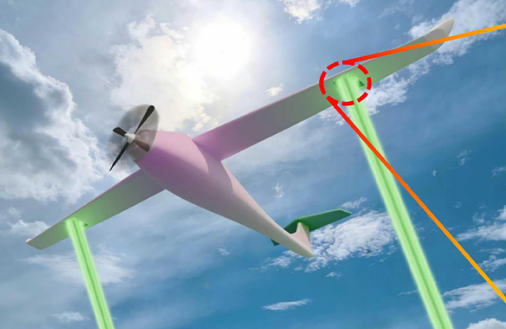
A green laser aimed beneath a drone wing powered a propeller without a conventional wired connection. (CREDIT: Matter & Light)
- Researchers built a lightweight device that converts laser light and waste heat into electricity for drones.
- Nanocrystals and wing-mounted airflow helped control heat, allowing the system to reach 38.49 percent efficiency.
- The device powered a stationary drone propeller, but it still needs flight tests, moving-target tracking, and safety studies.
A green laser aimed beneath a drone wing powered a propeller without a conventional wired connection, offering an early glimpse of aircraft that could someday receive energy while remaining in the air.
The experimental system combines a laser-sensitive solar cell with a thermoelectric layer that captures part of the heat produced during operation. Researchers also added heat-blocking nanocrystals and built cooling channels into the wing.
Together, those features helped the device convert 38.49 percent of incoming laser energy into electricity under its strongest test conditions.
The work addresses a persistent problem for unmanned aircraft. Battery capacity limits how long drones can remain airborne before landing for charging or replacement.
“Imagine a future where drones inspecting forests, monitoring disasters, or delivering packages no longer need to land frequently to replace batteries,” said senior author Jianhua Han of Civil Aviation University of China. “As drones take on longer missions, battery life has become one of the biggest barriers.”
A Solar-Cell Design Tuned for Laser Light
The researchers created a perovskite laser cell-thermoelectric tandem device, known as a PLC-TE system.
Its perovskite layer works like a solar cell but is optimized for laser light rather than sunlight. It converts incoming light directly into electrical power.
Beneath it, a thermoelectric component collects some of the energy that would otherwise escape as heat. That layer produces more electricity when the temperature difference between its hot and cool sides grows.
The approach gives heat a second role. It remains a threat to the laser cell, but it also becomes another potential source of energy.
Strong laser exposure quickly revealed the scale of the thermal problem.
“When we tested the device under a high-power laser, the thermal camera showed temperatures of 80 to 90 degrees Celsius,” Han said. “That was much higher than we expected and made us realize that heat buildup was a far more serious problem than we had imagined.”
High temperatures reduce the amount of laser energy that the perovskite cell can convert. Prolonged heating can also weaken performance over time.
Nanocrystals Slow the Movement of Heat
To control that buildup, the team incorporated specialized antimony selenide nanocrystals into the device.
These particles conduct heat poorly, allowing them to act as a thermal barrier. They slow heat transfer into the active perovskite layer while helping preserve the temperature difference needed by the thermoelectric component.
The nanocrystals also improved the structure of the perovskite material. Tests showed smoother, larger crystal grains and fewer defects than in untreated devices.
Those changes improved the movement of electrical charge and reduced energy losses.
Under a 520-nanometer green laser at an intensity of 0.5 watts per square centimeter, a standard perovskite laser cell reached 32.04 percent efficiency.
Adding the optimized concentration of nanocrystals raised that figure to 35.73 percent.
The thermoelectric layer increased the output further. Under the highest tested laser intensity, 1.2 watts per square centimeter, the complete device reached 38.49 percent efficiency.
A comparable tandem device without the nanocrystals achieved 34.65 percent under the same conditions.
The modified system also lost less efficiency as the laser became more intense. That result indicated that the thermal barrier helped protect the device during high-power operation.
The Wing Became Part of the Cooling System
The team did not treat heat control as a materials problem alone.
Researchers mounted the device beneath the wing of a stationary drone model. They carved airflow channels through the wing and added cooling structures that directed air across the thermoelectric layer.
The moving air cooled the layer’s colder side. That increased the temperature difference across the thermoelectric component and improved its electrical output.
Computer simulations indicated that the channel design removed heat more effectively. The design also increased lift and reduced drag in the simulated airflow.
“Previous studies largely focused on the materials or the device itself,” Han said. “We wanted to think beyond the laboratory, to how the system could actually be integrated into an aircraft, cooled during operation, and made compatible with flight. It isn’t just a materials science problem; it’s an engineering one.”
The combined design linked the laser cell, thermoelectric generator, wing shape, and airflow into one power system.
That integration allowed the aircraft structure itself to help manage heat rather than relying only on added cooling equipment.
A Laser Starts the Propeller Turning
For a proof of concept, the researchers connected the tandem device to motors driving drone propellers.
A conventional laser cell turned a 2.64-inch propeller at about 5,260 revolutions per minute. Its operation became unstable after roughly 740 seconds.
Adding the thermoelectric generator increased the steady speed to about 7,660 revolutions per minute.
With the nanocrystal-enhanced tandem device, the propeller maintained about 7,820 revolutions per minute without major fluctuations during the experiment.
The team also tested a 3D-printed wing containing the device and its internal cooling channel.
The propeller remained still until researchers applied the laser. After about five seconds, the thermoelectric component began contributing power as a temperature difference developed.
The propeller accelerated from roughly 1,200 to 1,450 revolutions per minute, then remained stable for about one minute. It slowed and stopped as the laser power decreased.
The experiment did not involve a flying drone. It showed that the integrated system could receive laser energy, manage heat, and power a propeller while mounted within a wing structure.
Flight, Tracking, and Safety Remain Unresolved
The next planned test will place the system aboard a lightweight drone outdoors.
That step will introduce conditions absent from the stationary demonstration, including changing airflow, movement, vibration, and varying alignment between the aircraft and laser.
Accurately tracking a moving drone with a focused beam will present another engineering challenge. The system must keep the laser on the receiver while the aircraft changes position.
Safety will also require careful study before laser power transmission could move beyond controlled testing.
“Our work demonstrates the possibility of ‘refueling aircraft with light,’” Han said. “Going from 1 to 100 will require solving many engineering challenges, but we hope this provides a starting point for future development.”
Practical Implications of the Research
The system offers a possible route toward auxiliary power for drones that perform extended inspections, monitoring, delivery, or other remote tasks.
Its strongest contribution may be the way it combines several functions. The perovskite layer captures light, the thermoelectric layer recovers heat, the nanocrystals limit thermal damage, and the wing channels provide airflow cooling.
Future flight tests can show whether those parts continue working together under outdoor conditions.
Researchers will also need to determine how reliably a laser can follow a moving aircraft and how the beam can operate safely.
The current demonstration does not remove the need for batteries or prove continuous flight. It establishes that a wing-mounted receiver can turn remotely delivered laser energy and some of its waste heat into enough electricity to drive a propeller.
Research findings are available online in the journal Matter & Light.
The original story "Researchers power drones using ground-based green laser light" is published in The Brighter Side of News.
Related Stories
- New Phantom Twist drone spins so quickly that it virtually disappears
- Tiny flapping drone matches insect speed with an AI brain
- SHIELD protects drones from cyberattacks midflight in real time
Like these kind of feel good stories? Get The Brighter Side of News' newsletter.
Joshua Shavit
Writer and Editor
Joshua Shavit is a NorCal-based science and technology writer with a passion for exploring the breakthroughs shaping the future. As a co-founder of The Brighter Side of News, he focuses on positive and transformative advancements in technology, physics, engineering, robotics, and astronomy. Having published articles on AOL.com, MSN, Yahoo News, and Ground News, Joshua's work highlights the innovators behind the ideas, bringing readers closer to the people driving progress.