Could a nuclear blast deflect an asteroid? The answer depends on the asteroid
An asteroid’s uneven shape could strongly affect a nuclear deflection attempt. Sandia simulations show why choosing the right side matters.
 Sandia DOE Writer: Troy Rummler

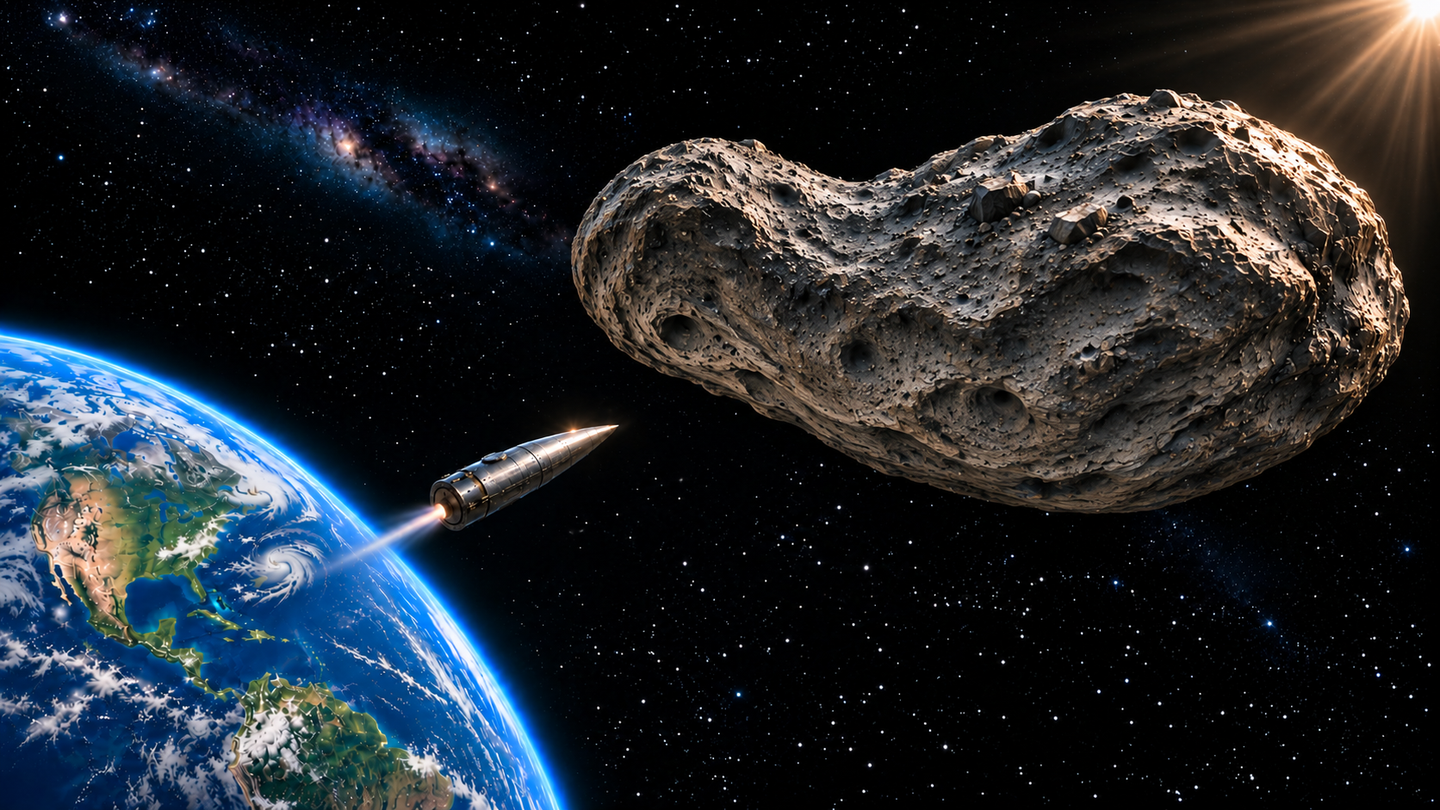
Conceptual illustration of a nuclear warhead intercepting an elongated asteroid approaching Earth. The study modeled nearby detonations rather than direct impacts. (CREDIT: The Brighter Side of News)
- Simulations show that targeting different sides of an irregular asteroid can change its deflection nearly fivefold.
- A faster modeling method combines realistic asteroid shapes with detailed calculations of X-ray heating and escaping material.
- The approach could improve planetary defense planning, but it cannot yet reliably predict whether an entire asteroid would break apart.
A nuclear burst might help steer a dangerous asteroid away from Earth. But delivering enough energy would solve only part of the problem. For a rocky body covered in ridges, hollows and uneven slopes, choosing which side receives the blast could make a striking difference.
New simulations led by Sandia National Laboratories physicist Nathan Moore show how strongly an asteroid’s shape can affect that outcome. The research, published in Icarus, examines how X-rays from a nearby nuclear detonation could change an asteroid’s motion.
In one simulated case, targeting one side produced a deflection velocity of 3.9 millimeters per second. Irradiating another side produced just 0.8 millimeters per second, a nearly fivefold difference. Those figures describe the change in the asteroid’s linear velocity after the burst, rather than its overall traveling speed.
“We expected aim to matter,” Moore said. “What surprised us was how much.”
Why an asteroid’s shape changes the outcome
The proposed defense relies on a burst of X-rays heating an asteroid’s surface. Material vaporizes and escapes, producing a push that changes the remaining body’s motion. The aim would be to redirect the asteroid while keeping it largely intact.
An irregular surface complicates that process. Different orientations expose different arrangements of slopes and surface features to the radiation. The simulations calculate how the resulting loss of material changes both the asteroid’s forward motion and its rotation.
Those effects can vary substantially, even when researchers model the same object. For a different simulated asteroid, the change in rotational speed varied by a factor of 17 between irradiation directions. A strong push and a strong spin response therefore represent distinct outcomes that planners must evaluate.
The findings point to a practical challenge: knowing an asteroid’s shape could be essential to choosing an effective approach. A calculation based on a smooth, rounded object may miss important differences between possible targeting directions.
Moving beyond simplified spheres
Modeling a nuclear burst near an asteroid requires calculations that span several complicated processes. Researchers must account for radiation heating, changes in the surface material and the movement of escaping vapor. Adding a realistic shape makes that work more demanding.
Previous approaches often traded detailed asteroid geometry for more complete physics, or simplified the physics to accommodate a realistic shape. Moore and his colleagues developed a method that brings those elements together. Its speed made the new calculations possible.
“Our new algorithm is over 1,600 times faster, which was critical to this breakthrough,” Moore said. “With the old models, computers just couldn’t handle it.”
Moore began considering how to improve full-scale predictions after experiments at Sandia’s Z machine showed that X-rays could deflect small samples of asteroid material. The laboratory result raised another question: how could researchers calculate the response of an entire, uneven asteroid?
Combining two different kinds of simulation
Moore found a possible route in a colleague’s work on outgassing from objects in space. That research addressed material escaping from a surface, an important part of the deflection problem. It suggested a way to move beyond idealized spheres.
“You can make estimates that way, but asteroids come in all kinds of odd, lumpy shapes,” Moore said. “That’s when I latched onto some work one of my colleagues was doing related to outgassing of objects in space. I think we had an aha moment when we realized we could do this. No more spheres. We would be able to model deflection for any asteroid.”
The team combined two simulation tools already used at Sandia. ALEGRA typically handles fast, high-energy experiments, including magnetically imploding wires at the Z machine. SPARTA, a direct simulation Monte Carlo code, usually addresses weaker, more slowly evolving effects, such as drag on a satellite from the solar wind.
“The key innovation here was figuring out how to combine the two simulation approaches,” Moore said. Together, the tools let researchers connect the initial energetic event with the behavior of material leaving an irregular surface.
Calculating the push without losing sight of breakup
The method can use high-resolution, three-dimensional imagery from spacecraft flybys to represent an asteroid’s shape. Researchers can then adjust the simulated explosion’s strength and distance. They can also change which side of the asteroid receives the radiation.
The program produces a heat map showing how much material vaporizes across the surface. From there, it calculates the resulting push, changes in rotation and possible breakup of surface rocks. Those outputs help compare targeting choices before committing to any particular scenario.
But surface damage and the destruction of an entire asteroid are different problems. Breaking a threatening object into smaller pieces could leave dangerous fragments on paths toward Earth. A useful defense must therefore consider more than the size of the initial velocity change.
“Right now, our computer model only considers breakup of rocks on the surface. We can’t predict breakup of the entire asteroid body accurately yet,” Moore said. That limitation leaves a major question for future research, even as the new approach improves calculations of deflection.
Better targeting still depends on better information
A real mission would need sufficiently accurate knowledge of the asteroid’s shape from all sides. That information would allow planners to compare orientations and identify a favorable location for the burst. Without it, even a sophisticated model would face uncertain inputs.
Gathering those observations could take time that a planetary defense emergency does not provide. Positioning an explosive at the chosen distance and on the correct side would create another challenge. The simulation offers a planning tool, but carrying out its preferred scenario would require a separate operational effort.
The research, funded by Sandia’s Laboratory Directed Research and Development program, makes those choices more concrete. Rather than treating an asteroid as a generic target, planners could examine how its particular shape responds. They could compare changes in motion, spin and surface damage across possible approaches.
“Our study shows how important it is to aim carefully,” Moore said. “Pick the right side and you win. Guess wrong and it could be a bad day.”
The next step is to improve the treatment of effects that remain difficult to predict, particularly whole-body breakup. Heating, escaping material and structural damage can interact, making a complete calculation demanding. Faster simulations help researchers explore those interactions, but speed alone does not remove the remaining uncertainties.
For now, the central finding is clear: an asteroid’s uneven shape can strongly influence the response to an X-ray burst. A defense plan would need to account for those differences before choosing where to act. The new work provides a way to investigate that decision with greater detail, while identifying what scientists still need to learn.
Dig deeper into asteroid deflection
These resources explain earlier X-ray experiments, spacecraft deflection tests and the observations needed to assess their results.
NASA’s DART Mission Changed Orbit of Asteroid Didymos Around Sun: Follow-up research examines how DART’s impact changed the binary asteroid system’s motion around the Sun. (NASA Jet Propulsion Laboratory, March 2026).
Planetary defence mission Hera heading for deflected asteroid: Explains Hera’s mission to investigate the aftermath of DART’s asteroid impact. (European Space Agency, October 2024).
Simulation of asteroid deflection with a megajoule-class X-ray pulse: Describes laboratory experiments testing the response of asteroid-like samples to intense X-rays. (Nature Physics, September 2024).
Asteroid’s Orbit, Shape Changed After DART Impact: Examines changes in Dimorphos after the impact, highlighting the importance of an asteroid’s physical response. (NASA's Jet Propulsion Laboratory, March 2024).
NASA Confirms DART Mission Impact Changed Asteroid’s Motion in Space: Reports confirmation that a spacecraft impact altered an asteroid moon’s orbit. (NASA, October 2022).
Research findings are available online in the journal Icarus.
The original story "Could a nuclear blast deflect an asteroid? The answer depends on the asteroid" is published in The Brighter Side of News.
Related Stories
- DART spacecraft's asteroid impact informs new planetary defense strategy
- Apophis will zoom past Earth in 2029, turning a rare flyby into a planetary defense test
- A 1-megaton nuclear blast could prevent 97% of a city-killer asteroid from hitting Earth
Like these kind of feel good stories? Get The Brighter Side of News' newsletter.
Joseph Shavit
Writer, Editor-At-Large and Publisher
Joseph Shavit, based in Los Angeles, is a seasoned science journalist, editor and co-founder of The Brighter Side of News, where he transforms complex discoveries into clear, engaging stories for general readers. With vast experience at major media companies like The Los Angeles Times, Times Mirror and Tribune Publishing, he writes with both authority and curiosity. His writing focuses on space science, planetary science, quantum mechanics, geology. Known for linking breakthroughs to real-world markets, he highlights how research transitions into products and industries that shape daily life.