New JWST image-processing method erases the glare of stars to spot hidden exoplanets
A digital twin of Webb’s camera removes stellar glare more precisely, recovering a known giant planet at 4.3 microns and improving faint-planet detection.
 Caltech Writer: Emily Velasco

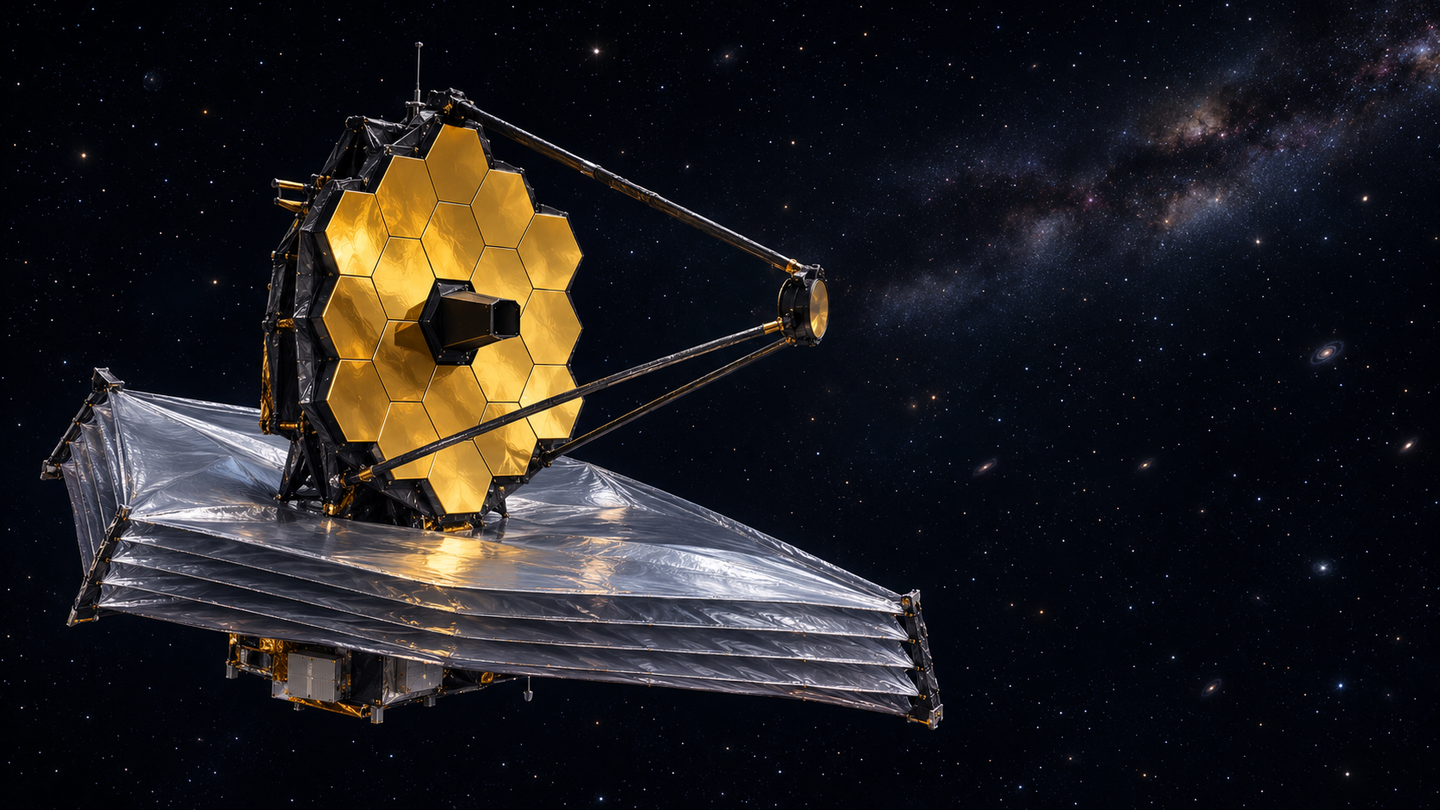
Artist’s impression of the James Webb Space Telescope observing deep space. The new FLIP technique helps reveal faint exoplanets by removing stellar glare from Webb’s images. (CREDIT: The Brighter Side of News)
- A physics-based telescope model improved sensitivity to faint planets by roughly two to 15 times in tested JWST observations.
- FLIP recovered the known giant planet 51 Eridani b at 4.3 microns, where conventional processing had missed it.
- The method could help other observatories, but it has not reached the fundamental photon-noise limit or demonstrated Earth-like planet imaging.
A giant planet was already present in an archived James Webb Space Telescope observation, but leftover starlight concealed it. A new processing method has now recovered its glow at a wavelength where earlier analysis failed. The result shows that some astronomical discoveries may depend on extracting more information from observations already collected.
The technique, called Physics-based Learning for Imaging Planets, or FLIP, uses a detailed computer model of the telescope. Researchers led by Rodrigo Ferrer-Chavez at Northwestern University developed it with collaborators including Katie Bouman at Caltech. Ferrer-Chavez is an astronomy doctoral student in Jason Wang’s research group. Their paper in Nature demonstrates the approach using Webb’s Near Infrared Camera, NIRCam.
Across the tested observations, FLIP improved sensitivity to faint planets by approximately two to 15 times compared with standard processing. The gain depended on the target, observing configuration and distance from the star in the image. It advances direct exoplanet imaging, without establishing that every Webb observation will improve by the same amount.
Why blocking the star leaves a difficult problem
Even relatively bright young giant planets can be about 100,000 times fainter than their host stars in near-infrared light. Instruments called coronagraphs suppress much of the starlight before the detector records an image. However, residual light still forms patterns that can obscure a planet or resemble one.
Those patterns depend on the telescope’s condition during an observation. Tiny pointing changes, optical distortions and thermal drifts alter how starlight spreads across the detector. A reference image taken at another time therefore may not perfectly match the glare surrounding the target star.
Conventional processing builds a model of that glare from reference observations. These can include images of other stars, different wavelengths or observations made at different times. Subtracting the model helps expose faint objects, but mismatched patterns leave residual glare that limits detection.
“What's exciting is that we're showing how computation can help overcome limitations of the telescope itself,” Bouman said. She is a Caltech professor working across computing, electrical engineering and astronomy. Those overlapping fields helped the team connect a realistic instrument model with methods for efficiently adjusting its parameters.
Building a digital twin that follows the light
The team’s digital twin simulates the star, the telescope’s optical system and the detector. It describes how light propagates through the instrument and produces a stellar image. The researchers then adjust the model’s parameters to reduce the difference between its prediction and the recorded observation.
That process uses computational tools familiar from machine learning, particularly automatic differentiation. This calculates how changes in model settings affect the output, guiding an optimization algorithm toward a better fit. The method does not rely on a trained AI system deciding which bright spots are planets.
“We used the same computational tools that researchers use to train AI models, but we did not actually use AI,” Wang said. The distinction reflects the model’s foundation in known optical physics. Its adjustable settings represent quantities such as optical aberrations, the star’s position and brightness, and detector response.
The fitting proceeds in stages, beginning with a reference-star observation that helps calibrate the instrument model. FLIP then adjusts selected parameters using the science image, compensating for differences between the two observations. It still uses reference data, but it can go beyond the limited range of glare patterns those images happen to contain.
Protecting a planet from being fitted away
A flexible model introduces its own danger: it might explain away a real planet as part of the glare. The researchers addressed this by adding artificial planet signals to the observations during processing. They monitored whether those signals became easier or harder to recover as optimization progressed.
The team stopped the fitting when the injected signals’ recovery peaked or leveled off. These injection-recovery tests also helped quantify signal loss and correct the final sensitivity estimates. Slowing the optimization and limiting which parameters changed provided additional protection against overfitting.
The demonstrated implementation adjusted around one million free parameters and took roughly 35 minutes on an NVIDIA A30 graphics processor. That is a computational benchmark for this implementation, rather than a guaranteed processing time for every dataset. Reducing computational cost is among the improvements the researchers identify for future work.
This approach grew from earlier attempts that did not succeed. Ferrer-Chavez initially explored training machine-learning models to predict stellar glare, according to the research team. Those efforts helped clarify the problem before the collaboration adopted a physics-based model optimized with tools developed for machine learning.
A known world appears at a new wavelength
The researchers tested FLIP on observations of HIP 65426 and 51 Eridani, both systems with known planets. They also examined TYC 5899, a target without known planetary companions. Artificial planets injected into that dataset tested detection performance; recovering them did not constitute discovering real planets there.
The most striking recovery involved 51 Eridani b at 4.3 microns. The giant planet had already been discovered using ground-based observations, but conventional processing had failed to detect it in this Webb filter. FLIP produced the first image of the planet in that wavelength band.
That band matters because carbon dioxide absorbs infrared light strongly near 4.3 microns. Absorption can make a planet harder to detect while providing useful information about its atmosphere. The new detection creates an opportunity for improved brightness measurements and atmospheric analysis, rather than completing that characterization by itself.
The largest sensitivity gain, roughly 15-fold, occurred at a particular separation from TYC 5899. At 51 Eridani b’s location in the 4.3-micron image, the improvement was about fourfold. These differences show why the headline maximum should not be treated as a uniform increase across all planets or images.
Toward fainter planets and future observatories
The results suggest that telescope stability need not impose the same processing limit as conventional reference-image subtraction. Nevertheless, FLIP did not reach the photon-noise limit, the unavoidable uncertainty from photons’ statistical arrival, in any tested observation. Better detector models, calibration and handling of parameter ambiguities remain important next steps. A good image fit also does not guarantee that every fitted parameter uniquely describes the telescope’s actual physical condition.
The team hopes to extend the framework to other instruments, including ground-based coronagraphs and the Nancy Grace Roman Space Telescope. Each application would require suitable instrument modeling and testing. Ground-based observations also present challenges involving atmospheric distortions and large data volumes.
NASA’s proposed Habitable Worlds Observatory represents a more demanding long-term possibility. Directly imaging Earth-like planets around Sun-like stars can require separating objects roughly 10 billion times fainter than their hosts. The researchers suggest that sufficiently precise computational correction might eventually ease some optical-stability requirements, but that remains to be demonstrated at those contrasts.
For now, the immediate opportunity is to revisit existing Webb observations for faint giant planets and atmospheric signals. FLIP recovers information already present in the data by modeling unwanted light more accurately. The next tests will establish how broadly those gains hold as astronomers apply it to more targets and increasingly demanding instruments.
Dig deeper into exoplanet imaging
These resources explain the observatory goals, computational foundations and earlier observations behind high-contrast planet imaging.
Habitable Worlds Observatory
Outlines NASA’s proposed mission to image potentially habitable planets and investigate their atmospheres. (NASA, updated April 2026)
JWST-TST High Contrast: Living on the Wedge, or, NIRCam Bar Coronagraphy Reveals CO₂ in the HR 8799 and 51 Eri Exoplanets’ Atmospheres
Provides the earlier NIRCam observations and atmospheric context for the 51 Eridani system reanalyzed with FLIP. (The Astronomical Journal, 2025)
Exoplanet Imaging via Differentiable Rendering
Tests a precursor physics-based optimization approach on simulated telescope observations. (IEEE Transactions on Computational Imaging, January 2025)
Discovery and spectroscopy of the young jovian planet 51 Eri b with the Gemini Planet Imager
Reports the original discovery of the planet later recovered at 4.3 microns in archival Webb data. (Science, August 2015)
Detection and Characterization of Exoplanets and Disks Using Projections on Karhunen–Loève Eigenimages
Introduces KLIP, the reference-image subtraction method used as the benchmark in the FLIP study. (The Astrophysical Journal Letters, August 2012)
Research findings are available online in the journal Nature.
The original story "New JWST image-processing method erases the glare of stars to spot hidden exoplanets" is published in The Brighter Side of News.
Related Stories
- JWST finds hidden structure in a hot exoplanet's atmosphere 1,300 light-years away
- JWST captures stunning images of one of the lightest known exoplanets
- JWST catches mineral clouds forming and fading on 'hot Jupiter' exoplanet
Like these kind of feel good stories? Get The Brighter Side of News' newsletter.
Joseph Shavit
Writer, Editor-At-Large and Publisher
Joseph Shavit, based in Los Angeles, is a seasoned science journalist, editor and co-founder of The Brighter Side of News, where he transforms complex discoveries into clear, engaging stories for general readers. With vast experience at major media companies like The Los Angeles Times, Times Mirror and Tribune Publishing, he writes with both authority and curiosity. His writing focuses on space science, planetary science, quantum mechanics, geology. Known for linking breakthroughs to real-world markets, he highlights how research transitions into products and industries that shape daily life.